A 4000W inverter is a powerful device that can transform DC battery power into AC electricity for running household appliances, power tools, and RV equipment. But understanding its true capabilities and limitations is essential for making the right purchasing decision and avoiding costly mistakes.
In this comprehensive guide, I'll walk you through everything you need to know about 4000W inverters, from technical specifications to real-world applications. Whether you're setting up an off-grid system, powering an RV, or preparing emergency backup power, you'll learn exactly what a 4000W inverter can handle.
Understanding the capacity of 4000w inverter
Before purchasing a 4000W inverter, it's essential to understand the significance of its power rating and how various specifications influence real-world power availability. Evaluating key features beyond wattage ensures you select the optimal system for your needs, making informed decisions crucial for meeting your power requirements effectively.
Considerations when buying a 4000w inverter
When shopping for a 4000W inverter, focus on 4 specifications in order of importance. Let's break down each of these specifications using PowMr 4000w 24v inverter as example:
| Specification | Value |
|---|---|
| Continuous Power Rating | 4000W |
| Peak/Surge Power | 8000W (5 seconds) |
| DC Input Voltage | 24V |
| Output Voltage | 110V AC |
| PV Input Capacity | 5600W (55-350V DC) |
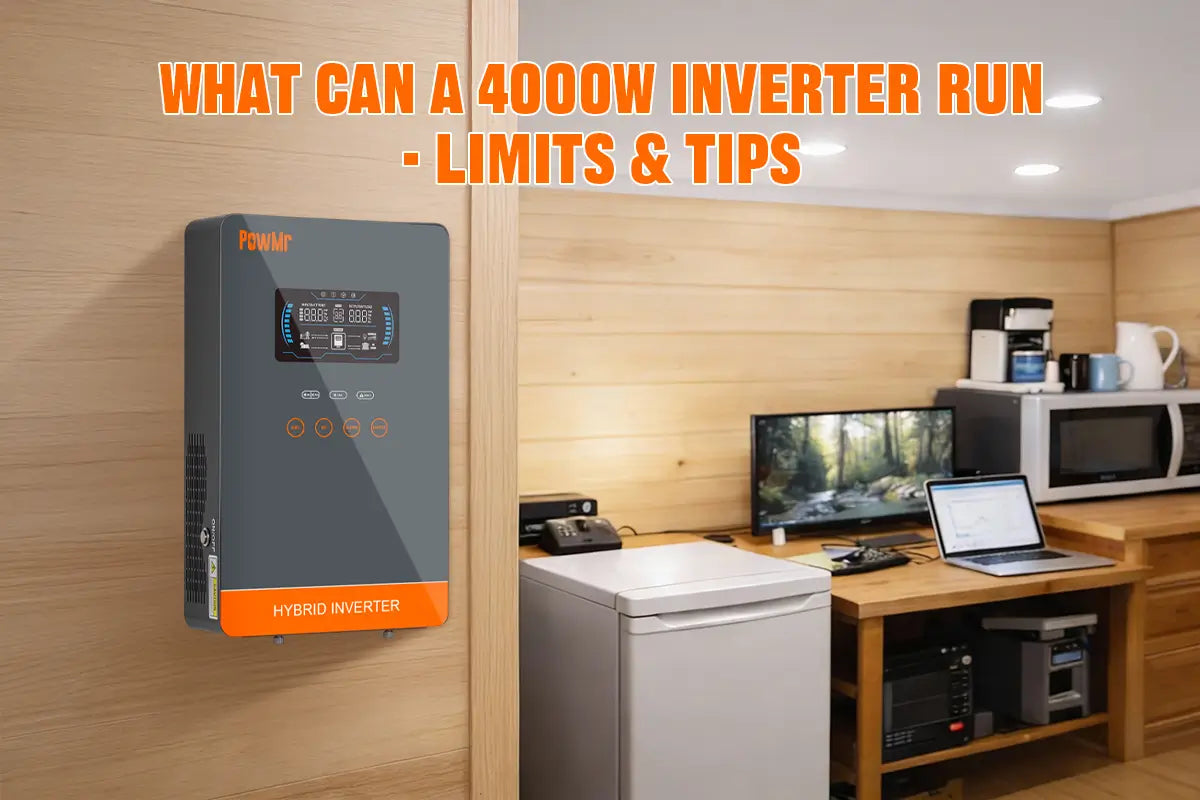
The PowMr 4000W 24V Inverter is a popular mid-range all-in-one system that combines an inverter, solar charge controller, and AC charger. It's commonly used in RVs and off-grid cabins. We'll use its specifications throughout this section to demonstrate how to evaluate each parameter when making your buying decision.
Continuous / Rated power
A 4000W inverter's continuous power rating, also known as rated power, indicates the amount of power it can deliver steadily over extended periods.
For such an inverter, it means providing 4000 watts of sustained power for your appliances, which is essential for calculating the energy needs of running devices.
In turn, the total wattage of all simultaneously running appliances must remain below 4000W. To ensure safety and efficiency, maintaining a 30% power margin is advisable.
Peak / Surge Power
Peak power, also known as surge power, is the maximum power an inverter can handle beyond its rated capacity for brief periods. This capability is crucial for inductive loads, such as air conditioners and refrigerators, which require 6-9 times their running wattage to overcome initial inertia.
So, when determining what loads a 4000W inverter can handle, consider both the surge power and the duration to avoid performance issues or failure to start. Additonally, you can opt for low frequency inverters, which offer an extended power surge that benefits the startup of appliances.
DC Voltage
The DC voltage of your inverter system (12V, 24V, or 48V) is one of the most important decisions you'll make. It dramatically affects current draw, cable sizing, installation costs, and system reliability.
At 4000W, the current flowing from your batteries to the inverter becomes substantial. Using Ohm's Law (Power = Voltage × Current), we can know that a 24V system draws 196 Amps compared to 392 Amps for a 12V system.
For the same 10-foot distance, a 12V system is impractical for a 4000W inverter due to high current demands requiring a 4/0 AWG cable, which is costly. In comparison, a 24V system for a 4000W inverter uses a more manageable 2 AWG cable and standard fuse, making it a better choice in terms of cost and ease of installation.
Similarly, for longer system distances, using 48V can help reduce battery cable size and energy loss.
PV Input Limit
If you're buying a 4000W inverter/charger (also called a hybrid inverter or all-in-one system), the PV input capacity determines how much solar power you can connect.
Check two things: (1) Maximum PV wattage (5600W for PowMr) tells you the total solar capacity, and (2) MPPT voltage range (55-350V) determines how you wire your panels in series/parallel.
You can calculate how many solar panels can connect and the solar array design:
- Maximum Number of Solar Panels = PV Input Power ÷ Panel Wattage
- MPPT Max voltage ÷ Voc ≥ Number of panels in series ≥ MPPT Start Voltage ÷ Vmp
- Number of parallel solar panel strings = Total Panels ÷ Panels per String
Taking the PowMr inverter as an example, it accepts up to 5600W of solar panels with an MPPT voltage range of 55-350Vdc. Assuming you use 400W panels with an open circuit voltage (Voc) of 48V and a voltage at maximum power (Vmp) of 41V, you can connect up to 14 solar panels to the 4000W inverter.
These panels should be divided into 7 strings (350V ÷ 48V ≈ 7) of 2 panels (55V ÷ 41V ≈ 2) in series for a parallel connection, also known as a 2S7P configuration.
What can 4000w inverter run
After understanding the specifications above, you can know that determining what a 4000W inverter can run isn't straightforward.
Simply keep running loads under 4000W, ensure startup surges stay below 8000W, and start only one motor-driven appliance at a time, like AC units or refrigerators, and you're good to go.
This detailed chart illustrates what a 4000W inverter can run across various common scenarios. Use it as a reference when planning your power system.
| Appliance | Running Watts | Starting Watts | 4000W Compatible? |
|---|---|---|---|
| Kitchen Appliances | |||
| Refrigerator | 700W | 6300W | ✅ Yes |
| Microwave | 800W | 7200W | ✅ Yes |
| Coffee Maker | 1000W | 1000W | ✅ Yes |
| HVAC & Climate | |||
| Window AC (5000 BTU) | 500W | 4500W | ✅ Yes |
| Space Heater (1500W) | 1500W | 1500W | ✅ Yes |
| Electronics | |||
| LED TV (55") | 120W | 120W | ✅ Yes |
| Gaming PC (high-end) | 450W | 450W | ✅ Yes |
| Laptop | 65W | 65W | ✅ Yes |
| Medical Devices | |||
| CPAP Machine | 65W | 65W | ✅ Yes (pure sine required) |
| Oxygen Concentrator | 350W | 350W | ✅ Yes (pure sine required) |
| Power Tools | |||
| Table Saw (10") | 1500W | 9000W | ❌ No |
| Drill (1/2") | 650W | 3900W | ✅ Yes |
Is 4kw enough to power a house
Many household appliances are inductive loads with high power demands, so a 4kW inverter often isn't enough to power an entire house simultaneously. A 4000W inverter can power essential circuits in a typical house during an outage. When using it, it's important to stagger the startup of these loads.
Can a 4000w inverter run an airconditioner
This is a common question, especially for RV owners and off-grid enthusiasts. The answer is: Yes, a 4000W inverter can run a 5000-8000 BTU air conditioner, but with important caveats. Higher BTU units are beyond its capacity.
Air conditioners are rated in BTU (British Thermal Units), while inverters operate in watts, so you need to convert BTU to watts for compatibility.
BTU to Watts Conversion Formula
-
Running Power Calculation: Running Watts ≈ BTU ÷ 10
This is an approximation. Actual efficiency varies by AC model and EER rating. -
Starting Watts: Starting Watts ≈ (BTU ÷ 10) × 9
The factor of 9 is used here as a simplified estimate to cover most scenarios, ensuring that the inverter can handle typical starting surplus demands.
For example:
- A 5000 BTU air conditioner uses approximately 500W for continuous operation and requires 4500W to start up.
- A 10000 BTU unit uses around 1,000W continuously and needs 9000W to start up.
Thus, a 4000W inverter is sufficient for a 5000 BTU AC but exceeds its capacity for a 10000 BTU unit.
How long will a 4000w inverter last
Understanding how long your 4000W inverter can run on battery power is crucial for effective system planning. The runtime is influenced by factors such as battery capacity, voltage, and the power draw of the connected load. The formula to estimate runtime is:
Run time = (Battery Ah × Voltage × DoD × Efficiency) ÷ Load Watts
For instance, if you're using two 24V, 100Ah batteries for emergency backup and powering a 2500W load with a 94% efficient inverter, the runtime would be approximately 1.44 hours (54 mins).
If instead, you run the inverter at its full 4000W capacity, the runtime would decrease to around 0.90 hours (54 mins).
Tips for using a 4000w inverter
A typical 4000W inverter has a lifespan of 5-6 years, though with proper use and maintenance, it can last 8-10 years, depending on its quality and environmental factors.
To maximize your inverter's longevity, follow these best practices for installation, operation, and maintenance. Here are essential tips based on professional experience:
- Use Appliances in Sequence: Prioritize high-power items to prevent overload caused by surge during multiple device startups. For example, running a refrigerator (700W) with a 5000BTU AC starting (4500W surge) is fine at 7700W total, but starting both the AC and refrigerator together would cause an overload at 10800W.
- Handling Overload: If the inverter alarms or shuts down, it means you've exceeded limits. Unplug a device, wait 30 seconds, restart the inverter, and run appliances one at a time.
- Ensure Adequate Ventilation: Inverters generate heat, so it's crucial to ensure adequate airflow. Follow the manufacturer's guidelines for clearance on all sides and install the inverter in a cool, dry place.
- Ground Your System: Properly ground your inverter chassis to vehicle/building ground. Bond negative DC to ground for safety. Use appropriate grounding rods for stationary installations. Follow local electrical codes.