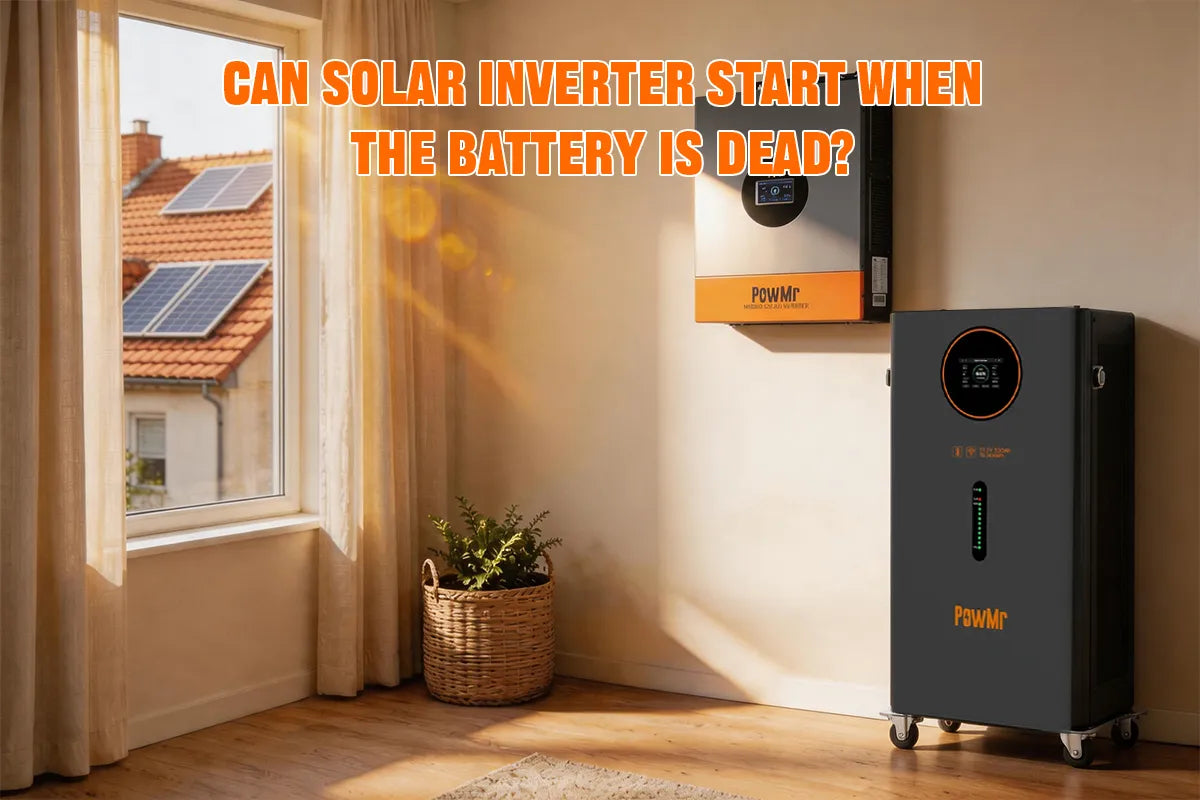
Many users often encounter a common issue in solar system applications: when the battery is fully discharged or enters protection mode, can the solar inverter still start normally? In some systems, the inverter cannot power on at all when the battery appears to be “dead,” while in others, the system can still operate partially using solar PV input.
This difference mainly depends on the inverter type, the battery management system (BMS), and the overall solar system design logic. Factors such as inverter startup voltage requirements, battery low-voltage protection, and solar inverter operating modes all play a critical role in system behavior.
In this article, we will analyze the issue from three key perspectives: different types of solar inverters, common failure reasons, and practical startup solutions when the battery is dead or in low-voltage protection mode.
- Inverter Type Determines Startup Capability
- Why Can't the Inverter Start When the Battery Is Dead?
- Startup Solutions When the Battery Is Dead
Inverter Type Determines Startup Capability
Power Inverters
Power Inverters are designed primarily to convert DC power from a battery into AC output. They do not include solar charging management functions.
These inverters rely entirely on the battery as their power source. Therefore, when the battery is fully discharged or the voltage drops below the required startup threshold, the inverter will not be able to start.
Off-Grid Inverters
In PowMr off-grid inverters, the system can operate using a combination of solar (PV) input and utility power without requiring a battery in certain conditions.
This “battery-less operation” mode depends on the specific product design and input conditions and is not supported by all off-grid inverters. The battery can still be used as an optional component for energy storage, nighttime power supply, or to improve overall system stability and flexibility.
All-in-One Inverters
All-in-one inverters typically integrate an inverter, an MPPT solar charge controller, and charging functions into a single unit, offering more flexible system design. Some models support a bypass mode, where the utility grid directly powers the load when available, while solar energy acts as a supplementary or priority power source to improve efficiency. Under sufficient sunlight, the system can prioritize PV power to reduce reliance on the battery.
When operating without grid power, the powmr all in one inverter requires a stable battery voltage to ensure proper startup and operation. If solar input is insufficient to charge the battery, or when the battery voltage drops below the minimum threshold, or when the BMS enters protection mode, the inverter will fail to start or operate normally until the battery is reactivated via mains or sufficient PV input.
Hybrid Inverters
Hybrid inverters offer more advanced energy management capabilities by coordinating solar power, battery storage, and grid power simultaneously. They typically support bypass mode or grid-direct supply, allowing loads to be powered directly from the utility grid while solar energy supplements or takes priority when available.
However, in off-grid conditions, when solar input is insufficient, the system still depends on the battery as the primary source for startup and stable operation. If the battery is deeply discharged or the BMS enters protection mode, the inverter may fail to start or switch to output mode. Therefore, although hybrid inverters offer greater flexibility, the battery remains a critical component for reliable operation in off-grid scenarios.
Why Can't the Inverter Start When the Battery Is Dead?
Insufficient DC Startup Voltage (DC Bus Voltage Issue)
A solar inverter requires a stable DC bus voltage from the battery to initialize its internal circuits during startup. If the battery voltage is too low and falls below the inverter’s minimum startup threshold, the internal control system cannot power on properly, causing the inverter to fail to start or enter operating mode.
Even when solar (PV) input is available, most solar inverters cannot rely solely on PV power during the startup stage, because photovoltaic input is unstable and cannot replace the stable DC voltage required for system initialization. As a result, the system is detected as an undervoltage condition.
BMS Protection Trigger (Lithium Battery Sleep Mode)
In lithium battery systems, the Battery Management System (BMS protection) may enter sleep mode or shutdown when the battery voltage becomes too low or remains uncharged for a long period. Once the BMS disconnects the output, the battery terminals provide no detectable voltage, preventing the off-grid inverter from recognizing a valid input signal.
In this case, even if residual energy remains inside the battery, the system cannot be directly awakened without recharging or using a dedicated wake-up method.
Inverter Self-Test Failure
During startup, a solar inverter performs multiple self-checks, including input voltage detection, DC bus stabilization, relay status verification, and communication protocol validation. If the battery voltage is too low or unstable, the inverter cannot pass these critical checks, triggering a protection shutdown.
This safety design prevents the inverter from operating under abnormal electrical conditions, avoiding potential damage to power modules, capacitors, or internal control circuits.
System Protection Logic Explanation
Modern off-grid and hybrid inverters are equipped with multiple protection mechanisms, including under-voltage protection, over-voltage protection, short-circuit protection, and battery abnormal condition protection.
When the system detects low battery voltage or abnormal battery status, it will automatically enter protection mode and block startup to ensure safe operation of the entire solar power system.
Although this prevents operation when the battery is completely discharged, it effectively protects both the battery and the inverter from deep discharge damage and system failure.
Startup Solutions When the Battery Is Dead
When a solar inverter battery is completely discharged, the system cannot start normally. Different methods can be used depending on system type.
1. Grid Bypass Startup (Hybrid Inverter)
Applicable Conditions: Solar inverter with available utility/grid or generator power
Hybrid inverters typically feature a grid bypass function. When the battery voltage is too low or completely depleted, the inverter can directly supply power to loads through the AC input while simultaneously charging the battery via the built-in charger. Once the battery voltage recovers to the minimum operating threshold, the system automatically switches back to normal inverter mode.
2. PV Wake-Up Mode
Applicable Conditions: Inverter with cold start function and sufficient daylight
Some all-in-one/hybrid inverters, such as the PowMr 11KW 220Vac 48Vdc All in One Inverter (SKU:POW-HVM11KP), support the PV wake-up function. When the battery enters protection status due to deep discharge or the BMS goes into sleep mode, the DC output from the PV panels can trickle-charge the battery first, gradually waking up the battery management system. Once the battery voltage recovers to the minimum startup threshold, the inverter automatically completes initialization and starts operating.
3. Battery Replacement or Repair and Restart
Applicable Conditions: Battery is aged, damaged, or unable to recover charging
When the battery cannot be recovered due to physical damage, end of life, or deep sulfation (lead-acid batteries), the most direct solution is to replace it with a new battery or repair the existing one before reconnecting to the system.
4. Temporary Startup with External Backup Power
Applicable Conditions: Emergency situation requiring rapid power restoration without the above conditions
By connecting an external backup DC power source (such as another battery pack, DC regulated power supply) to temporarily replace the original battery, the inverter can obtain the minimum DC voltage required for startup. After startup, the system can be switched back to the original battery or continue operating on the backup power as appropriate.