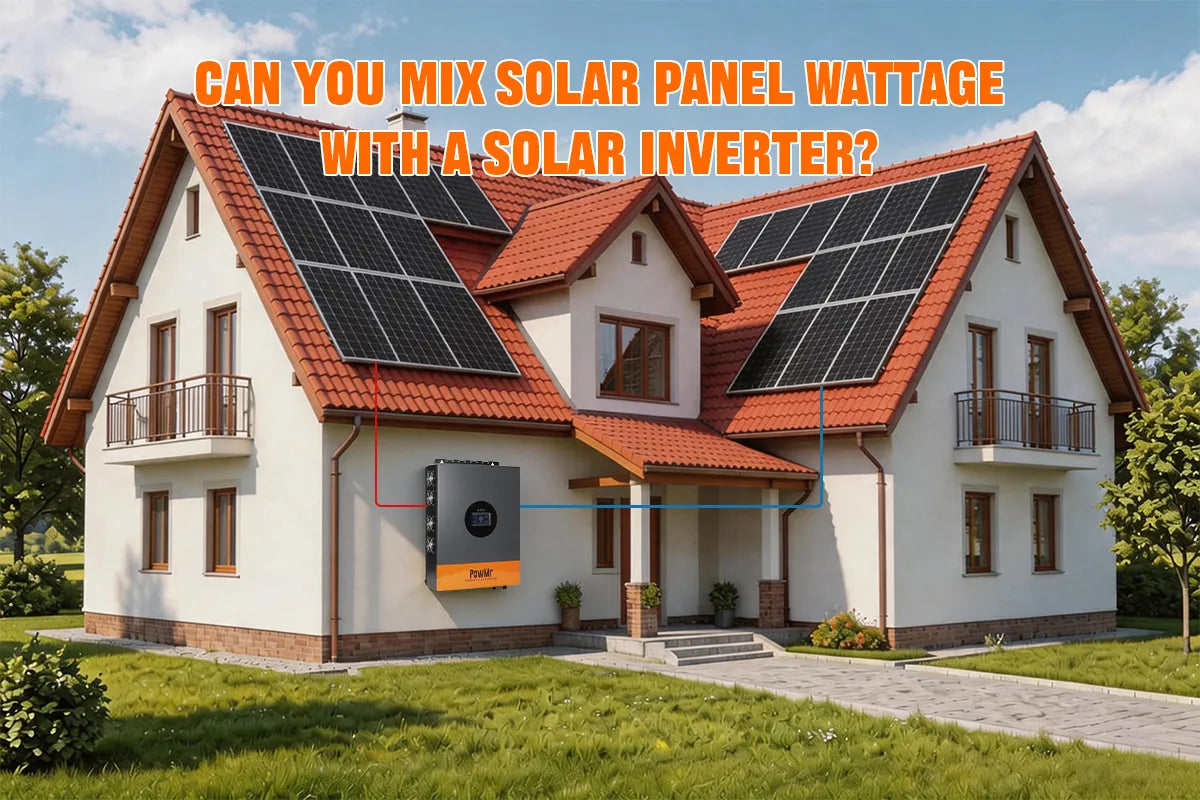
When users expand or upgrade their solar power systems, they often face a common question: can solar panels with different wattages be used together, and can they still operate properly with the same solar inverter system? This concern becomes especially important when adding new panels to an existing setup, as mismatched solar panel wattage may affect overall solar system performance and efficiency.
In reality, mixing different wattage solar panels depends on several key factors such as the connection method (series vs parallel), the number of MPPT inputs on the solar inverter, and the overall solar system design.
In this article, we will explain solar panel compatibility, the effects of mixing different wattage solar panels, whether solar inverters can support mixed wattage inputs, and how to safely use different wattage solar panels to help you better design and optimize your solar power system.
Can Different Watt Solar Panels Be Used Together?
The short answer is: yes, but you must follow the principles of current matching or voltage matching.
Solar panels with different wattages can physically be connected in the same system. Whether they work properly — and how efficiently — depends on whether you choose series or parallel connection, and how closely the key parameters — especially Imp (current at maximum power point) and Vmp (voltage at maximum power point) — match between the panels.
- In series connection, the total current is limited by the panel with the lowest current in the string. This is the classic bucket effect. For example, if you connect a 300W panel (10A Imp) in series with a 100W panel (5A Imp), the entire string's output current will not exceed 5A. As a result, the 300W panel can only deliver less than half of its potential, creating significant mismatch loss.
- In parallel connection, the system voltage is limited by the panel with the lowest voltage. If the Vmp values of two panels differ too much, the lower-voltage panel will "drag down" the higher-voltage panel and may even become a load that consumes power instead of contributing to output.
Even if you manage to connect them, the combined maximum power point of all panels becomes ambiguous — because panels of different wattages have different peak voltage/current positions. This makes it difficult for the inverter's MPPT (Maximum Power Point Tracking) to locate the true optimal operating point.
Can Solar Inverters Work with Mixed Watt Solar Panels?
In real PV system design, due to complex roof layouts, system expansion needs, or budget constraints, different wattage solar panels are often used within the same solar power system.
Whether this mixed configuration is supported mainly depends on whether the solar inverter is equipped with an integrated MPPT (Maximum Power Point Tracking) function and the number of MPPT trackers it includes.
Single MPPT Inverter
A single MPPT inverter has only one independent tracking channel, meaning all PV modules must be connected to the same input terminal. In this configuration, mixing solar panels with different wattages is not recommended.
When solar panels of different power ratings are connected in series or parallel, each string has different optimal operating voltage and current characteristics. A single MPPT tracker can only operate the entire PV array at one “compromised” maximum power point.
Higher-power panels cannot reach their rated output, while lower-power panels may be “pulled down” by the system. This leads to significant power loss across the entire system—known as the “bottleneck effect” or “weakest link effect.”
Single MPPT inverters require all connected PV modules to have closely matched specifications in terms of power, voltage, and current.
Dual MPPT Inverter
A dual MPPT inverter is equipped with two independent MPPT input channels, each capable of performing maximum power point tracking separately. This allows different PV arrays with different power ratings to be connected to separate channels, operating independently without interfering with each other. This effectively eliminates the limitations of a single MPPT system.
Taking the PowMr 12.5KW 48Vdc All in One Inverter (SKU:POW-SunSmart 12.5KP ) as an example, this is a 12.5kW split-phase hybrid inverter equipped with a dual MPPT design. Its main features include:
With the dual MPPT architecture of the POW-SunSmart 12.5KP, users can connect a high-power PV string to MPPT1 (e.g., 10 × 550W modules = 5,500W), while connecting a lower-power PV string to MPPT2 (e.g., 10 × 400W modules = 4,000W). Each MPPT channel independently tracks its optimal operating point, allowing the system to achieve near-maximum theoretical power output.
In addition, this inverter supports up to 9,000W PV input per single channel, providing sufficient headroom for mixed configurations.
Important Notes for Dual MPPT Mixed Configuration:
Even when using a dual MPPT system, the following rules must be observed:
- PV modules connected to the same MPPT channel must still be well matched in terms of power, voltage, and current.
- A single PV source must not be shared by multiple inverters, and within one inverter, PV1 and PV2 must not be connected to the same PV source.
- For the same MPPT channel, all PV modules must have the same orientation, tilt angle, and specifications.
- Each MPPT channel must have the same number of PV modules.
- PV ports and PV arrays must be used independently. Under no circumstances may PV arrays or PV ports be shared.
How to Safely Use Different Watt Solar Panels?
When using solar panels with different wattages, system safety and compatibility are extremely important. Solar panels with different power ratings may have variations in voltage and current output. If they are mixed without proper design, it can lead to reduced system efficiency and may even affect equipment safety.
1. Voltage matching (Vmp / Voc) is critical
In the same series or parallel system, solar panels should have similar or closely matched voltage parameters (Vmp/Voc). If the voltage difference is too large, lower-spec panels may limit the overall system performance and reduce energy output efficiency.
2. Parallel connection current balancing
In a parallel solar panel system, voltage remains the same while current is combined. Therefore, voltage matching is essential, and proper wiring design should be used to prevent reverse current flow that may damage lower-power solar panels.
3. Use MPPT charge controller or dual MPPT inverter
It is highly recommended to use an MPPT solar charge controller or a dual MPPT inverter system. These systems can independently track the maximum power point of different panel strings, improving overall energy efficiency and system stability in mixed-watt solar panel setups.
4. Check inverter and controller voltage limits
To ensure safe operation, the total open-circuit voltage (Voc) of all connected solar panels must stay within the input range of the solar inverter or MPPT charge controller. Proper protection devices such as fuses and circuit breakers should also be installed to prevent overcurrent or short-circuit risks.