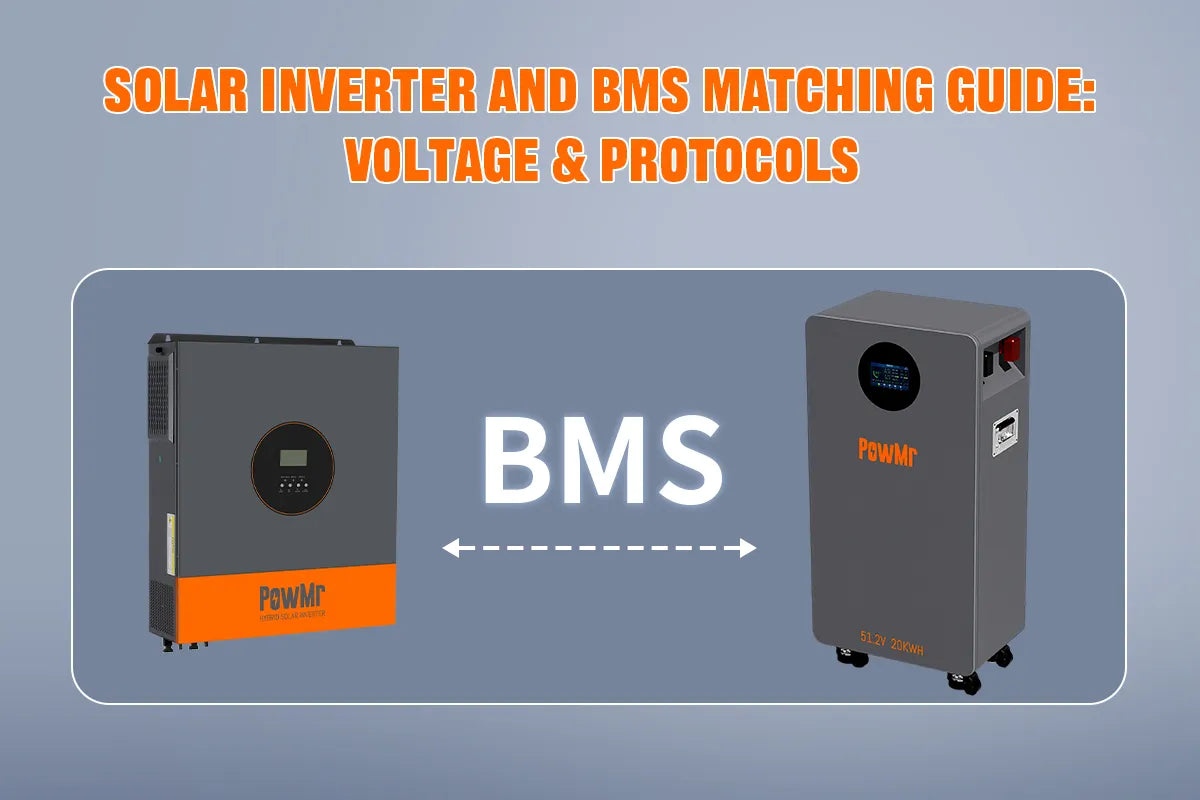
Proper matching between a solar inverter and a battery management system (BMS) is a prerequisite for the stable operation of any energy storage system.
In practice, the two most common matching obstacles—inconsistent voltage levels and incompatible communication protocols—often result in improper battery charging/discharging, protection function failure, or even equipment damage.
This article will systematically address the principles, procedures, and troubleshooting methods for solar inverter and BMS matching from two core perspectives: voltage matching and communication protocol compatibility.
- Voltage Matching Fundamentals
- Communication Protocol Matching
- PowMr Inverter BMS Communication Protocol Compatibility
Voltage Matching Fundamentals
In the process of matching a solar inverter with a Battery Management System (BMS), voltage is the most fundamental and critical parameter. Whether you are using lithium batteries, lead-acid batteries, or LiFePO4 batteries, the inverter must operate within its designed Battery voltage range to ensure safe and reliable performance.
Voltage Range Matching
In operation, battery voltage is not fixed. It continuously fluctuates depending on the state of charge, temperature conditions, and battery aging. The inverter must be able to handle these variations to ensure stable and safe charging and discharging performance. Key considerations include:
- Voltage tolerance: The inverter must be able to cover the full operating voltage fluctuation range of the battery to avoid frequent protection triggers.
- Dynamic response: During charging and discharging, transient voltage spikes or drops may occur, and the inverter must respond quickly with appropriate control and protection mechanisms.
- System safety: If the voltage remains outside the inverter’s acceptable range for an extended period, it may affect performance or trigger protective shutdowns.
If the battery voltage exceeds the inverter's allowable range during charging or discharging, several issues may occur:
- Over Voltage Protection (OVP) activation
- Low Voltage Shutdown (LVD) activation
- Repeated inverter restarts or system reboot cycling
Therefore, when matching an inverter and battery system, it is essential to verify both:
- Whether the nominal voltage ratings are compatible
Whether the actual operating voltage ranges overlap throughout the charge and discharge cycle - Ensuring proper voltage range compatibility helps maintain stable operation, prevents unnecessary protection events, and improves the overall reliability and lifespan of the energy storage system.
Impact of Series/Parallel Configurations on Total Voltage
Series connection is the only way to increase battery pack voltage, directly determining the BMS "series count" parameter and solar inverter system voltage matching.
Voltage Range.
| Series Count | Nominal Voltage (LiFePO₄ 3.2V) | Full Charge Voltage | Cut-off Voltage | Compatible Inverter | BMS Series Count |
|---|---|---|---|---|---|
| 4S (4 Series) | 12.8V | 14.6V | 10.0V | 12V Inverter | 4S |
| 8S (8 Series) | 25.6V | 29.2V | 20.0V | 24V Inverter | 8S |
| 16S (16 Series) | 51.2V | 58.4V | 40.0V | 48V Inverter | 16S |
| 32S (32 Series) | 102.4V | 116.8V | 80.0V | High-Voltage Inverter | 32S |
Core BMS Matching Principle:
- The number of BMS voltage sampling channels must equal the actual number of series-connected cells
- Each series cell corresponds to one individual cell voltage detection point on the BMS
- Incorrect series count = voltage sampling misalignment → all protection thresholds shift → overcharge/overdischarge risks
Typical Error Scenarios:
- Using a 7S BMS to manage an 8S battery pack results in one cell being unmonitored. This creates a serious safety risk, as the unmonitored cell may experience overvoltage during charging and become imbalanced over time, potentially leading to cell damage or swelling.
- Using a 9S BMS to manage an 8S battery pack may cause system configuration mismatches. Depending on the BMS design, unused channels can lead to abnormal voltage readings, incorrect state-of-charge estimation, or fault warnings such as wiring errors or cell voltage imbalance alarms.
Parallel Configuration
Parallel connection increases battery pack capacity and maximum current, without changing total voltage. Therefore, the BMS series count remains unchanged, but the current rating must be upgraded.
| Parallel Configuration | Capacity Change | Current Change | BMS Current Rating Requirement |
|---|---|---|---|
| 1P (Single Pack) | 100Ah | 100A | 100A continuous |
| 2P (Two Packs Parallel) | 200Ah | 200A | 200A continuous |
| 3P (Three Packs Parallel) | 300Ah | 300A | 300A continuous |
| 4P (Four Packs Parallel) | 400Ah | 400A | 400A continuous |
Communication Protocol Matching
- Dynamic Charging Adjustment: The inverter can adjust charging parameters in real time based on battery status (SOC, SOH, temperature, individual cell voltage)
- Bidirectional Safety Control: The BMS can command the inverter to halt charging or discharging when critical thresholds are reached
- Conflict Prevention: Coordinated protection prevents scenarios where the inverter pushes high current while the BMS attempts to balance cells
- Enhanced Fault Detection: Dual-system monitoring reduces the risk of undetected faults caused by each system assuming the other is managing protection
Without protocol matching, the inverter operates in "blind mode" — relying solely on its own voltage and current sensors to estimate battery state. This leads to:
- Charging Conflicts: Inverter continues high-current charging while BMS attempts cell balancing
- Premature Shutdowns: Mismatched voltage thresholds trigger unnecessary protection stops
- Protection Gaps: Worst-case scenarios where both systems fail to detect a fault because each assumes the other is managing it
- Reduced Battery Life: Unoptimized charging profiles accelerate cell degradation
PowMr Inverter BMS Communication Protocol Compatibility
The supported communication protocols listed below are based on current firmware versions. Actual protocol availability may vary by firmware revision, regional model, or future software updates. Always verify compatibility with the latest user manual before installation.
| Model | BMS Port | Supported Protocols | Wifi Module |
|---|---|---|---|
|
POW-RELAB 5KU-SPLIT POW-RELAB 10KU-SPLIT POW-HVM12KP |
BMS | PYLON, Growatt, Voltronic | WIFI-RELAB |
|
POW-SunSmart LVM12K POW-SunSmart 10KP-PRO |
RS485/CAN | PACE (PACE), RUDA (RITAR), AOGUAN (ALLGRAND), OULITE (OLITER), CEF (CFE), XINGWANGDA (SUNWODA), DAQIN (DYNESS), WOW (SRNE), PYL (PYLONTECH), MIT (FOXESS), XIX (XYE), POL (PowMr), GUOX (Gotion), SMK (SMK), VOL (WEILAN), WES (WES), SGP (SGP), GSL (GSL Energy), PYT (Pylon tech 2) | WIFI-HF-N |
| POW-SunSmart 16KP | RS485/CAN | PAC (PACE), RDA (RITAR), AOG (ALLGRAND), OLT (OLITER), CEF (CFE), XWD (SUNWODA), DAQ (DYNESS), WOW (SRNE), PYL (PYLONTECH), POW (PowMr), VOL (VILION), SGP (SGP), GSL (GSL Energy), PYT (Pylon tech 2) |
|
| POW-SunSmart SP5.2K | RS485 | PAC (PACE), RDA (RITAR), AOG (ALLGRAND), OLT (OLITER), HWD (SUNWODA), DAQ (DYNESS), WOW (SRNE), PYL (PYLONTECH), UOL (WEILAN) | WIFI-HF-N |
| POW-LVM3K-24V-H | RS485 | PAC (PACE), RDA (Ruida), AOG (Aoguan), OLT (Oliter), HWD (Sunwoda), DAQ (Daqin), WOW (SRNE), PYL (Pylontech), UOL (Vilion) | WIFI-HF-N |
| POW-LVM3.6M-24V | RS485 | LIC (PACE 232), LIP (PACE 485), LIL (PYLON 485) | ECO/MAX-730 |
| POW-LVM3.2K-24V | RS485 | PAC (PACE), RDA (Ruida), AOG (Aoguan), OLT (Oliter), XWD (Sunwoda), DAQ (Daqin), WOW (SRNE), PYL (Pylontech), SHO (FOX ESS), POW (PowMr) | WIFI-HF-N |
| POW-HVM4.2K-24V-D | RS485 | PYL (PYLONTECH), PAC (PACE) | - |
|
POW-ECO-3KW POW-ECO-6KW |
BMS | PACE_485, PYLON_485 |
|
| POW-HVM6.5KP | BMS | PYL (Pylontech), GRO (Growatt), TQF (Techfine), FEL (Felicity) | WIFI-RELAB |