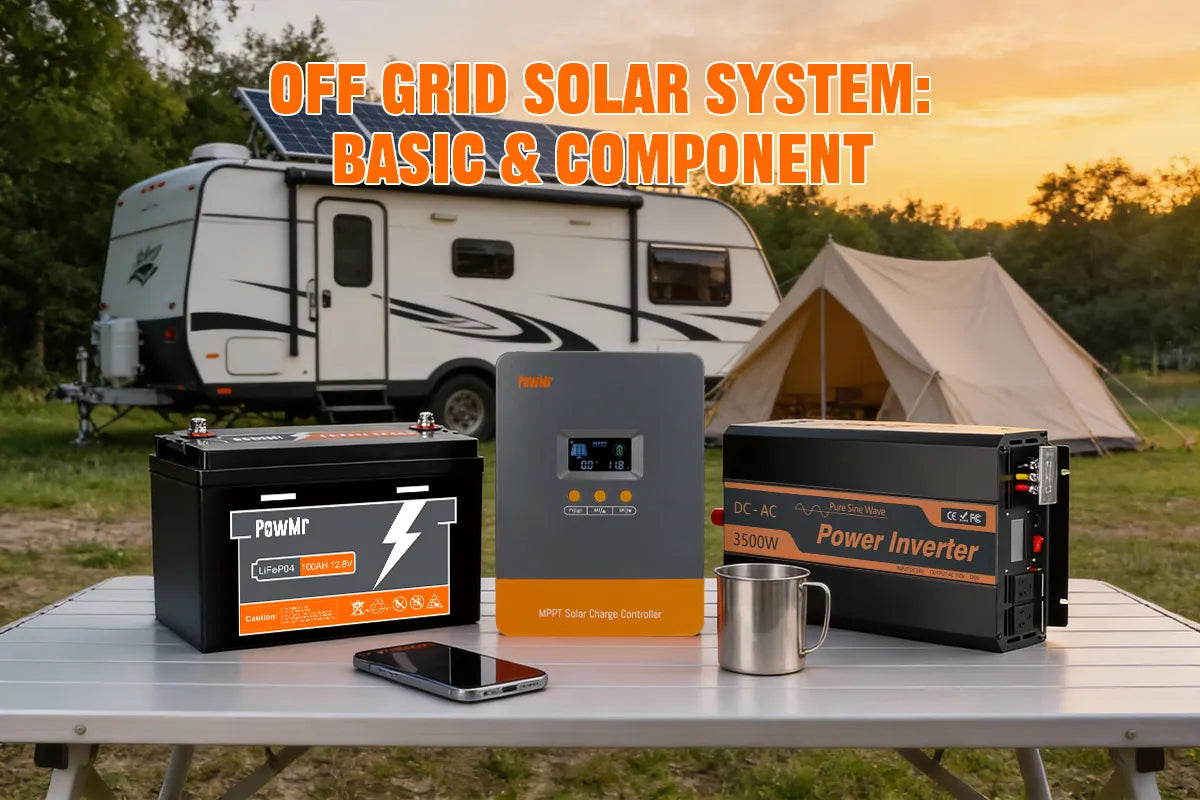

For an off-grid home, accurately estimating the number of solar panels it's essential. Even a brief dip in solar output during winter or cloudy days can leave you in the dark. That's why careful planning makes all the difference between a reliable energy system and a frustrating one.
This guide addresses that gap. We'll walk you through how to accurately calculate the number of solar panels you need for off-grid living, based on winter conditions rather than optimistic scenarios. You'll learn the four-step formula professionals use, understand why battery sizing matters just as much as panel count, and discover the real costs of going off-grid.
Whether you're building a remote cabin, planning energy independence for your existing home, or just exploring your options, this guide provides the data and framework to make informed decisions.
- Considerations before calculating number of solar panels for off grid house
- Winter Reality vs. Summer Optimism
- Energy Load Profile (Not Average kWh)Considerations before calculating number of solar panels for off grid house
- System Losses and Efficiency
- Autonomy Days and Battery Recovery
- How to calculate the number of solar panels for off grid house
- Number of solar panels for off grid house reference table
Considerations before calculating number of solar panels for off grid house
Before diving into calculations, it's crucial to understand that off-grid solar design follows completely different rules than grid-tied systems. Here are the critical considerations that will impact your design:
Winter Reality vs. Summer Optimism
Annual average sunlight hours are often used in system calculations. While useful for high-level estimates, they don't reflect seasonal variability that's critical for off-grid systems. In many regions, winter solar production can drop by 60–80% compared to summer, which can significantly impact system performance during those months.
| Region | Winter | Spring | Summer | Fall | Annual Average |
|---|---|---|---|---|---|
| Southwest (AZ, NV) | 5-6 hrs | 7-8 hrs | 7-8 hrs | 6-7 hrs | 6.5 hrs |
| California | 4-5 hrs | 6-7 hrs | 6-7 hrs | 5-6 hrs | 5.5 hrs |
| Texas | 4-5 hrs | 5-6 hrs | 6-7 hrs | 5-6 hrs | 5.5 hrs |
| Florida | 3-4 hrs | 5-6 hrs | 5-6 hrs | 4-5 hrs | 4.5 hrs |
| Midwest | 2.5-3.5 hrs | 4-5 hrs | 5-6 hrs | 3-4 hrs | 4.0 hrs |
| Northeast | 2.5-3.5 hrs | 4-5 hrs | 4-5 hrs | 3-4 hrs | 3.5 hrs |
| Pacific Northwest | 1.5-2.5 hrs | 4-5 hrs | 4-5 hrs | 2-3 hrs | 3.0 hrs |
The recommended approach: Design for your lowest-production month rather than the average. This ensures year-round reliability without relying on backup power during winter months.
Energy Load Profile (Not Average kWh)
Many people make the mistake of designing a system based on their average daily energy consumption, but for off-grid setups, the timing and magnitude of energy usage are much more important.
The system must be able to handle your peak load, which is the maximum electricity demand in a given hour or during critical periods, rather than just your daily average. Seasonal variations and the simultaneous operation of high-power devices such as heaters, pumps, or kitchen appliances can significantly increase the required capacity of both your solar panels and battery bank.
The recommended approach: Track your energy usage hourly or by appliance category and identify peak load periods. Use these figures to size both your solar array and battery storage to ensure the system can reliably supply energy during high-demand periods, even in months with the lowest sunlight.
System Losses and Efficiency
No solar power system is perfectly efficient. Off-grid solar setups experience energy losses at multiple stages, including solar panel conversion, inverter efficiency, wiring resistance, and battery charging and discharging cycles.
If these losses are not accounted for, total system losses commonly fall in the range of 20 to 30 percent of potential production. Ignoring them can result in a system that appears adequate in calculations but fails to meet real-world energy demands.
The recommended approach: Include realistic system efficiency assumptions when calculating solar panel and battery capacity. For example, if you expect total system losses of 25 percent, multiply your required energy output by 1.25. This ensures the system can reliably generate enough usable energy under actual operating conditions.
Autonomy Days and Battery Recovery
System autonomy measures how many days your system can operate without sunlight. Most off-grid systems should handle 2–5 consecutive cloudy days. To maintain battery health and avoid premature failure, design must ensure both sufficient autonomy and solar capacity to fully recharge depleted batteries.
The recommended approach: Determine your critical loads and how many days of backup you need, then calculate battery capacity in amp-hours (Ah) or kilowatt-hours (kWh). Don't forget to consider depth of discharge (DoD) for battery longevity, and an additional reserve to fully recharge batteries after extended cloudy days.
How to calculate the number of solar panels for off grid house
Step 1: Calculate Daily Energy Consumption
The most critical factor in determining your solar panel requirements is understanding how much electricity your household actually uses. According to the U.S. Energy Information Administration (EIA), the average American home consumes approximately 886 kWh per month, or about 30 kWh per day.
Since averages can be misleading for off-grid systems, you should tailor your solar panel needs to your real consumption. There are two ways to calculate this: using your electric bills for a quick estimate, or summing each appliance’s usage for a more precise measurement.
Method 1: Check Your Electric Bills
This method is suitable if your home already has electricity bills and you want a quick estimate of your daily consumption.
- Review your electricity bills for the past 12 months and identify the month with the highest usage.
- Divide that month's total kWh by 30 to get your daily average consumption.
- Add a 20% safety buffer to account for peak usage or future energy needs.
For example, if the household's highest monthly electricity usage is 900 kWh, the daily average consumption can be calculated by dividing 900 by 30, which gives approximately 30 kWh per day. Adding a 20% safety buffer to account for peak usage or future increases brings the estimated daily consumption to about 36 kWh per day.
Method 2: Manual Appliance Calculation
This method is especially useful for a newly built off-grid home or any home without prior electricity usage data. By calculating the daily energy consumption of each appliance, you can get a customized estimate.
Daily Energy (kWh) = Power (W) × Hours ÷ 1,000
Step 2: Determine Your Peak Sun Hours
Your location's solar irradiance directly impacts how much energy each panel can generate. This step focuses on winter production capacity to ensure year-round reliability.
Always use the "Design Recommendation" range (winter-adjusted values) for off-grid calculations, not annual averages.
Due to panel orientation and tilt, shading, temperature effects, and dust and debris, theoretical peak sun hours must be adjusted for real-world factors that reduce actual energy production. These combined conditions typically decrease system performance by 15-25% compared to laboratory maximums.
Usable Peak Sun Hours = Theoretical Peak Sun Hours × 0.75-0.85 (adjustment factor)
This conservative adjustment factor ensures your system calculations reflect achievable performance rather than theoretical maximums.
Step 3: Calculate Battery Storage Requirements
Battery sizing determines your system's autonomy and reliability during extended cloudy periods. Several critical factors must be considered for proper system design.
Autonomy Days: Determine how many consecutive days without sunlight your system should handle. Most climates need 2-3 days minimum, while areas with frequent cloudy weather require 4-5 days. Remote or critical applications should plan for 7+ days.
Depth of Discharge (DoD): Battery technology limits safe usage capacity. Lead-acid batteries should only discharge to 50% to maximize lifespan, while lithium batteries can safely discharge to 80-90%.
Battery Recovery Reserve: Solar arrays must generate extra energy (25-40% additional capacity) to recharge depleted batteries while covering daily consumption.
System Efficiency: Account for 20-25% energy losses during battery charging, discharging, and power conversion processes.
With these factors understood, you can now calculate both your required battery capacity and the solar production needed to support your battery system:
Total Battery Capacity Required:
Battery Capacity (kWh) = (Daily Energy Consumption × Autonomy Days) ÷ Depth of Discharge
Total Solar Production Required:
Required Solar Production (kWh) = (Daily Consumption + Battery Recovery Reserve) ÷ System Efficiency
Step 4: Calculate Number of Solar Panels Needed
Now that you have determined your energy requirements, peak sun hours, and battery storage needs, you can calculate the exact number of solar panels required for your off-grid system using a comprehensive formula that accounts for all factors.
Complete Solar Panel Calculation Formula
Modern residential solar panels typically range from 300W to 450W, with 400W panels being the current standard for off-grid applications. The following formula incorporates individual panel production, required solar capacity, and necessary safety margins:
Final Number of Panels = (Required Solar Production × 1,000) ÷ (Panel Wattage × Usable Peak Sun Hours) × Safety Factor
Where:
- Required Solar Production = From Step 3 calculation (kWh)
- Panel Wattage = Chosen panel size (typically 400W)
- Usable Peak Sun Hours = From Step 2 (winter-adjusted)
- Safety Factor = 1.10 to 1.20 (10-20% extra capacity)
Number of solar panels for off grid house reference table
Most online calculators suggest that off-grid homes need anywhere from 15-40 solar panels, but these simplified estimates often fail to account for critical factors like winter production, battery integration, and system efficiency losses. The wide range reflects the significant differences in home sizes, energy consumption patterns, and geographic locations.
To provide more accurate guidance, the following table shows solar panel requirements calculated using the professional methodology outlined above. These calculations assume 3 days of battery autonomy, winter solar conditions, and include all necessary safety margins and system losses that are often overlooked in basic estimates.
Calculation Assumptions:
- Location: Colorado (3.2 usable peak sun hours in winter)
- Battery type: Lithium (80% depth of discharge)
- System efficiency: 75% (includes all conversion losses)
- Panel size: 400W standard residential panels
- Safety factor: 15% additional capacity
- Autonomy period: 3 consecutive days without sun
| Home Size | Daily Energy (kWh) | Required Panels | Total System Size (kW) | Battery Bank (kWh) |
|---|---|---|---|---|
| Small Cabin | 10-15 | 12-18 | 4.8-7.2 | 37.5-56.3 |
| Medium Home | 20-30 | 24-36 | 9.6-14.4 | 75-112.5 |
| Large Home | 35-50 | 42-60 | 16.8-24 | 131.3-187.5 |
Frequently Asked Questions.
Is off-grid solar worth it?
Worth it if:
- You're more than 100 meters from existing grid infrastructure
- Grid connection would cost $15,000+ (trenching, transformers, etc.)
- You live in an area with unstable or expensive electricity
- Energy independence is a personal priority
Not worth it if:
- You have reliable, affordable grid connection nearby
- You're purely motivated by financial return (10-20 year payback period)
- You're unwilling to adjust consumption habits
Break-even analysis:
- Off-grid system: $25,000-55,000 (after tax credits)
- Grid connection cost (remote): $15,000-100,000+ depending on distance
- Monthly grid savings: $150-400/month
Can I expand my system later?
Yes, it is possible to expand your system in the future. However, each component has key considerations to keep in mind when planning upgrades.