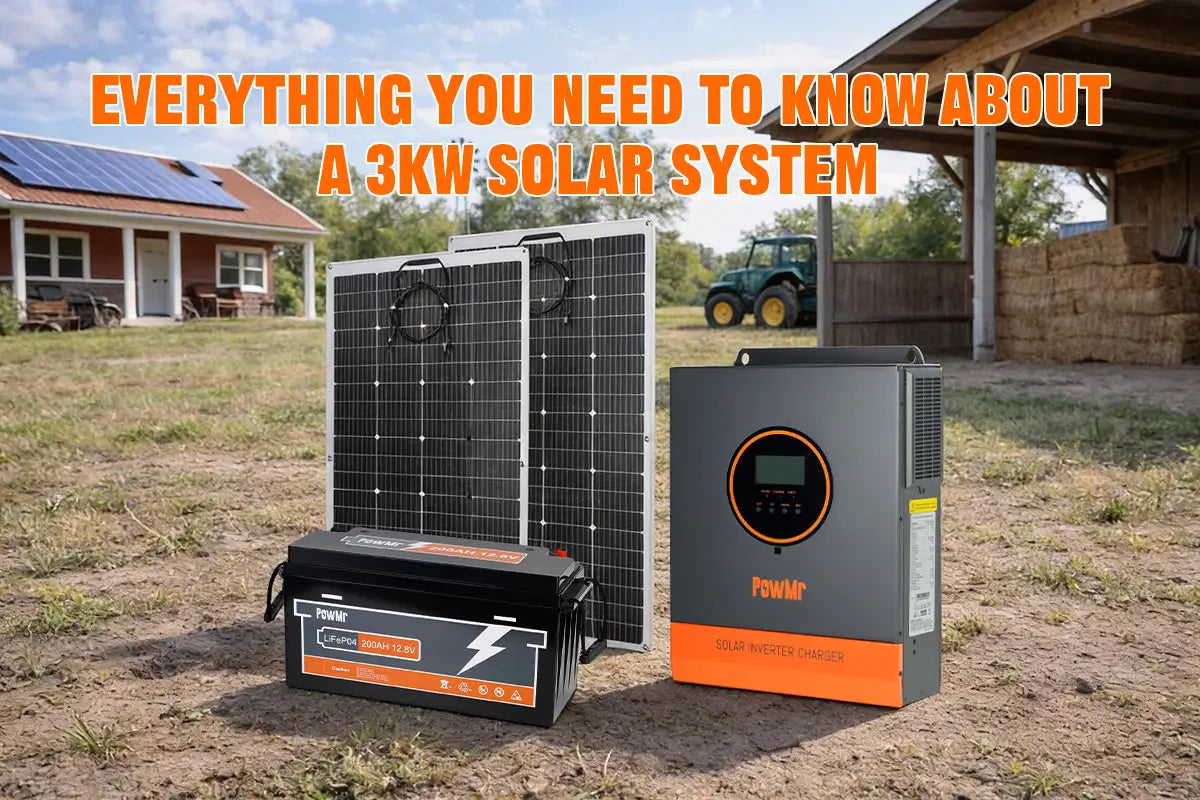
Thinking about transitioning to solar energy? A 3kW solar system is a great entry-level solution for small homes or energy-conscious households looking to reduce electricity bills and enhance sustainability.
This guide covers everything from the system's basic functionality to its power output, configuration, costs, and limitations. Read on to understand whether this system is right for your home and how it can align with your energy needs.
Definition of 3kW solar system
When we talk about a "3kW solar system," the "3kW" primarily refers to the inverter's continuous output power rating, not necessarily the solar panel array's peak capacity. This distinction is crucial for understanding system performance and what appliances it can power.
In any off-grid or hybrid solar setup, the inverter is the heart of the system, and its power rating dictates the maximum electrical load the entire system can support at any given moment.
If your inverter is rated at 3kW, it means it can continuously deliver 3kw of AC power to your appliances. Any load exceeding this limit will either cause the inverter to shut down, trip a breaker, or operate under severe stress, potentially leading to damage.
Designing a "3kW solar system" based solely on panel capacity risks energy mismatches, inverter bottlenecks, and even damage. Balancing panel, inverter, and battery capacities is crucial for optimal performance under real-world conditions.
Capacity of 3kW solar system run
A 3kW solar system can power many household appliances, but you need to manage two key factors carefully to stay within the inverter’s limits: continuous power and starting power surge.
Continuous Power
The inverter is the heart of your solar system and determines how much electricity can be supplied at any given moment. For example, a 3,000W inverter sets the maximum load it can run continuously and stably. If the total energy consumption exceeds this 3,000W limit, the inverter may shut down or become overloaded, risking damage.
Starting Power Surge
Many appliances require more power to start than their rated operating wattage. This is especially true for devices with motors or compressors, such as air conditioners, refrigerators, washing machines, and pumps. Starting (or surge) power can range from 6 to 9 times the appliance’s rated wattage.
A typical 3,000W inverter can handle surge power up to around 6,000W, allowing it to manage short bursts of high power without tripping. Always ensure that the starting power of any appliance does not exceed this limit, and avoid starting multiple high-surge devices simultaneously.
| Appliance | Average Power Consumption (Running) | Surge Power Requirement (6-9x) |
|---|---|---|
| LED TV (50-inch) | 100W | 100-300W |
| Ceiling Fan | 75W | 450-675W |
| Hair Dryer | 1200W | 1200-3600W |
| Microwave Oven | 1000W | 1000-3000W |
| Electric Kettle | 1500W | 1500W (resistive load, minimal surge) |
| Energy Star Refrigerator | 150W | Surpassable if not running large loads simultaneously |
Solar panels for 3kW solar system
The number of panels required for a 3kW solar system depends on the wattage of each individual panel, the total panel power required, and how panels are configured to meet the operating voltage of the inverter.
Understanding PV Array Requirements
A 3000W Inverter Charger supports solar input voltage MPPT range: 30-108V with a maximum supported input power of 1600W. This specification indicates that you cannot exceed 1600W of panel input for the inverter.
Then, you can carefully configure your solar array by connecting panels in series to achieve a starting voltage above 30V while ensuring the total voltage stays below 108V. This approach keeps the system within safe operating limits.
Step 1: Determine Number of Panels for Total Power
To approach the 1600W maximum input power, you will need 10 panels producing 150W each. The total input power will be 1500W, which is within the inverter’s limit.
For 100W panels, you will need 16 panels to reach 1600W total power (16 × 100W = 1600W). This configuration fully utilizes the inverter’s input capacity.
Step 2: Ensure Voltage Compatibility
Each 150W panel has a Voc of 21.6V, so panels must be configured in series-parallel strings to fit the MPPT range (30–108V). Connect 5 panels in series, generating a Voc of 108V per string. Two such strings connected in parallel will provide 1,500W total power while staying within the inverter voltage limits.
With 100W panels, although the Voc is also 21.6V, you can use a total of 15 panels, connecting 5 panels in series to produce 108V per string, and then wiring the strings in parallel. All parallel strings must have the same number of panels so that their voltage and power outputs are equal, avoiding current mismatches that can cause serious inefficiencies or even damage to the system.
Note:
The above calculations reflect the optimal and maximum capacity configurations based on the inverter's specifications. However, you can adjust the number of panels based on actual site conditions, as long as the panels meet the minimum start voltage for operation and do not exceed the inverter’s maximum power input.
Batteries for 3kW solar system
To determine the battery requirements for a 3kW solar system, you need to consider the inverter’s voltage, your average daily energy consumption, and desired backup duration. Batteries are sized based on the energy capacity they can store, and the system configuration should align with the inverter‘s DC input voltage.
Battery Capacity (Wh) = Daily Energy Consumption (Wh) / Depth of Discharge (DoD)
Required Amp-Hours (Ah) = Battery Capacity (Wh) / System Voltage (V)
Assuming a daily energy consumption of 6,000Wh (6kWh), different types of batteries will affect how you configure this system.
Lead acid batteries
Lead-acid batteries are widely used in solar power systems, but they can only safely discharge up to 50 percent of their total capacity. This limit is known as the Depth of Discharge or DoD. To supply a daily energy demand of 6,000Wh or 6kWh, the battery bank must provide a total capacity of 12,000Wh or 12 kWh. For a 3000w 24V solar inverter, this translates to a required battery capacity of 500 Ah.
Lithium-ion batteries
Lithium-ion batteries, such as LiFePO4, support a deeper discharge of up to 80% DoD, which reduces the storage requirements. For a daily energy demand of 6,000Wh, the total required storage capacity is 7,500Wh, or 312.5Ah for a 24V system.
Using 12V 200Ah lithium-ion batteries, the configuration becomes simpler. You can conncet two batteries connected in series form a 24V string, maintaining 200Ah capacity per string. To achieve the needed 312.5Ah, you would only need two parallel strings, resulting in a total of four batteries.
This setup actually provides 400Ah total capacity (or 9.6kWh storage capacity), exceeding the required 312.5Ah and offering excellent reliability and buffer capacity.
Cost of a 3kW solar system
Based on the calculations above, we can estimate the initial cost of a 3kW solar system using the optimal configuration that balances performance, efficiency, and value.
| Component | Quantity | Unit Price | Total Cost |
|---|---|---|---|
| 3000w 24v solar inverter | 1 unit | $299/unit | $299.00 |
| 150W panels (Voc: 21.6V) | 10 panels | $142.50/panel | $1,425.00 |
| 12V 200Ah LiFePO4 | 4 units | $365.00/unit | $1,460.00 |
| 3kW solar system cost | $3,184.00 |
- With an average daily production of 10-12 kWh (accounting for real-world efficiency), this system can save $600-$900 annually on electricity bills at $0.15-$0.25/kWh rates.
- At the core equipment cost of $3,184, plus approximately $1,200 for installation and balance-of-system components (total ~$4,400), this translates to a payback period of approximately 5-7 years.
Electricity production of a 3kW solar system
The electricity output of a 3kW solar system is influenced by several factors, including geographic location, solar panel efficiency, weather conditions, and system configuration. Understanding these components helps in estimating the expected energy production.
Key Factors Affecting Production:
- Geographic Location: Solar irradiance varies greatly across regions. Areas with higher solar exposure, like those near the equator or in sunny regions, produce more electricity. In contrast, areas with frequent overcast or lower sunshine hours may generate less.
- Solar Panel Efficiency: High-efficiency panels convert more sunlight into electricity, enhancing overall output. Efficiency is typically between 15% and 22% in modern solar panel technology.
- Weather Conditions: Sunlight availability is impacted by weather, with clear, sunny days boosting production and cloudy or rainy conditions causing reductions. Shading from obstacles can further affect efficiency.
- System Configuration: Proper panel orientation and tilt optimize sun exposure. Panels should ideally face south in the Northern Hemisphere and be angled to match the local latitude.
To calculate potential electricity production, you can use the formula:
Daily Energy Production (kWh) = Solar Input Power × Peak Sun Hours × System Efficiency
A 3kW inverter with 1600W solar input, assuming 4.5 peak sun hours per day and 80% efficiency, can produce about 5.76 kWh daily. This output depends on consistent sunlight and an optimized system setup.
FAQs on 3kW solar system
Is a 3kW solar system big enough for a home
For small homes (1-2 occupants) or energy-conscious households, a 3kW system can cover essential loads like lighting, refrigeration, entertainment, and charging devices. Larger homes or high-consumption households may need a 5kW or larger system to meet their needs entirely.
How many AC can you run on a 3kW solar system
The number of air conditioning units that can be operated on a 3kW solar system is primarily determined by the continuous running wattage of each unit and its surge (startup) power requirements.
A 3kW solar system can efficiently power one small 5,000 BTU window AC unit, provided surge power is carefully managed and other appliances are accounted for. Larger systems like 1.5 ton or 2 ton central ACs exceed both the running and surge capabilities of the inverter, making them unsuitable for this setup.