In RV living and off-grid outdoor power scenarios, the RV air conditioner is one of the most important yet most power-hungry appliances. When building a solar power system, many users face a key question: whether a solar inverter can be used to run an RV air conditioner, and what size power system is required to operate it reliably.
This article will focus on three core questions: what an inverter does in an RV and how it works; whether a solar inverter can run an RV air conditioner; and the recommended inverter sizing for different RV air conditioner capacities. The goal is to help you design a reliable off-grid RV power system with proper planning and system configuration.
What Does an Inverter Do in an RV?
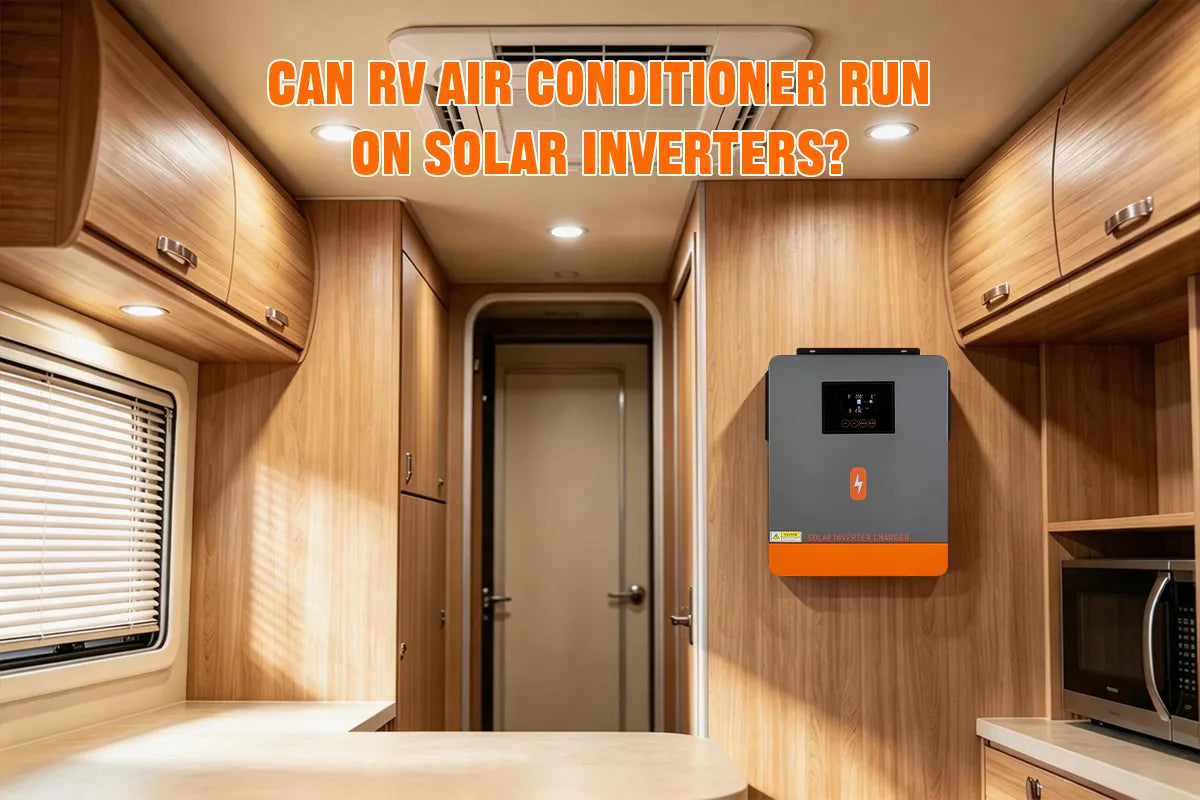
In an RV’s electrical system, the inverter’s primary job is to convert DC (direct current) power—typically 12V or 24V or 48V from the solar panels and stored in the battery bank—into standard AC (alternating current) power (120V/230V), the same type that comes from household wall outlets.
This allows you to run everyday appliances like a air conditioner, microwave, coffee maker, TV, or laptop when you’re off-grid and don’t have shore power. However, an inverter doesn’t generate electricity; it only transforms the form of power, so it places a significant current draw on your deep-cycle battery bank—high-wattage devices will drain your batteries quickly.
A quality inverter also offers low-voltage shutdown, overload protection, and pure sine wave output (to keep sensitive electronics safe), making it an essential component for “off-grid freedom” in any RV.
Can a Solar Inverter Run an RV Air Conditioner?
Short answer: Yes, but it is far from a "plug-and-play" solution.The RV air conditioner is the most power-hungry and startup-demanding appliance in the vehicle—its compressor can draw;3 to 7 times its rated running power during startup surge, which places extreme demands on a solar inverter. To successfully run an air conditioner on a solar system, you must meet the following four hard requirements simultaneously:
- the inverter must be pure sine wave. Modified sine wave inverters output a rough, choppy waveform that will cause the compressor to overheat, produce abnormal noises, or even burn out the motor. Only a pure sine wave inverter can deliver a smooth waveform identical to grid power, ensuring the compressor runs stably and efficiently over the long term—this is a non-negotiable baseline requirement.
- the inverter's surge capacity must cover the startup impact. The few seconds during compressor startup are the most critical test for the inverter—you need to pay close attention to the inverter's peak surge power rating, which must be able to handle the instantaneous current spike of the air conditioner during startup.
- For example, a 13,500 BTU air conditioner typically requires a peak surge capacity of over 6,000W; once it transitions to steady operation, the continuous power requirement drops to about 1.5 times its rated running wattage. If you only consider continuous power while neglecting surge capacity during selection, you may encounter a situation where the inverter "looks sufficient on paper but trips as soon as you turn it on."
- the solar panel array's power output must be sufficient to support the air conditioner's operation. An air conditioner typically consumes 1,000W–1,500W while running, which means on a sunny day, you need to configure at least 600W–1,000W+ of solar panels to maintain input-output balance. If sunlight is insufficient or the panel capacity is too low, the inverter will draw power from the battery bank and quickly deplete its stored energy.
- the battery bank must have high-current discharge capability. While the air conditioner is running continuously, the battery side faces a sustained current draw of over 100A. If the battery's discharge rate (C-rating) is inadequate, or if the battery capacity is too small, the voltage will drop sharply, and the inverter will immediately trigger low-voltage protection and shut down—this is often the primary reason why a system with sufficient solar panels and inverter capacity still fails to operate properly.
Practical tip: choose a solar dc air conditioner with built-in soft-start functionality. Many modern solar-ready air conditioners come factory-equipped with soft-start technology, which reduces the compressor's startup surge current by 40%–50%. This means an air conditioner that originally required a 6,000W peak surge inverter can start smoothly with a 4,000W-class inverter. Opting for such a unit from the outset simplifies system sizing and eliminates the need for aftermarket installation, making it a more convenient and integrated solution for RV owners.
What Size Inverter for RV Air Conditioner?
Choosing the right inverter for an RV air conditioner essentially comes down to finding the balance between peak surge power and continuous running power, while also considering the overall voltage platform of the RV's electrical system.
If you undersize the inverter, the air conditioner will trip the overload protection the moment it starts up. If you oversize it, you add unnecessary cost and bulk, and the inverter's own idle consumption will waste valuable battery power.
Inverter Sizing for Air Conditioner (RV Applications)
Core Sizing Principle: The inverter's continuous power rating should be no less than 1.5 times the air conditioner's rated running power, and its peak/surge power must be able to handle the startup current spike (typically 3 to 7 times the rated power).
In RV applications, because current draw becomes extremely high on a 12V system (especially above 3,000W, which imposes stringent requirements on wire gauge and safety), high-power air conditioners are generally better paired with a 48V voltage platform inverter to reduce line losses and improve overall safety.
Recommended PowMr Inverters for RV Air Conditioners
| Air Conditioner Size (BTU) | Typical Running Power | Recommended Inverter Continuous Power | Recommended PowMr Model & Key Specifications |
|---|---|---|---|
| 13,500 BTU | Approx. 1,300 – 1,500W | ≥ 2,500W |
PowMr 6500W Hybrid Inverter Charger • Continuous Power: 6500W • Peak/Surge Power: 3s @ ≥150% load; 30s @ 101%~150% load • Voltage: 48VDC / 220VAC • Features: Pure sine wave output with ample power margin to stably handle both the running and startup requirements of a 13,500 BTU air conditioner. |
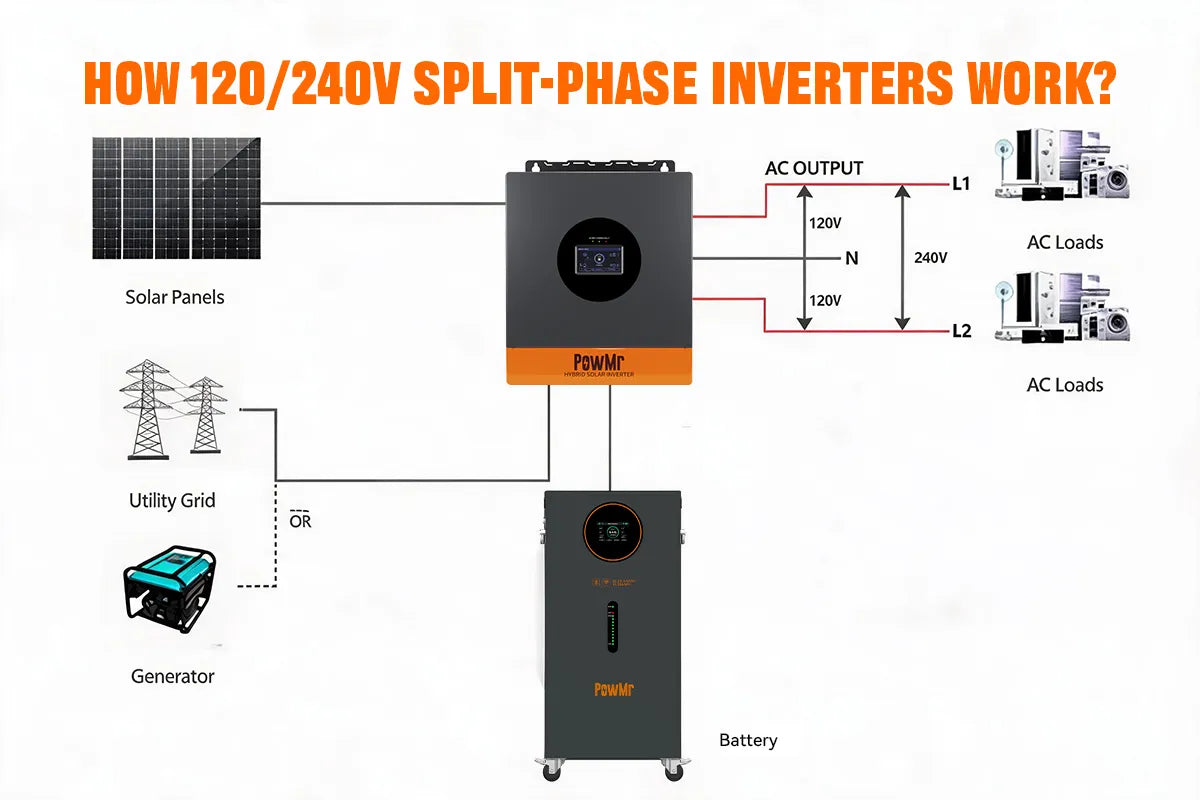
| 15,000 BTU | Approx. 1,500 – 1,800W | ≥ 3,000W |
PowMr 8KW Hybrid Inverter Charger (Split-Phase) • Continuous Power: 8000W • Peak/Surge Power: 2x rated power for 10 seconds (based on similar models, 16000W peak) • Voltage: 48VDC / 110-240VAC Split-Phase • Features: Designed for parallel operation (supports up to 6 units), pure sine wave output. The 8000W continuous and high surge capacity easily covers 15,000 BTU air conditioners, with split-phase output ideal for 120/240V RV systems and excellent scalability. |