In small off-grid solar systems, managing roof solar panels with different roof orientations, partial shading, and future system expansion is one of the most important design challenges in modern rooftop solar installations.
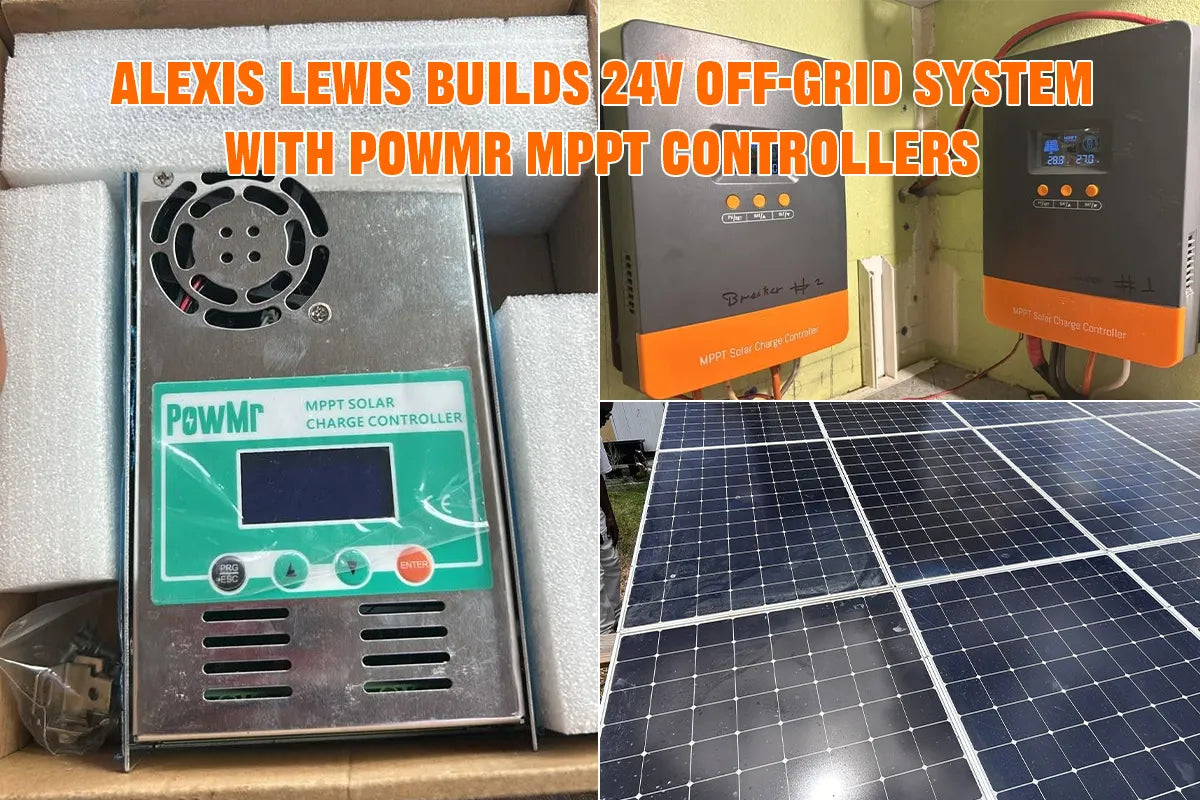
A PowMr user from the United States, Alexis Lewis, implemented a highly flexible solution by deploying multiple independent PowMr MPPT charge controllers within a 24V battery system. Instead of forcing all solar panels into a single large array, each rooftop-facing section of the PV system is managed separately.
This modular MPPT management approach allows each solar array to operate at its own optimal maximum power point (MPP), significantly reducing energy losses caused by shading or inconsistent panel orientations. At the same time, it provides greater flexibility for system expansion and future upgrades in off-grid solar power systems.
Alexis Lewis’ Early 60A System Design
In the early stage of the system configuration, Alexis Lewis primarily used an earlier generation of PowMr silver 60A MPPT charge controllers. At this stage, the system also adopted a multi-controller approach, with each MPPT independently managing different sections of the solar array.
The older 60A MPPT charge controllers did not support communication or networking functions, Each unit operated completely independently without data synchronization or system-level coordination between controllers.
As system requirements grew in scale and complexity, the earlier controller was replaced by the newer 80A PowMr MPPT charge controller (SKU:POW-M80-PRO), enabling improved communication and better coordination between multiple controllers.
60A vs 80A MPPT Controller Comparison
After upgrading to the new generation PowMr 80A MPPT charge controllers, the overall system performance and management capability were significantly improved. Compared to the earlier 60A models, the new 80A controllers support multi-unit communication and parallel operation, allowing multiple MPPTs to work in a more coordinated manner instead of operating as completely independent units.
In addition, the 80A version offers higher charging capacity and a wider PV input voltage range, making it more flexible when working with different solar panel configurations. In practical applications, this upgrade not only improves charging efficiency, but also enhances compatibility with complex roof structures, multiple array inputs, and future system expansion in off-grid solar power systems.
Alexis Lewis Current System Setup
Alexis Lewis’s current system is based on a 24V off-grid battery architecture, using two PowMr 80A MPPT charge controllers operating in parallel. Each controller manages two 360W solar panels, with different roof solar array sections assigned to separate MPPT channels.
The controllers support automatic 12V / 24V / 36V / 48V system voltage detection, allowing seamless adaptation to different battery configurations and improving installation flexibility.
This modular design provides greater adaptability for mixed roof orientations, partial shading, and future system expansion, with each solar array operating independently at its optimal power point to reduce mismatch losses.
PowMr 80A MPPT Parallel System Wiring Principle
In Alexis Lewis’s current system, two PowMr 80A MPPT charge controllers operate in a parallel configuration while maintaining independent inputs and a unified output to the battery bank.

In the 80A solar charge controller connection diagram, this can be summarized in three points:
- Each MPPT controller is independently connected to its own photovoltaic (PV) array and performs independent maximum power point tracking (independent PV input & MPPT control).
- The output terminals of both controllers are connected to the same 24V battery bank through a shared battery busbar, enabling parallel current summing (battery busbar parallel connection).
- The controllers communicate via a Parallel Communication Cable to synchronize operating status and enable system coordination (parallel communication link).
This parallel architecture ensures that each PV array operates independently without affecting others, even under different orientations or partial shading conditions, while the battery bank efficiently aggregates charging current from multiple MPPT controllers, improving system scalability and overall performance.