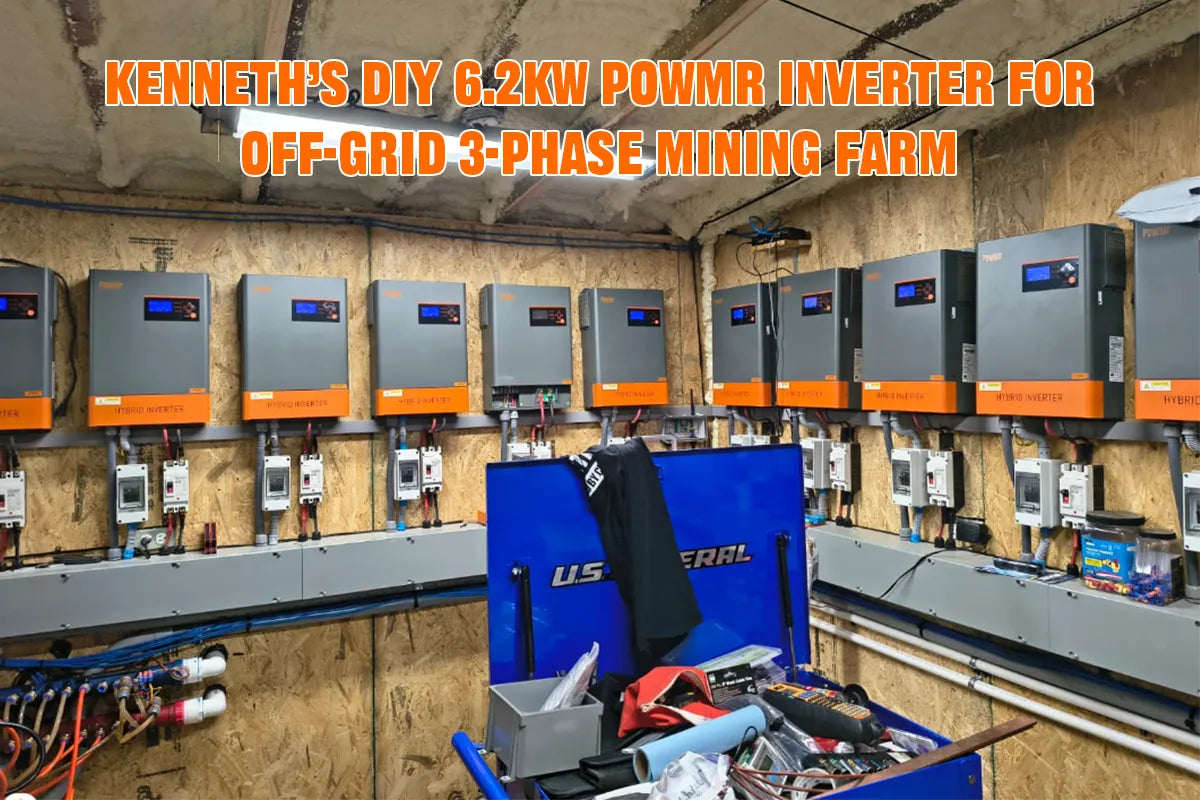
American user Kenneth Gentry shared how, through a DIY approach (self-built system), he used a PowMr 6.2kW 220V solar inverter to construct a fully independent off-grid three-phase power system. The system is mainly used to power barn equipment and heavy-duty workshop machinery.
Facing the high energy demands of typical commercial loads, this project breaks free from the constraints of the traditional utility grid. The system has now successfully paralleled 12 units of 6.2kW inverters to deliver stable three-phase output, and there are plans to further expand the system matrix to 24 units in the future.
Solving EU/US Voltage Mismatch with PowMr Inverters
Kenneth Gentry initially had no knowledge of solar power systems. At the beginning, he installed a single inverter on a wall and connected it to part of the building’s distribution panel.
When purchasing equipment, due to a lack of understanding of international electrical standards, he mistakenly bought an inverter designed for European power specifications (single-line 240V output with a separate neutral). But, Kenneth chose not to return the product.
Instead, driven by a determined DIY mindset, he thoroughly researched and experimented until he developed a workable electrical compromise solution. In doing so, he successfully solved the voltage matching challenges between high/low frequency systems and US/EU standards.

Smart Redundant Off-Grid Power System
After overcoming the voltage matching challenges, Kenneth significantly scaled up his system, upgrading the configuration to a massive parallel network of 12 PowMr 6.2kW inverters to form a highly intelligent and redundant power grid.
To ensure uninterrupted operation of his heavy equipment even during continuous rainy days, he independently designed and built an HOA (Hand/Off/Auto) control panel integrated with voltage monitors and time-delay relays.
When the 48V lithium battery bank voltage drops to a preset critical threshold of 49V, the system automatically triggers an external Generac generator to start for closed-loop charging. Meanwhile, all loads continue to be powered seamlessly through the 12-inverter matrix, achieving zero-transfer-time switching.
By physically interconnecting the 48V DC busbars across the main house, guest cabin, and barn workshop, he created a cross-linked three-zone backup network. This multi-layer redundancy and massive scale not only significantly improved energy utilization, but also provided the entire DIY off-grid system with commercial-grade reliability, allowing for future expansion to 24 inverters.
Current System Operation & Performance
Currently, this system consisting of 12 inverters connected in parallel as a three-phase off-grid power setup is fully in daily operation, and its real-world performance has far exceeded expectations.
In operation, the PowMr 12 6.2kw solar inverter system has proven its strong instantaneous load-handling capability under high power demand. When heavy-duty machinery and various workshop equipment are started simultaneously, the 12 high-frequency inverters work in coordination, ensuring the output voltage and frequency remain extremely stable, with no system shutdowns or tripping events caused by overload.
In addition, Kenneth specifically pointed out that the DC interconnection design plays a crucial role in real-world operation. During daytime, the photovoltaic arrays from the main house and the guest cabin continuously feed surplus energy to the barn area, keeping the entire site’s battery banks at a consistently healthy high state of charge, significantly reducing the need for generator startup.
Overall, the entire system operates fully automatically without on-site supervision. With extremely low maintenance costs and very high power reliability, it perfectly supports the energy demands of the entire facility.