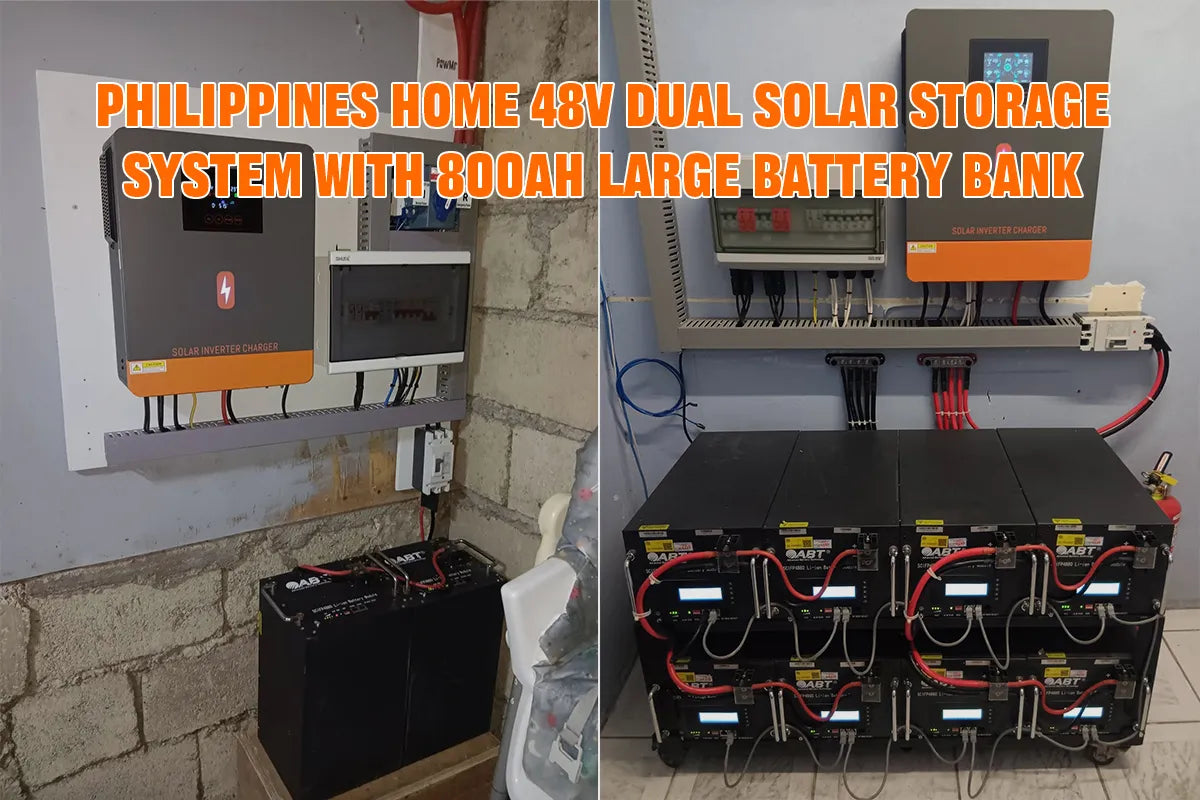
This case is based in Miagao, Philippines, where a local user built an independent dual-system 48V energy storage setup using PowMr inverters. The solar storage system consists of two separate lithium battery banks with a total capacity of approximately 800Ah. Through independent control and distributed operation, it achieves higher stability and system redundancy, significantly improving the reliability of the home energy supply while ensuring continuous power during nighttime and low-light conditions.
The first system operates with a 6200W 220Vac 48Vdc all in one (SKU: POW-HVM6.2M-48V-E) solar inverter paired with a 48V 160Ah battery bank, while the second system uses a 10.2KW 220Vac 48Vdc all in one (SKU: POW-HVM10.2M) solar inverter supported by a larger 48V 640Ah battery bank, providing stronger energy storage capacity and higher load support for the household.
How the Dual Independent Solar Inverter Setup Works
The dual solar storage system employ a fully independent DC-AC architecture, with physical isolation and electrical independence maintained from PV input through battery storage to AC output.
PV Input: Independent MPPT Tracking for Uninterrupted Generation
DC Storage: Parallel Lithium Battery Banks with Built-In BMS Protection
On the DC storage side, the 6.2kW system uses two 80Ah lithium iron phosphate battery units wired in parallel for a 160Ah bank, while the 10.2kW system employs eight 80Ah units in parallel to build a 640Ah high-capacity battery bank.
Together, these two independent battery banks deliver a combined 800Ah total capacity at 48V for this Philippines home solar storage system, providing substantial energy reserves for extended off-grid operation.
Every battery module features a built-in Battery Management System (BMS), performing individual voltage monitoring, cell balancing, and fault protection without requiring an external master-slave balancer. This design fundamentally eliminates the risk of an entire battery bank going down due to a single BMS failure, ensuring the dual solar storage system maintains reliable performance even in demanding tropical conditions.
AC Output: Dual-Bus Configuration with Intelligent Load Distribution
On the AC output side, both inverters feed into separate circuits within the home distribution panel, forming a dual-bus power supply configuration. During normal operation, the 6.2kW solar system continuously carries base loads such as lighting, refrigeration, and networking equipment, while the 10.2kW solar system dynamically responds to intermittent high-power appliances like air conditioners, water pumps, and induction cookers. Load distribution between the two systems is not fixed; it adjusts flexibly based on real-time solar generation, battery State of Charge (SOC), and peak/off-peak consumption patterns.
When one system enters protection mode or requires maintenance, the other can temporarily expand its load coverage to ensure critical circuits remain powered.
The core advantage of this distributed energy storage architecture lies in its redundancy: inverters, battery banks, BMS units, and distribution circuits share no common nodes. The impact of any single-point failure is strictly confined within its own system. For remote areas with weak grid infrastructure and slow maintenance response, this fault isolation capability delivers more practical value than simply maximizing the efficiency of a single large system.