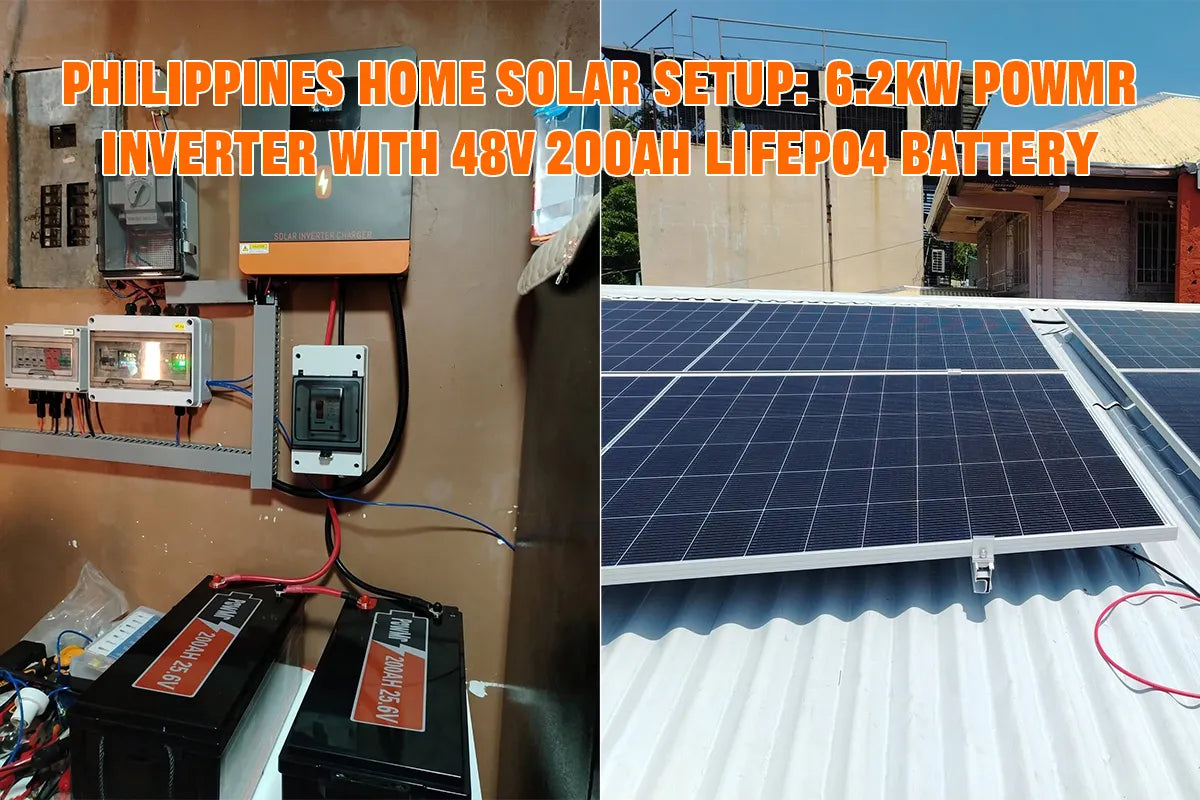
In Philippines, Mark Reuterez built a dependable home solar system using the PowMr 48v 6.2kW hybrid inverter (SKU:POW-HVM6.2M-48V-N). Four 650W solar panels wired in series deliver 2600W of PV input—enough to charge his battery bank and power household loads through the day.
For storage, two PowMr 24v 200ah LiFePO4 batteries (SKU:POW-200AH-25.6V) run in series as a 48V 200Ah battery bank, providing about 9.6kWh capacity for nighttime use and backup. With 6.2kW of inverter output, Mark runs appliances, fans, lighting, and electronics without leaning on the grid. Solar comes first; the hybrid design keeps the utility ready when he needs it.
Mark’s LiFePO4 Battery Bank for Solar Storage
In Mark’s system, energy storage is built on the PowMr 24V 200Ah LiFePO4 lithium battery (SKU:POW-200AH-25.6V). Designed as a deep-cycle home energy storage battery with A-grade cells and a built-in BMS, it supports solar, backup, and lead-acid replacement applications. Mark connected two units in series to form a 48V 200Ah bank—about 9.6kWh of storage—so the battery voltage matches his POW-HVM6.2M-48V-N hybrid inverter.
Each 24V 200AH battery (SKU:POW-200AH-25.6V) is rated for more than 6000 cycles (0.2C, 25°C @ 80% DOD) and includes five-layer BMS protection to monitor and manage charging, discharging, and cell balancing. With up to 200A max charge/discharge current and support for 2 in series / 2 in parallel, it fits Mark’s 48V home setup today and leaves room to expand later.
Features of Mark’s Hybrid Inverter
Mark chose the PowMr 6.2kW 48V hybrid solar inverter (POW-HVM6.2M-48V-N) designed for home PV systems. It integrates inversion, MPPT solar charging, and grid connection in one unit.
It works with solar, lithium batteries, and the utility grid: solar power can supply household loads first, with surplus energy stored in the battery; when sunlight is low, the system draws from the battery; and when needed, the grid provides backup.
Pure sine wave output supports most home appliances and electronics. On the DC side, it matches 48V battery systems and uses a wide-voltage MPPT to connect PV arrays and charge LiFePO4 batteries.
Through the control panel, users can adjust charging current, battery type, and operating mode to fit their loads and storage capacity. For a home setup like Mark’s, this hybrid inverter’s real value is handling solar input, energy storage management, and stable power supply in a single machine.
How Long Can Mark’s 48V 200Ah LiFePO4 Battery Power a Home?
With two 24V 200ah lifepo4 batteries (POW-200AH-25.6V) in series, Mark’s bank is 48V 200Ah, for a total storage of about 9.6kWh. Runtime mainly depends on total load power: the lower the continuous draw, the longer the battery lasts.
Formula:Runtime (hours)=Load power (kW)/Battery capacity(kWh)
Example:9.6 ÷0.5 = 19.2 hours.
| Household load | Approx. power | Estimated runtime |
|---|---|---|
|
Lights + Wi-Fi
|
100W (0.1kW)
|
~96 hours
|
|
Lights + fans
|
300W (0.3kW)
|
~32 hours
|
|
Fridge + lights + fans
|
500W (0.5kW)
|
~19 hours
|
|
Typical evening use
|
800W (0.8kW)
|
~12 hours
|
|
Heavier home use
|
1000W (1kW)
|
~9.6 hours
|
This table shows the estimated runtime of common home appliances that Mark’s 48V 200Ah LiFePO4 battery bank can power. Actual runtime may vary with real load and inverter conversion loss.
How Long Does a 48V 200Ah LiFePO4 Battery Take to Charge?
Mark’s hybrid inverter (POW-HVM6.2M-48V-N) can charge his 48V 200Ah LiFePO4 battery bank through its built-in MPPT charger. Charge time mainly depends on charging current: the higher the current, the faster the battery fills up.
On this 48V system, the inverter’s max charging current is about 120A, so a full charge estimate is:
200Ah÷120A =1.67 hours
Mark’s PV array is about 2600W, so daytime solar charging is usually lower than the max rate:
Formula:Current(A)=PV power (W)÷Battery voltage(V)
2600W ÷ 48V ≈ 54A
Based on this solar charging current:
200A÷54A ≈3.7hours
| Charging condition | Approx. current | Estimated full-charge time |
|---|---|---|
|
Max inverter charge rate
|
120A
|
~1.7 hours
|
|
Mark’s ~2600W PV input
|
~54A
|
~3.7 hours
|
Want to Build a System Like Mark’s?
If you also want to build a home solar energy storage system with the PowMr POW-200AH-25.6V 24V 200Ah LiFePO4 lithium battery, start by choosing the battery voltage—then match it with the right solar inverter. With a single 24V battery, pair it with the 4500W 110Vac 24Vdc all-in-one inverter from the 110V/120V single-phase inverter series. It suits common North American 110V/120V appliances, RVs, and small backup systems.
If you connect two batteries in series for a 48V 200Ah bank—just like Mark—choose the 5200W 48Vdc 110Vac inverter from the same series for higher load capacity and better expandability. For homes that need both 110V and 220V/240V high-power appliances (water heaters, air conditioners, pumps, and more), choose a model from the 110V/220V split-phase inverter series—such as the 6.5kW, 8kW, or 12.5kW 48V models—for a better match with a 48V lithium battery bank.
Whether you go single-phase or split-phase, the rule is the same: the lithium battery sets capacity and voltage, and the inverter sets output and load capability. Match them first, then install—so the system can run stably for the long term.