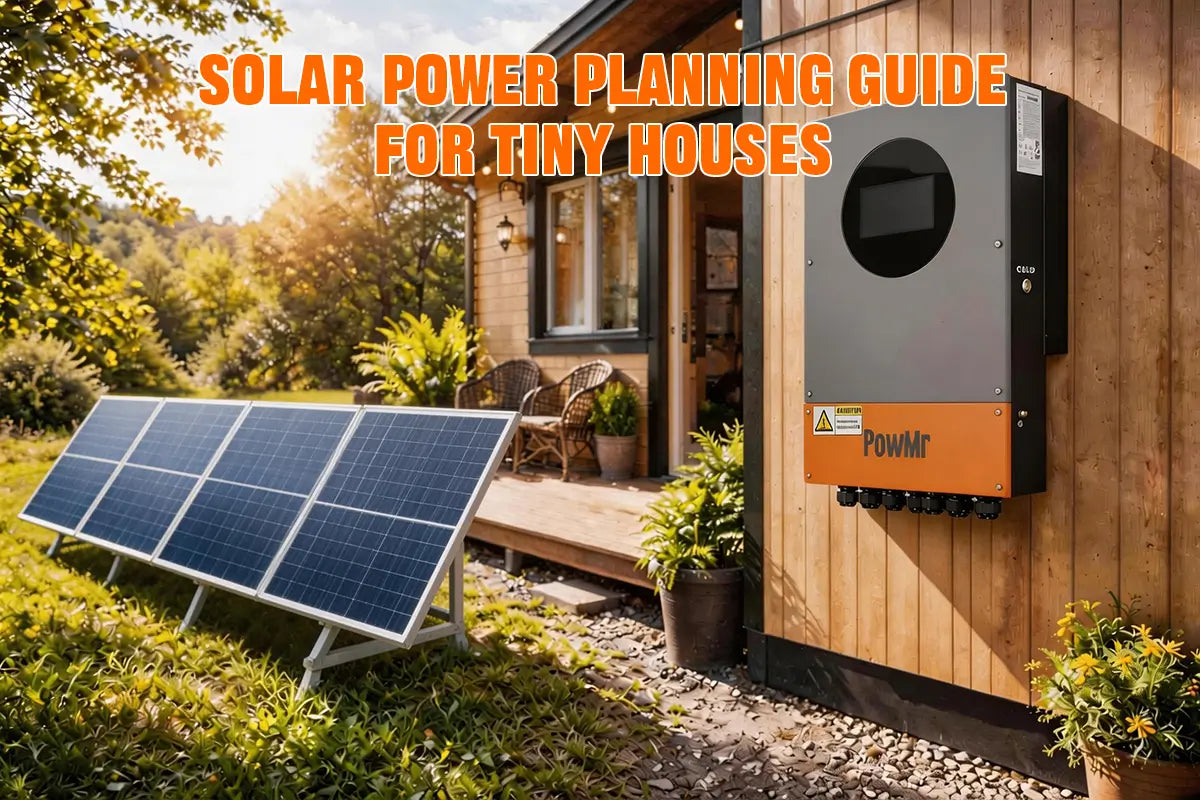

A 6500W solar inverter represents a substantial power solution that can support the energy needs of most medium to large households or small commercial applications. Before purchasing one, you need to carefully plan your entire system around your specific energy requirements.
In this comprehensive guide, we'll explore everything you need to know about sizing your solar array and battery bank for a 6500W solar inverter. We'll examine the intricate relationships between watts, volts, and amps, calculate realistic load requirements, and determine exactly how many solar panels and batteries you need for reliable off-grid or hybrid power.
Understanding 6500W Inverter's Load Capacity
Before diving into calculations, it's essential to understand what a 6500W inverter can actually power in practical terms. The rated power of 6500 watts refers to the maximum continuous power output under optimal conditions. This doesn't mean you'll always draw 6500 watts—rather, it establishes the upper limit of what your system can deliver.
To design an effective solar power system, you must accurately estimate your actual energy usage. A 6500W inverter can easily handle a full household setup, including air conditioners, refrigerators, washing machines, TVs, computers, lighting, and kitchen appliances. The crucial factor isn’t just what appliances you own, but which ones you run at the same time and their real power consumption.
Critical load calculation factors
- Rated vs. Surge Power: Continuous power consumption vs. startup power spikes
- Inductive Load Multiplier: Motor-driven appliances require 3-9× rated power at startup
- Operating Duration: How long each load runs directly impacts battery capacity needs
List all appliances with their rated and surge power along with their operating hours. Divide the day into time periods and calculate the total load for each period by summing the power of all appliances running simultaneously.
Identify the period with the highest total load, then compare the total continuous load with the inverter’s continuous rating and the total surge load with the inverter’s surge rating to ensure both stay within safe limits and prevent overload.
| Time Period | Appliances Running | Rated Power (W) | Surge Power (W) | Total Continuous Load (W) | Total Surge Load (W) |
|---|---|---|---|---|---|
| 06:00-07:00 | Refrigerator, Lighting, Pump | 400 + 200 + 750 = 1350 | 400 + 600 + 2250 = 3250 | 1350 | 3250 |
| 18:00-19:00 | AC, Refrigerator, Lighting | 1500 + 200 + 400 = 2100 | 4500 + 600 + 400 = 5500 | 2100 | 5500 |
| 20:00-21:00 | AC, Washing Machine, Lighting | 1500 + 500 + 400 = 2400 | 4500 + 1500 + 400 = 6400 | 2400 | 6400 |
Based on the table above, the highest total continuous load is 2400W and the highest total surge load is 6400W during the 20:00–21:00 period. Compared with the inverter ratings of 6500W continuous power and 13000W surge power (5 seconds), both values remain well within the allowable limits, indicating that the inverter can safely support these loads with sufficient operating margin.
If the calculated loads exceed the inverter limits, you should reduce the number of appliances running simultaneously or stagger their operating times to keep the total load within the inverter’s rated capacity.
Calculating Solar Panel Requirements for 6500W Inverter
Sizing the solar array for a 6500W inverter requires balancing daily energy demand, available sunlight, and inverter charging limits. A properly sized solar array must generate enough energy to cover daily consumption while staying within the inverter’s PV input specifications.
Using SunSmart 6500W inverter as example, the key solar charging limits are:
- Maximum PV input power: 6500W
- Maximum solar charging current: 130A
- MPPT operating voltage range: 60–115V DC
- Maximum PV open-circuit voltage: 145V DC
These specifications define the safe operating window for your solar array.
Required Solar Capacity for 6500W Inverter
The solar array must generate enough energy during daylight hours to cover daily consumption and charge the batteries. The required solar capacity can be estimated using the following formula:
Required Solar Capacity (W) = Daily Energy Consumption (Wh) ÷ Peak Sun Hours ÷ System Efficiency
Where Daily Energy Consumption is the total energy used per day, Peak Sun Hours represent the average daily solar irradiance (typically 4–6 hours), and System Efficiency accounts for real-world losses such as inverter efficiency, battery charging losses, temperature effects, and wiring resistance. Typical efficiency values range from 0.70 to 0.80.
This formula provides a practical estimate of the minimum solar array size needed to meet daily energy demand under normal conditions.
Number of Solar Panels for 6500W Inverter
Once the required solar capacity is known, the number of solar panels can be calculated based on the rated power of each panel:
Number of Panels = Total Solar Capacity (W) ÷ Panel Rated Power (W)
Because solar panels cannot be installed in fractional quantities, the calculated result should always be rounded up to ensure sufficient capacity and reliable system performance.
Sizing Battery Bank for 6500W Inverter
Properly sizing the battery bank ensures your system can store enough energy to supply your loads during periods of low solar generation. For a 48V LiFePO4 battery system, the required capacity can be estimated using the following formula:
Required Battery Capacity (Ah) = Daily Energy Storage (Wh) ÷ Battery Voltage (V) ÷ Depth of Discharge (DoD)
Where:
- Daily Energy Storage (Wh) is the energy you want to cover, typically your average daily consumption multiplied by the number of autonomy days.
- Battery Voltage (V) is the nominal voltage of your battery bank (48V for the POW-SunSmart 6.5KP).
- Depth of Discharge (DoD) accounts for the usable portion of the battery’s capacity, usually 80–90% for LiFePO4.
This formula provides a practical estimate of the minimum battery capacity required to reliably support your loads.
Summary: Putting It All Together
Designing a solar power system around a 6500W inverter like the POW-SunSmart 6.5KP requires careful consideration of multiple interconnected factors. By following the systematic approach outlined in this guide, you can calculate precisely how many solar panels and batteries you need for your specific situation.
| Application | Solar Array Size | Battery Capacity | Battery Configuration |
|---|---|---|---|
| Light residential (10-15 kWh/day) | 4000-5000W | 400-600Ah @ 48V | 4-6× 100Ah or 2-3× 200Ah |
| Medium residential (15-25 kWh/day) | 5000-6500W | 800-1200Ah @ 48V | 8-12× 100Ah or 4-6× 200Ah |
| Heavy residential/off-grid (25-35 kWh/day) | 6500W+ | 1400-1800Ah @ 48V | 14-18× 100Ah or 7-9× 200Ah |
These are general guidelines. Your specific requirements depend on actual energy consumption, geographic location, desired autonomy, and budget. The most reliable approach is to monitor your power usage for several weeks with an energy monitor, then use that real data for precise sizing.
Here we recommend the POW-SunSmart 6.5KP, which provides 6500W continuous output, 13000W surge capacity, and 130A maximum solar and battery charging. It operates with a 48V battery system and features two built-in MPPT trackers, each supporting up to 5000W of PV input with voltages from 150 to 450V.
The wide voltage range allows for longer series strings of solar panels, reducing wiring complexity and losses. The dual MPPT design enables independent tracking of separate arrays, improving energy harvest under partial shading or when arrays face different orientations.
Overall, these specifications provide flexibility to efficiently size and configure solar arrays for light, medium, and heavy residential or off-grid systems.