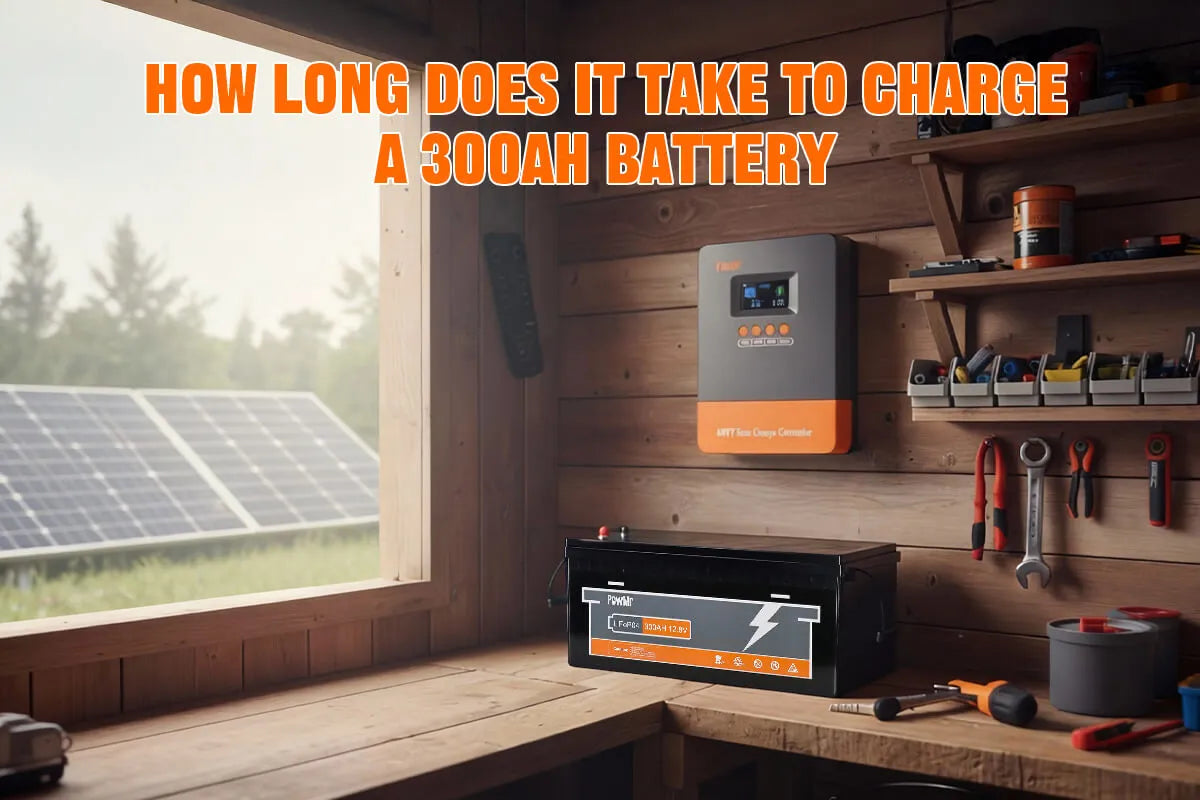
Quick Takeaway: How long does it take to charge a 300Ah battery? A 300Ah battery takes 2 to 15 hours to charge from 0% to 100% under ideal conditions, depending on charger amperage and battery chemistry.
A 300 Ah battery is considered a large-capacity battery in most off-grid solar systems, capable of storing significant energy for daily use. Knowing how long it takes to charge such a battery is important for planning your energy setup, choosing the right charger, and ensuring safe operation.
In this article, we'll explore a simple formula to calculate charging time, the variables that affect it, and how to estimate the number of solar panels you need to keep a 300 Ah battery fully charged efficiently.
Formula for calculating how long does it take to charge a 300Ah battery
Basically, to estimate charging time, take the 300Ah battery, multiply it by the portion you want to refill, and then divide by the charger's current.
Charging Time (hours) = (300Ah × Depth to Recharge) ÷ Charger Amps
- Battery Capacity (Ah): 300Ah in this case means the total amount of charge the battery can hold, basically how much energy you can use before needing to recharge.
-
Depth to Recharge: The amount of battery capacity that needs to be replenished, calculated as the difference between the current SoC and the target SoC.
For example, charging from 0% to 100% requires 100% of the battery capacity, while charging from 20% to 80% requires 60% to recharge. - Charger Amps: The current supplied by your AC charger or solar charge controller. Higher current charges the battery faster, but must stay within the battery's safe limits.
For example, if you're charging a completely empty 300 Ah battery at 20A, it would take about 15 hours. A 30A charger would do it in roughly 10 hours, and a 50A charger would take around 6 hours.
To accelerate the charging of the 300Ah battery, you could use a 150 A charger, which would shorten the charging time to about 2 hours.
Note:
To get a more realistic estimate, you can multiply your result by 1.2 to account for energy losses, like heat, the battery's internal resistance, and inefficiency in the charger.
Factors affecting 300Ah battery charging duration
Charging time for a battery might look easy to calculate, but there are a few things to keep in mind.
Knowing these helps you understand what can happen during real charging and lets you plan your charging setup better based on your battery and charger, and stay safe at the same time.
Stage of charge
The battery charging isn't linear, the voltage and charging current vary with the stage of charge. When the battery is very low, it can accept charge quickly. As the battery gets closer to full, the charging speed gradually slows down.
This is why the last 20% of the charging capacity takes 30-40% of total charging time. The bulk phase (0-80%) charges quickly at full current. The absorption phase (80-95%) slows to 25-50% current. The float phase (95-100%) drops to 5-10% current for cell balancing.
Battery chemistry and C rate
Different battery chemistries behave differently during charging. The most obvious example is LiFePO₄ versus lead-acid batteries. The former can handle higher charging currents safely, charge faster, and has a flatter voltage curve, while the latter needs slower charging to prevent overheating or damage.
The C-rate shows how fast a battery can safely be charged relative to its capacity. For example, for a PowMr 12V 300Ah LiFePO₄ battery, a 0.66C rate means you can safely charge it at 200A. Lead-acid batteries require much lower currents, typically around 0.1C to 0.5C, which equals 30 A to 100 A for the same 300 Ah battery.
Exceeding the recommended C-rate can reduce battery life, generate heat, or even damage the battery. Knowing your battery type and its safe C-rate helps you choose the right charger and charging speed.
Temperature impact
Battery charging behaves very differently under different ambient temperatures, and the change can be quite dramatic.
When the temperature drops, the chemical reactions inside the battery slow down, which makes the battery accept charge more slowly. Conversely, higher temperatures speed up reactions and charging, but excessive heat can damage the battery and shorten its lifespan.
If your location experiences extreme temperatures, it is better to use a quality charger with a temperature compensation sensor. This allows the charger to adjust the charging voltage based on the actual battery temperature, which helps improve charging efficiency and protects the battery from damage.
Battery age and health
A new battery usually charges faster and holds its capacity well. As a battery ages, its internal resistance increases, and its capacity gradually decreases. This means it will accept less current and take longer to charge.
This is also why batteries used in series or parallel should be the same age, so you can avoid uneven charging, unbalanced voltages, and extra stress on the weaker battery. Mixing old and new batteries can slow down the whole bank and may even cause long-term damage.
How many solar panels do you need to charge a 300Ah battery
To estimate how many solar panels are needed, you can use this simple formula:
Number of Panels = ((Battery Voltage × Battery Capacity) ÷ Peak Sun Hours) × 1.25 ÷ Panel Power
Note:
In winter or cloudy days, Peak Sun Hour may be lower than average, meaning panels produce less energy. To ensure your 300 Ah battery fully charges even in low sunlight, use the shortest Peak Sun Hours of the year value when calculating solar panel needs.
-
Battery Voltage × Battery Capacity = Watt-hours (Wh)
By multiplying the battery voltage (V) and the battery capacity (Ah), you get the total energy stored in the battery in watt-hours (Wh). This tells you how much energy you need to fully charge the battery. -
Divide by Peak Sun Hours
Dividing by the number of peak sun hours converts the total energy needed into the solar power required per hour of sunlight. In other words, it shows how much power your solar panels must produce each hour to fully charge the battery in one sunny day. -
Multiply by 1.25 (Loss Factor)
Charging is not 100% efficient. Energy is lost in the wiring, the charge controller, and inside the battery itself. Multiplying by 1.25 adds a 25% buffer to account for these losses, giving a more realistic estimate. -
Divide by Panel Power
Finally, dividing the result by the rated power of a single solar panel tells you how many panels you need. Essentially, this step converts the total required solar power into the number of panels needed to meet it.
Assuming you use 400W solar panels to charge a 12V 300Ah battery that stores 3,600Wh of energy. With 5 average daily sun hours, the panels need to provide about 720W to fully charge the battery. After adding a 25% loss factor for inefficiencies, the required solar power becomes around 900W, which means you would need three 400W panels to reliably charge the battery in one day.