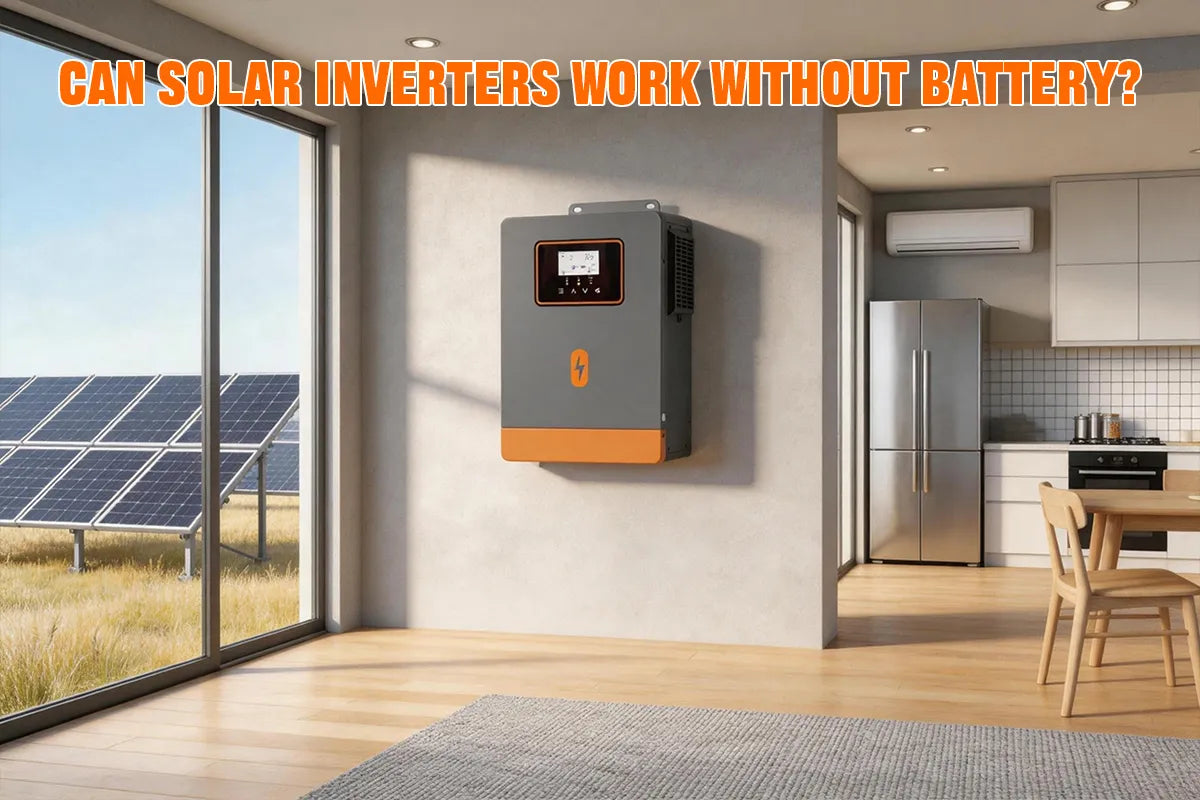
Can solar inverters work without a battery? The answer is yes — but it depends on the type of solar inverter. Many people assume a solar system must include expensive battery storage. You can choose a Batteryless Solar Inverter solution to cut upfront costs.
This guide explains whether solar systems need a battery, how a Batteryless Solar Inverter works, and how to balance bill savings with stable power.
Do Solar Systems Need a Battery?
The answer is: not always — it depends on your goal.If you need power during outages, or want to use solar energy at night, you usually need a solar battery and battery storage.
But if your grid is reliable and your main goal is to lower daytime electricity costs, you can choose a batteryless solar solution — batteryless required.During the day, solar power can go straight to your home loads, and the utility grid fills the gap when solar isn’t enough — that’s the core idea of a batteryless solar system, or batteryless solar.
Many people assume a solar system must include a battery. In reality, a battery’s job is to store energy for later — not to decide whether solar can work at all.
How Batteryless Solar Inverter Works?
How does a batteryless solar inverter work? Take the PowMr 6000W 220V batteryless solar inverter (SKU:PVS-6KW-ECO) as an example. Based on the product diagram Smart Load Allocation with Solar Priority Power Supply, a batteryless solar system allocates power by sunlight conditions like this:

When sunlight is sufficient (Sufficient PV Power)
Solar power is supplied to the Backup Load first — for example, a refrigerator.
If there is still surplus solar energy, the extra power helps supply the Home Load — such as an air conditioner — through current transformer (CT) monitoring, reducing electricity drawn from the utility grid. With CT feedback, the inverter can also limit or prevent export, so surplus solar is used on-site instead of being fed back to the grid — safer and easier to keep compliant.
When sunlight is insufficient (Insufficient PV Power)
If solar output is not enough, the Backup Load is powered by both solar and grid power, so critical appliances keep running.
The Home Load is mainly powered by the grid.
At the same time, the CT continues to monitor incoming grid current, helping the inverter coordinate solar and utility power — solar first, with the grid filling the gap when needed.
Types of Inverters That Work Without a Battery
PowMr offers many solar inverter categories for different voltages and applications. But only the Batteryless Solar Inverter is designed to work without a battery.
Most other solar inverter types are built around battery charging, backup power, or off-grid use. A Batteryless Solar Inverter is different: it uses solar power first and the utility grid as real-time support — batteryless required.
| Inverter Category | Voltage Line | Needs a Battery? | Notes |
|---|---|---|---|
|
Power Inverter
|
110V / 220V
|
Yes
|
Typically used with battery systems
|
|
Single Phase Inverter
|
110V
|
Yes
|
Common for battery-based home setups
|
|
Split Phase Inverter
|
110V
|
Yes
|
Designed for battery-supported split-phase power
|
|
Low Frequency Inverter
|
110V
|
Yes
|
Built for heavy loads and battery backup
|
|
Hybrid Inverter
|
110V / 220V
|
Yes
|
Mainly designed for solar + battery systems
|
|
IP21 All In One Inverter
|
220V
|
Yes
|
All-in-one solar charging with battery
|
|
IP65 All In One Inverter
|
220V
|
Yes
|
Outdoor-rated all-in-one with battery
|
|
Batteryless Solar Inverter
|
220V
|
No
|
Designed for batteryless daytime bill savings
|
When a Battery Is Still Necessary?
A batteryless solar Inverter is a strong fit for daytime bill savings — but it can’t replace a battery in every scenario.
If you need reliable backup during outages, you still need a battery. A batteryless inverter may power critical loads in strong sunlight, but it generally can’t keep running at night or when PV output is weak.
If you use most of your electricity at night, or want to save daytime solar power for evening use, you also need a battery. Batteryless solar is built for instant self-consumption, not energy storage.
The same applies to off-grid cabins, unstable grid areas, or any setup where critical loads must stay powered for longer periods. In these cases, LiFePO4 batteries for solar energy storage are often the better choice for safe, long-life backup.
Batteryless vs Battery Backup: Which Fits You?
For many users, the real question isn’t whether to go solar. It’s whether they also need a solar battery. These two setups solve different problems.
A Batteryless Solar solution is a better fit for homes or small businesses with a reliable grid and high daytime electricity use. The focus is lower daytime electricity bills and lower upfront cost.
A Battery Backup solution is better if you need emergency power, nighttime solar use, or more energy security on an unstable grid. The system can store extra solar energy in a battery — especially LiFePO4 batteries for solar energy storage — so you can keep running during outages or after sunset. The focus is power continuity and backup protection.
|
Comparison
|
Batteryless Solar Inverter
|
Battery Backup
|
|---|---|---|
|
Main goal
|
Cut daytime electricity costs
|
Backup power / nighttime use
|
|
Core setup
|
Solar panels + batteryless inverter + utility grid
|
Solar panels + inverter + energy storage battery
|
|
Solar first, grid fills the gap
|
Solar powers loads first; the grid fills the gap
|
Solar powers loads; surplus can charge the battery
|
|
Nighttime use
|
Mainly utility power
|
Battery can supply power
|
|
During outages
|
Limited backup (sunlight-dependent)
|
Can keep powering loads
|
|
Upfront cost
|
Lower
|
Higher
|
|
Best for
|
Reliable grid, high daytime use
|
Frequent outages, backup needs, high nighttime loads
|
|
Typical choice
|
Batteryless Solar Inverters: Pros, Cons
A solar inverter can operate without a battery—especially in batteryless solar inverter system. But “it can work” does not mean “it fits everyone.” Before you skip the battery, weigh the trade-offs and avoid common sizing mistakes.
Pros: Why Many People Choose a Batteryless Setup
A battery-free solar setup is often chosen for lower cost, simpler installation, and faster payback when daytime solar use is the main goal.
Lower upfront cost
Batteries are often one of the most expensive parts of a solar system. Starting with “solar panels + inverter, no battery” can cut the initial budget and help you start using solar power sooner.
Simpler, faster installation
Without a battery cabinet, BMS, complex wiring, and extra fire/space requirements, installation is cleaner—and better for homes with limited roof or indoor space.
Lighter maintenance
You don’t need to track battery cycle life, charge/discharge health, or replacement schedules, so routine use involves far less ongoing upkeep.
Built for bill savings
If your main goal is to use solar power during the day and lower electricity bills—and your local grid is stable and allows grid connection—a batteryless solar inverter system is often the most direct option.
Cons: What You May Give Up With a Batteryless System
Skipping the battery can mean weaker backup power, less ability to use daytime solar at night, and less flexibility if your needs or local policies change.
Usually no power during a grid outage
Without a battery, a batteryless solar inverter has no stored energy to fall back on. If an outage happens at night or when PV output is weak, your home can still lose power—even if the system works well in normal daytime conditions.
Limited backup during a grid outage
When sunlight is strong, a batteryless solar inverter may keep powering backup/critical loads during a grid outage. That backup is still limited: it depends on real-time solar production, so cloudy weather or low PV output can cut power again.
Tougher demand on when you use electricity
Without storage, system value depends more on having daytime loads. If your household mainly uses power at night, bill savings may fall short of expectations.
More sensitive to electricity rates and policy
Changes in net metering, export rates, or grid-connection rules can quickly change how economical a batteryless setup is.