When you notice a hybrid solar inverter automatically switching to grid—especially at night or under heavier loads—it is easy to assume something is wrong. In most cases, this is normal system behavior rather than a hardware fault.
This article explains how a hybrid inverter works with solar, battery, and grid, covers the most common reasons it switches to grid, and provides practical fixes to help you tell normal protection from settings that need adjustment.
How Hybrid Inverters Work with Solar, Battery & Grid
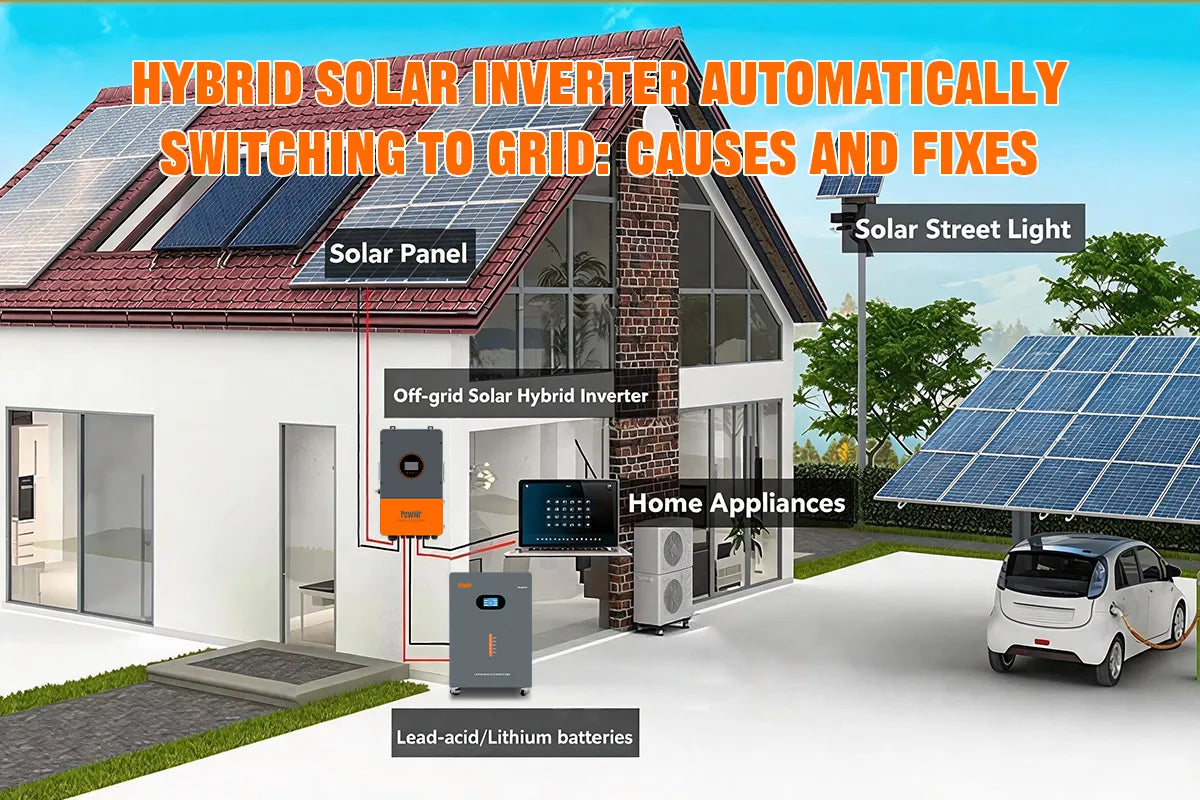
A hybrid inverter combines solar battery, and grid power in one system. When sunlight is available, it prioritizes PV energy. When solar is not enough, it uses the battery. When battery power is also low, it switches to the grid to keep your home powered.
Take the PowMr 12KW 48Vdc Hybrid Solar Inverter (SKU: POW-SunSmart LVM12K) as an example. It coordinates these three sources like this:
1. Solar (PV)
Solar panels connect through dual MPPT inputs. During the day, solar power supplies the load first, then charges the battery. In on-grid mode, any remaining surplus can be exported only if local regulations and the utility company allow it.
2. Battery
The battery stores extra solar energy for evening, night, or cloudy periods. On the LVM12K, battery energy management options include:
- Standby: limited discharge while on-grid; battery mainly used off-grid
- Battery to UPS load: battery supports critical loads when PV is insufficient
- Battery to home load: battery can power home loads
3. Grid (Utility)
The grid plays two key roles:
- Utility bypass: when solar and battery cannot cover the load, the hybrid inverter switches to grid power
- Grid charging: utility power can recharge the battery when enabled
The LVM12K also supports timed charging and discharging, so you can use battery power during high-tariff hours and grid power during low-tariff hours.
Why Hybrid Inverters Switch to Grid Power?
A hybrid inverter switches to grid power when solar and battery cannot keep the load stable. In many cases, this is normal protection—not a hardware failure. Below are the most common causes.
1. Low Battery Voltage or Insufficient Battery Capacity
When battery voltage drops below the transfer point, the inverter moves to utility bypass to protect the battery and keep power on.
This often happens if:
- Battery discharge limit is set too strictly (low DOD / high cut-off SOC)
- Voltage sags under heavy load
- The battery bank is too small for night loads
Fix tip: Increase battery capacity, raise the low-voltage transfer setting carefully, and reduce deep discharge.
2. High Power Consumption at Night
At night there is little or no solar input, so the battery alone must cover the load. Large appliances such as air conditioners, water heaters, ovens, or pumps can quickly trigger grid switching.
Fix tip: Shift high-power loads to daytime, or size the battery for peak night demand.
3. Solar Input Is Not Enough
On cloudy days, early morning, or late afternoon, PV output may be lower than load demand. The inverter then draws from the battery, and if battery support is limited, it switches to the grid.
Fix tip: Check shading, panel connections, string voltage/current, and whether the solar array matches your load.
4. Incorrect Inverter Settings
Wrong work-mode or transfer settings on a hybrid solar inverter can force frequent utility bypass, for example:
- Output priority is not set to Solar → Battery → Grid
- Back-to-grid / back-to-battery voltages are set too tightly
- Utility-first mode is enabled by mistake
Fix tip:Recheck output priority, transfer voltages, and timed charge/discharge settings.
5. Battery BMS Protection
If the BMS cuts output due to low SOC, cell imbalance, over-current, or temperature limits, the inverter loses battery support and switches to grid (or shuts down if grid is unavailable). Fix tip:Check BMS communication, alarms, SOC readings, and cell balance.
6. Grid Voltage or Frequency Problems
Unstable utility voltage or frequency can cause repeated transfer events, or prevent a clean return from grid mode to battery/solar mode.
Fix tip: Verify grid input readings, wiring quality, and whether the inverter input range matches local grid conditions.
How to Tell Normal Switching from a Real Fault?
When a hybrid inverter starts switching to grid, many users immediately assume the unit is broken. In reality, you first need to separate normal power-priority behavior from a real fault. A hybrid solar inverter is designed to move between solar, battery, and utility power.
So grid transfer by itself is not always a problem—what matters is when it happens, why it happens, and whether the system stays stable afterward.
When Grid Switching Is Usually Normal
In most home systems, hybrid inverter switching to grid power is normal if it follows a clear pattern:
- It happens more often at night or on cloudy days, when solar input is low or zero
- It appears after battery voltage drops under load, especially with high-power appliances
- After the transfer, the home stays powered and the system runs steadily
- Battery voltage may rise again after switching to grid (this rebound is often normal)
- There is no persistent fault code, burning smell, abnormal noise, or repeated shutdown
In these cases, the inverter is usually doing its job: solar first, then battery, then switch to grid to protect the battery and keep the load online.
Signs of a Real Fault
Treat it as a possible fault if you notice any of the following:
- The inverter switches to grid even with very low load, or when battery SOC/voltage still looks healthy
- Grid switching happens randomly through the day, not mainly at night
- The system keeps cycling between battery/inverter mode and utility bypass every few minutes
- Fault codes keep returning (BMS communication error, over-voltage, under-voltage, overload, fan failure, etc.)
- Grid is connected, but the display shows abnormal grid voltage/frequency, or transfer never works correctly
- You notice overheating, burning smell, sudden power loss, or the inverter cannot restart normally
These symptoms point more toward incorrect settings, BMS protection, wiring issues, unstable grid input, or hardware problems—not simple nighttime transfer.
How to Fix Hybrid Inverter Grid Switching Issues?
Separate normal switching from a real fault first
Many users see a hybrid solar inverter switching to grid and assume the unit is broken. In reality, a hybrid solar inverter is designed to follow this logic: solar first, battery second, and grid as backup. So grid transfer at night, on cloudy days, or under heavy load is often normal protection—not automatically a hardware fault.
-
Check the most common triggers before replacing parts
Before ordering spare parts or requesting a return, verify these high-frequency causes: no PV input at night, battery capacity too small for evening loads, high-power appliances pulling voltage down, transfer voltages set too tightly, or BMS protection activating early. Clearing these basics usually solves the issue faster than jumping straight to repair. -
Follow a fixed troubleshooting order for better results
Work through the system in this sequence:- Confirm the work mode (for example, Solar → Battery → Grid)
- Check battery voltage and SOC at the moment of grid transfer
- Inspect BMS communication, alarms, and cell balance
- Verify grid input voltage/frequency stability and wiring
A clear sequence reduces random parameter changes that can make the system less stable.
-
Most frequent switching can be improved with settings and load habits
Practical optimizations include: shifting air conditioners, water heaters, and pumps to daytime where possible; widening the gap between back-to-grid and back-to-battery voltages; confirming utility-first mode is not enabled by mistake; and increasing battery capacity when needed. After these adjustments, unnecessary switch to grid events often drop significantly. -
Know when to upgrade the system instead of only changing settings
If night loads are consistently high and the battery bank is undersized, settings alone will not fully solve the problem. In that case, the better path is to add battery capacity, improve the PV array, or move some loads to a dedicated utility circuit. Settings optimize strategy; they cannot replace missing capacity. -
Contact support when these warning signs appear
If the hybrid inverter still switches to grid irregularly under low load, or if you see persistent fault codes, output dropout, abnormal heat, burning smell, or failure to return to battery/solar mode, do not treat it as simple nighttime behavior. At that point, review logs, wiring, and battery data for deeper diagnosis. -
Keep the end goal clear
The purpose of a hybrid inverter is not “never use the grid.” It is to balance solar, battery, and utility power: prioritize clean energy, switch to grid when necessary, and reduce unnecessary grid switching. Stable power with fewer wasted utility charges is the right outcome.