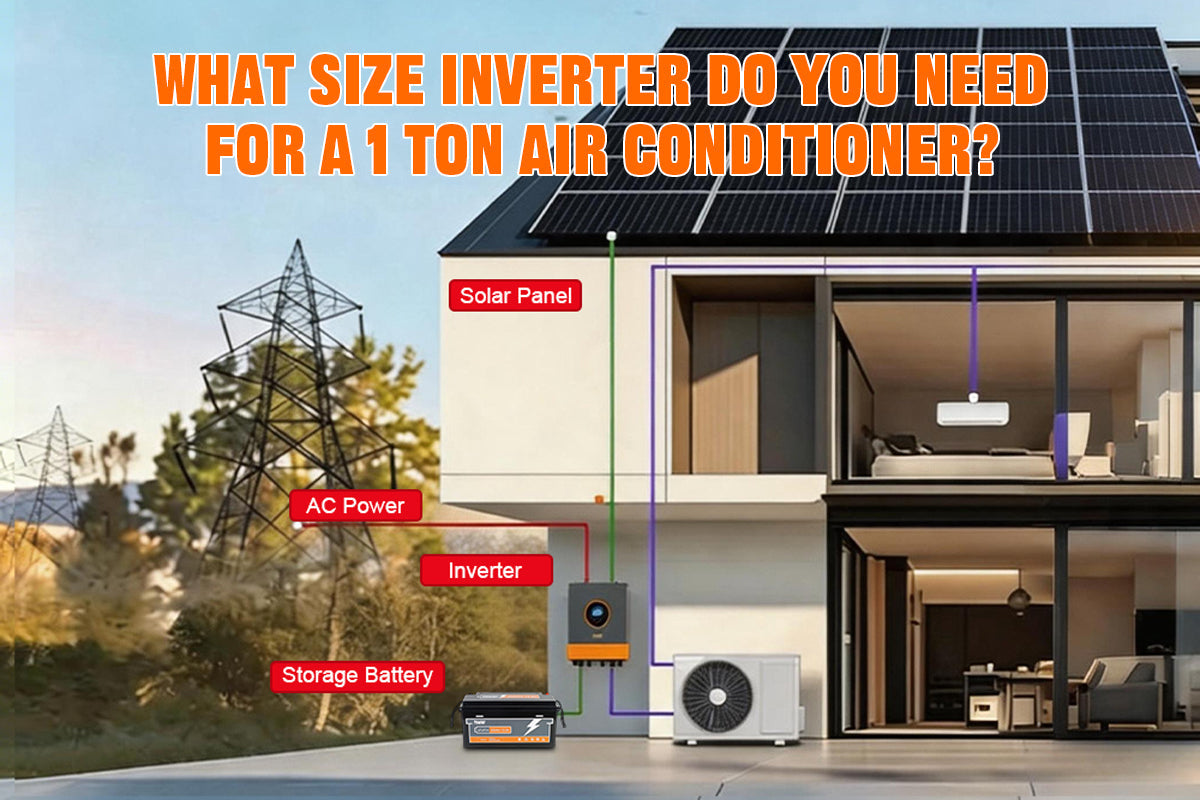
If you are planning to run a 1 Ton air conditioner on a solar inverter system, one of the most important questions is: what size inverter do you need for a 1 Ton AC?
In this guide, you’ll learn a simple step-by-step method to calculate the right inverter size for a 1 Ton air conditioner, including running watts, startup surge requirements, and solar system.
What Is the Power Consumption of a 1 Ton AC?
A "1 Ton" rating refers to cooling capacity (12,000 BTU/h), not the amount of electricity it consumes.According to ASHRAE standards and ENERGY STAR efficiency ratings, the power consumption of a modern 1 Ton unit is determined by its EER. A unit with a standard EER of 8.5 to 12.0 will typically draw between 1,000W and 1,410W.
Calculate Air Conditioner Running Watts with a Solar Inverter
A 1-Ton cooling air conditioner typically requires a solar inverter with a continuous output of 2,000–3,000 watts (2–3 kW) for stable operation. To handle the compressor startup current, the solar inverter should support a surge capacity of 4,000–6,000 watts. This is because the surge capacity of a solar inverter is typically 2–3 times its normal running load to safely handle heavy motor-driven appliance startup currents without overloading.
To find the exact air conditioner running watts of your unit, look for the EER (Energy Efficiency Ratio) on the manufacturer's label. The formula is:
Running Power (W) = Cooling Capacity (BTU/h) ÷ EER
For example, consider a 1 Ton air conditioner (12,000 BTU/h ≈ 3.5 kW cooling capacity).
If we assume an EER of 12 for a high-efficiency inverter AC, the air conditioner running power is:
12,000 BTU/h÷12≈1,000 W (1.0 kW)
For a non-inverter AC with a lower EER of 9, the air conditioner running power would be:
12,000 BTU/h÷9≈1,333 W (1.33 kW)
This illustrates how efficiency directly affects electricity consumption — higher EER means lower running watts for the same cooling output.
Pro Tip: Higher EER means lower running watts, which directly reduces the size (and cost) of the battery bank or solar array you'll need.
Inverter AC vs. Non-Inverter AC:
| Feature | Inverter AC (Variable Speed) | Non-Inverter AC (Fixed Speed) |
| Startup Behavior | Soft-start (low surge) | Hard-start (high surge) |
| Surge Requirement | ~1.5x - 2x Running Watts | ~3x - 5x Running Watts |
| Inverter Efficiency | Higher; saves battery life | Lower; heavy battery drain |
Daily Electricity Consumption of a 1 Ton AC
The daily electricity consumption of a 1 Ton air conditioner refers to how much energy the unit uses per day, measured in kilowatt-hours (kWh). This value is important for determining the correct solar inverter size, battery storage capacity, and solar panel system design.
Calculation Formula
Daily kWh = Running Power (kW) × Running Hours per Day
Typical Daily Consumption (8 hours of running)
| AC Type | Running Power | Daily kWh (8 hrs) |
|---|---|---|
| 1 Ton Non-Inverter AC | 1.2–1.5 kW | 9.6–12 kWh |
| 1 Ton Inverter AC | 0.8–1.2 kW | 6.4–9.6 kWh |
What Size Inverter is Best for a 1 Ton AC?
The best inverter size for a 1 Ton air conditioner depends mainly on two factors: the running power consumption and the startup surge power of the compressor.
The inverter should be sized to handle both the continuous running load and the temporary startup surge for stable operation.Here are the key recommendations:
By Air Conditioner Type:
- Non-inverter 1 ton AC (1,200–1,500 W running): needs a 3,000 W continuous / 5,000–6,000 W surge inverter due to high startup current
- Inverter 1 ton AC (800–1,200 W running): works with a 2,000–2,500 W continuous / 3,000–4,000 W surge inverter thanks to soft-start technology
By System Type:
- Solar power system: best choice is a 3–5 kW hybrid solar inverter with built-in solar charging and battery management
- Home backup (no solar): a 3 kW pure sine wave inverter with 5 kW surge is sufficient
- Important note: Always use a pure sine wave inverter — modified sine wave can damage the AC compressor or cause it to run inefficiently.
1 Ton Air Conditioner Size Comparison
| Air Conditioner Type | Running Power (Continuous) | Startup Power (Surge) | Recommended Inverter Size |
|---|---|---|---|
| Inverter AC | 800W – 1,200W | 1,500W – 2,500W | 2 kW – 3 kW |
| Non-Inverter AC | 1,200W – 1,500W | 2,500W – 4,500W | 3 kW – 5 kW |
| Recommended Safety Range | 2,000W – 3,000W inverter | 4,000W – 5,000W surge | 3 kW inverter (ideal) |
What Size Solar Panel Is Needed for a 1 Ton AC?
To run a 1 ton air conditioner on solar energy, you need two main components: a properly sized solar panel array and a compatible solar inverter. The size of each depends on your AC's daily energy consumption and your location's sun hours.
Step 1: Calculate daily energy requirement
The daily electricity consumption of a 1 Ton air conditioner is calculated using the following formula:
Daily Energy (kWh)=Running Power (kW)×Operating Hours per Day
- For example, if a 1 Ton AC runs for 8 hours per day:
- 1.0 kW × 8 hours = 8 kWh/day
Step 2: Size the solar panel array
The solar panel array size needed to run a 1 Ton air conditioner on a solar inverter system can be calculated using the following formula:
Solar panel array size (kW) = Daily Energy (kWh) ÷ Peak sun hours
- With 5 peak sun hours: 10 kWh ÷ 5 = 2 kW solar panel array
- Recommended array size for a 1 ton AC: 2.5 kW to 3.5 kW (to cover losses and cloudy days)
- This typically means 6 to 10 solar panels (350–400 W each)
Step 3: Choose the right solar inverter
The solar inverter must handle both the AC’s running load, battery charging, and any additional household loads connected to the system.
For a 1 Ton air conditioner, a 3 kW to 5 kW hybrid solar inverter is typically recommended. However, the final inverter size should be based on the total simultaneous load.
A hybrid solar inverter allows you to:
- Run the AC directly from solar power
- Charge batteries when excess solar energy is available
- Switch automatically between solar, battery, and grid power when needed
- Support other household appliances running at the same time