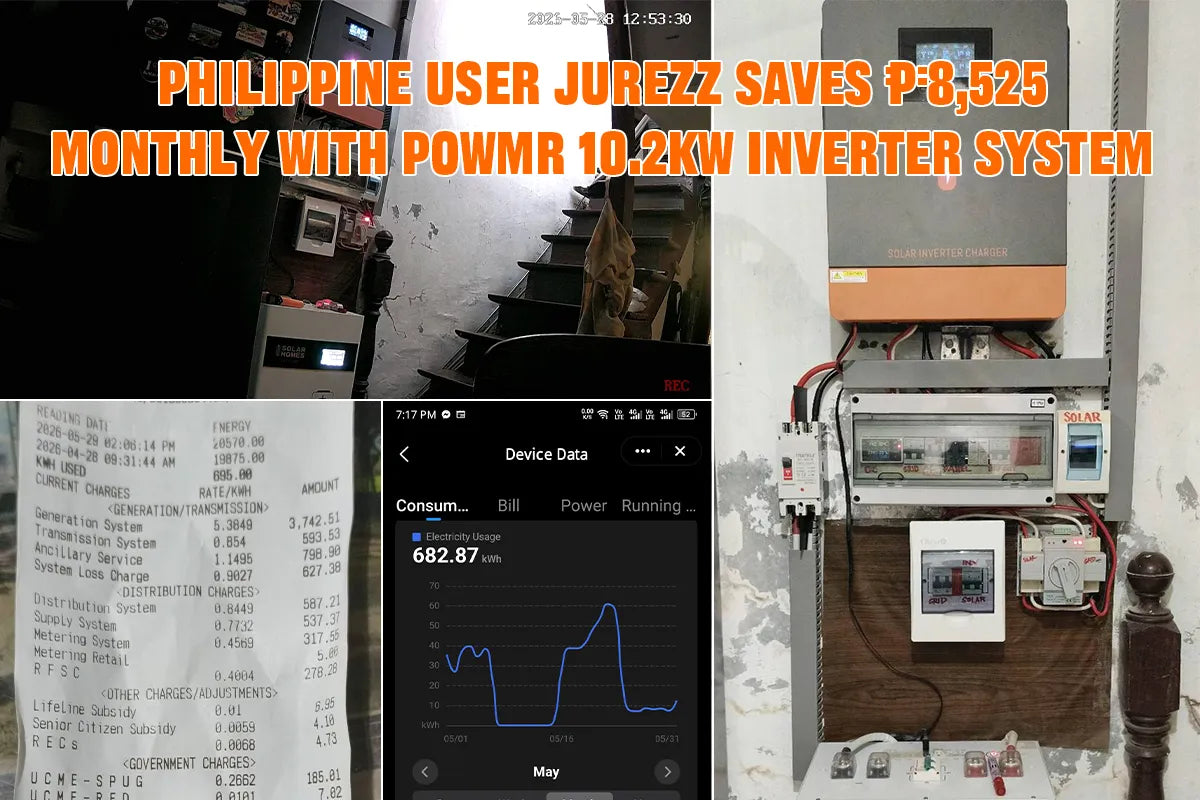
How much load can a PowMr 10.2kW inverter actually handle?” A Filipino user, Jurezz, shared real-world proof through his electricity bill.
In May 2026, his 10.2kW inverter system generated 682 kWh of solar energy, saving ₱8,525, while his grid electricity cost was ₱8,687.50—bringing his total electricity cost nearly in half.
Even with one week away from home and daily consumption dropping from around 50 kWh to 8 kWh, the system delivered stable, uninterrupted performance throughout the month, proving the real-world capability of the 10.2kW inverter under heavy residential loads.
What Jurezz's 10.2kW Inverter Actually Powers
Jurezz's POWMr 10.2kW system was simultaneously running a 2.5HP Boston Bay non-inverter air conditioner—a high-surge load notorious for stressing smaller inverters—alongside a 0.5HP unit, 10 desktop computers, a dedicated server PC, a refrigerator, an induction cooker, multiple lighting circuits, and full WiFi and hub router infrastructure.
Jurezz's Electricity Bill Breakdown
Jurezz's electricity bill shows that in May 2026, he purchased 695 kWh from the grid, costing ₱8,687.50 at Soleco's rate of ₱12.50/kWh. The 682 kWh of solar generation came from his own inverter monitoring app.
The Philippine electricity tariff structure is complex. The bill includes multiple charges: Generation System (₱3,742.51), Distribution System (₱587.21), Transmission System (₱593.53), Ancillary Service (₱798.90), System Loss Charge (₱627.38), and 12% Value Added Tax, among others.
Solar power can only offset the "generation cost" portion, while distribution, transmission, government surcharges, and other fixed fees remain unavoidable — this is the underlying reason why the total bill still reached ₱8,713.76. Jurezz's ₱8,525 in solar savings essentially covered nearly all of the Generation + VAT portion, but the fixed charges could not be eliminated.
PowMr 10.2kW Hybrid Inverter: How It Works
Daytime Mode (Solar Abundant): In the early morning, the PV array starts generating power. The POWMr 10.2kW hybrid inverter's dual-channel MPPT controller tracks the maximum power point at 99.9% efficiency. Electricity is prioritized for household loads—air conditioners, computers, servers, and refrigerators running simultaneously. If generation exceeds load demand, excess power is stored in the battery through the inverter's built-in charger. If the battery is full, surplus power can be sold back to the grid (with Net Metering) or remain idle.
Evening Transition (Solar Fading): As the sun sets and PV output declines, the inverter automatically detects battery SOC (State of Charge). When solar can no longer cover the load, the battery seamlessly takes over with zero-perception switching at the load end. Jurezz's mention of "uninterrupted power" comes from this—the transfer time between grid and battery is typically under 20ms, so computers and servers don't reboot, and air conditioners don't shut down.
Nighttime Mode (Battery + Grid): During peak evening loads, the battery continues discharging. If battery SOC drops to the set threshold (e.g., 20%), the inverter automatically activates grid bypass, powering loads from the mains while simultaneously charging the battery (if set to hybrid mode). Jurezz's bill showing 695 kWh of grid purchases reflects this nighttime supplementation after battery depletion.
Rainy/Cloudy Mode: When sunlight is insufficient, PV output drops sharply. If the battery has adequate reserves, the system maintains off-grid operation; if not, the grid steps in instantly. Jurezz's system remained stable during his one-week absence in May with only 8 kWh daily consumption, demonstrating that the battery can sustain low loads for multiple days.
What Type of Home Is a 10.2kW Inverter Suitable For?
Jurezz's experience shows that a 10.2kW hybrid inverter is well-suited for medium to large households with higher energy demands. Compared with common 3kW, 5kW, or 6kW systems, a 10.2kW inverter can power more appliances simultaneously while handling high-surge loads such as air conditioners, induction cookers, and water pumps more comfortably.
Typical applications include:
- Large homes with 4–8 family members
- Households running multiple air conditioners
- Home offices or small businesses
- Homes with servers, security systems, or other 24/7 equipment
- Users seeking backup power during grid outages
- Households consuming 20–40 kWh or more per day