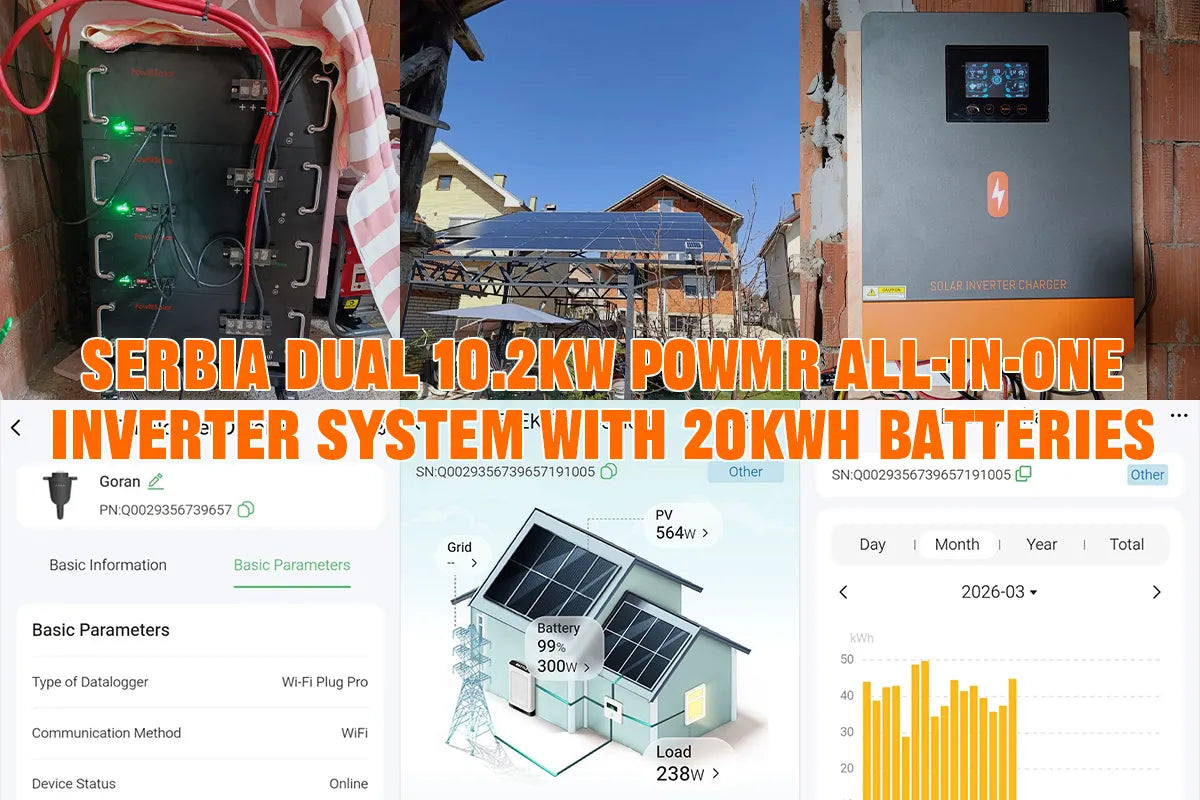
“For two years, the 6.2kW inverter worked flawlessly.”
That was the inverter usage shared by a PowMr customer in Serbia before upgrading to dual 10.2kW all-in-one inverters. Facing increasing electricity demand from both his home and a family-operated hair salon, he expanded his solar system with additional battery storage and inverter capacity. Today, the entire property runs primarily on solar energy.
Before the upgrade: 6.2kW all In one inverter configuration
Before the upgrade, the Serbian customer had been using a single 6.2kW PowMr all in one inverter, paired with a total of 20kW of lithium batteries (4 units × 5kW), which had been running stably for two years. At the time, this system was able to meet part of his household's electricity needs, and the overload protection function had always been responsive and trouble-free.
The original system was built around a PowMr 6.2kW all in one inverter (SKU: POW-HVM6.2K-48V-E), a 48V all in one single-phase inverter charger designed for residential and light commercial applications. It features a rated output power of 6200W, a 120A built-in MPPT solar controller with a PV input range of 60–500VDC, and supports both on-grid and off-grid operation.
The unit operates with multiple working modes, including Solar First, Utility First, and SBU (Solar-Battery-Utility), and provides automatic UPS-level switching (~10ms) to ensure stable power supply during grid interruptions.
Upgrade Process: From 6.2kW System to Dual Independent 10.2kW Systems
The user did not simply remove the original 6.2kW inverter and replace it with a larger unit. Instead, he adopted a distributed power architecture by operating multiple independent systems across the property.
The original 6.2kW PowMr all-in-one inverter system continued to operate as a standalone unit. In addition, two separate 10.2kW PowMr all-in-one inverter systems were installed independently to handle higher energy demand across different areas of the property. Rather than being connected in parallel, all systems operate independently and supply different electrical zones within the installation.
System Expansion Overview
The upgrade was carried out through a phased installation approach:
Step 1: Maintain the original 6.2kW system
The existing 6.2kW inverter continued to supply part of the household load, maintaining stable operation without interruption.
Step 2: Install a separate 10.2kW inverter system
A 10.2kW PowMr all-in-one inverter system was first introduced as an independent power unit to handle increased energy demand. As the system continued to expand, a second 10.2kW inverter system was later added, further increasing total available capacity and allowing better load distribution across the property.
Step 3: Allocate energy storage to the upgraded system
A 20kWh lithium battery bank (4 × 5kWh units) was connected to one of the systems to ensure stable energy supply for core loads.
Step 4: Implement load zoning strategy
The household and the family-operated hair salon were supplied by separate inverter systems, preventing overload during peak usage periods and improving overall system stability.
Step 5: Reserve flexibility for future expansion
The second system is designed with additional expansion potential, including the possibility of adding more PowMr batteries in the future.
6.2kW vs 10.2kW All-In-One Inverter Configuration
To better understand why the customer decided to expand his system, the table below compares the capabilities of the original 6.2kW setup and the upgraded 10.2kW inverter configuration.
| Specification |

PowMr 6.2kW All-In-One Inverter
|

PowMr 10.2kW All-In-One Inverter
|
|---|---|---|
| Rated Output Power | 6200W | 10200W |
| Battery Voltage | 48VDC | 48VDC |
| AC Output Voltage | 220VAC | 220VAC |
| Max PV Input Power | 8000W | Higher solar input capacity |
| Parallel Capability | Up to 9 units (model dependent) | Parallel expandable |
| Typical Application | Residential backup | Whole-home + commercial loads |
| Real Usage Scenario | Household only | Home + hair salon |
Customer Video Feedback
Serbian customer Goran recorded a video sharing his experience using PowMr inverters. Faced with extremely high household electricity demand, Goran adopted a solution of two independently operating PowMr 10.2 kW inverters, each connected to different household circuits.
During real-world load testing, the 10.2kw solar inverter system demonstrated outstanding stability—even under extreme conditions where multiple high-power appliances were running simultaneously, including four air conditioners, two water heaters, an electric stove, a washing machine, and several televisions, with a total load reaching 6–8 kW. The system continued to supply power seamlessly through solar energy and battery storage.
Goran stated that this highly efficient solar solution has completely eliminated his electricity bills and achieved true energy independence.