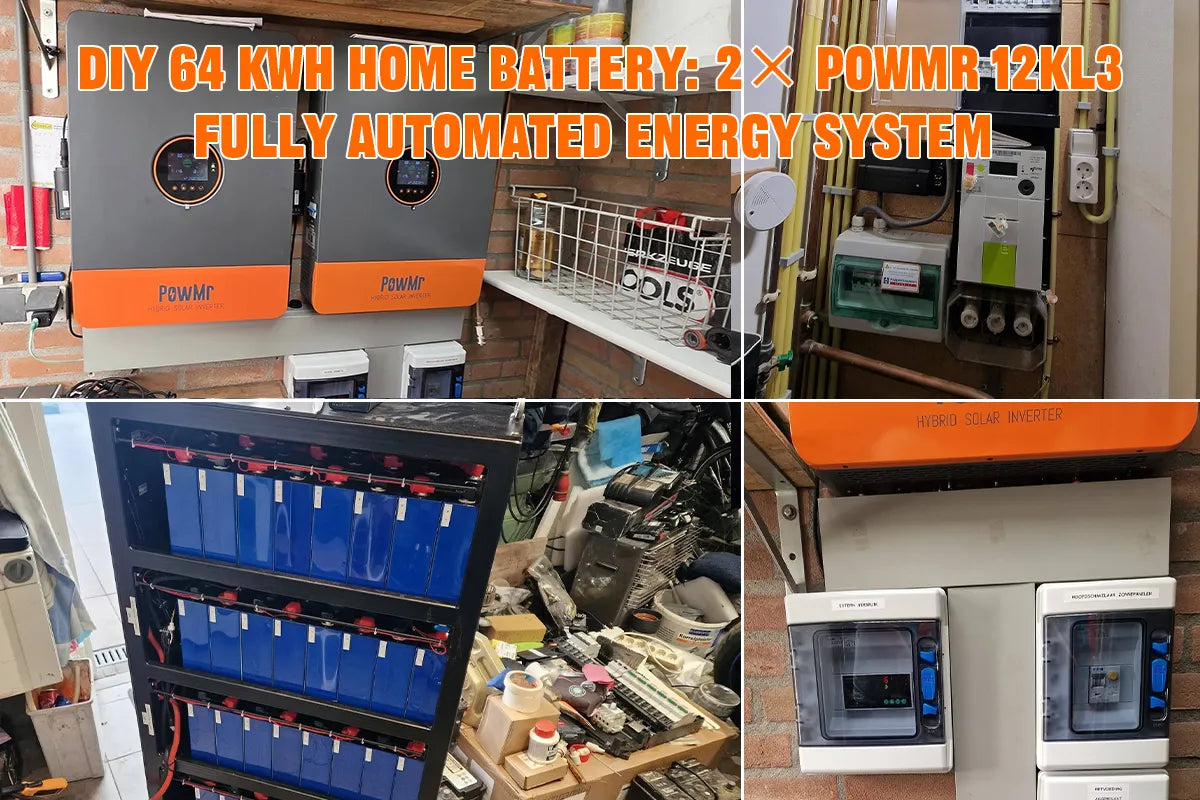
From the Netherlands, Artur van den Biggelaar built a fully automated home energy system around two PowMr 12 kW three-phase off-grid all-in-one solar inverters, 4,500 Wp of solar panels, and a DIY 64 kWh (8 × 4PCS 320Ah 3.2V LiFePO4 Prismatic Battery Cells) off-grid storage setup—all monitored and controlled by Home Assistant.
The system runs without manual intervention, continuously optimizing when to charge from the grid based on energy prices, while coordinating solar generation and battery storage to keep the home powered efficiently around the clock.
DIY 64 kWh LiFePO₄ Home Battery Pack
At the heart of this 64 kWh off-grid energy storage system is a fully DIY LiFePO4 home battery that Artur designed and built himself. He fabricated the entire frame from scratch, using Trespa for the cabinet panels and shelves to deliver strong mechanical strength and better fire resistance than standard wood-based materials.
The battery is made from 32 × 320Ah 3.2V LiFePO4 prismatic battery cells, split into two independent 16S packs at about 48V each—the same 320Ah cells referenced as 8 × 4PCS in the system overview.
Separating the DIY lithium battery pack into dual packs makes the home energy storage setup easier to manage, maintain, and protect. Each pack has its own JK BMS with temperature monitoring, can be switched on and off independently, and is protected by a dedicated 150A fuse. The packs are linked with 50mm² copper cables to keep voltage drop low and safely handle high current.
For a practical build reference, this DIY LiFePO4 home battery approach can also be followed through PowMr’s YouTube videos on prismatic cell assembly and off-grid energy storage setups.
How Home Assistant Automates the Dual PowMr Inverters
Both PowMr inverters stream live operating data into Home Assistant through their Wi-Fi communication interfaces, creating a single monitoring hub for the whole off-grid home energy system.
Home Assistant continuously tracks solar PV output, battery voltage and state of charge (SOC), grid input, household load power, and the working mode of each inverter, while also pulling in local energy price data to guide automation.

The control logic follows a peak-shaving and valley-filling principle: during low-price valley periods, the system prioritizes grid charging for the DIY battery storage; during high-price peak periods—or when solar generation is strong—it reduces grid import and favors solar power plus battery discharge to supply the home.
With both inverters following the same Home Assistant rules, the setup compares thresholds, triggers charge/discharge changes, and keeps checking device status—so the dual-inverter system runs automatically without manual intervention.
1.5 Years On: Still Running Strong
This PowMr off-grid home energy system has now been running for about 1.5 years. It has not been entirely without fine-tuning, yet the two three-phase all-in-one solar inverters, DIY LiFePO4 battery, and related components remain in strong condition.
That track record shows Home Assistant automation and energy storage hardware can work together reliably over the long term. For Artur, it is more than a successful DIY project: it is a home energy setup built to keep running.