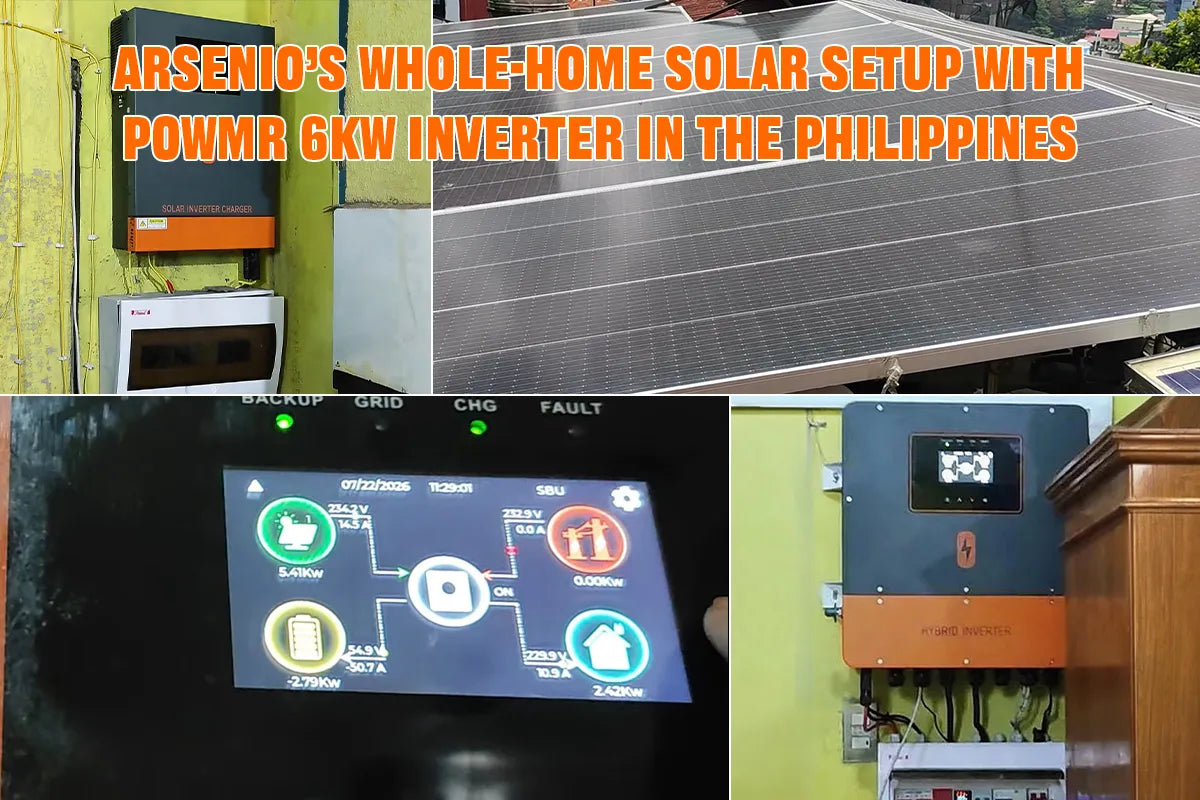
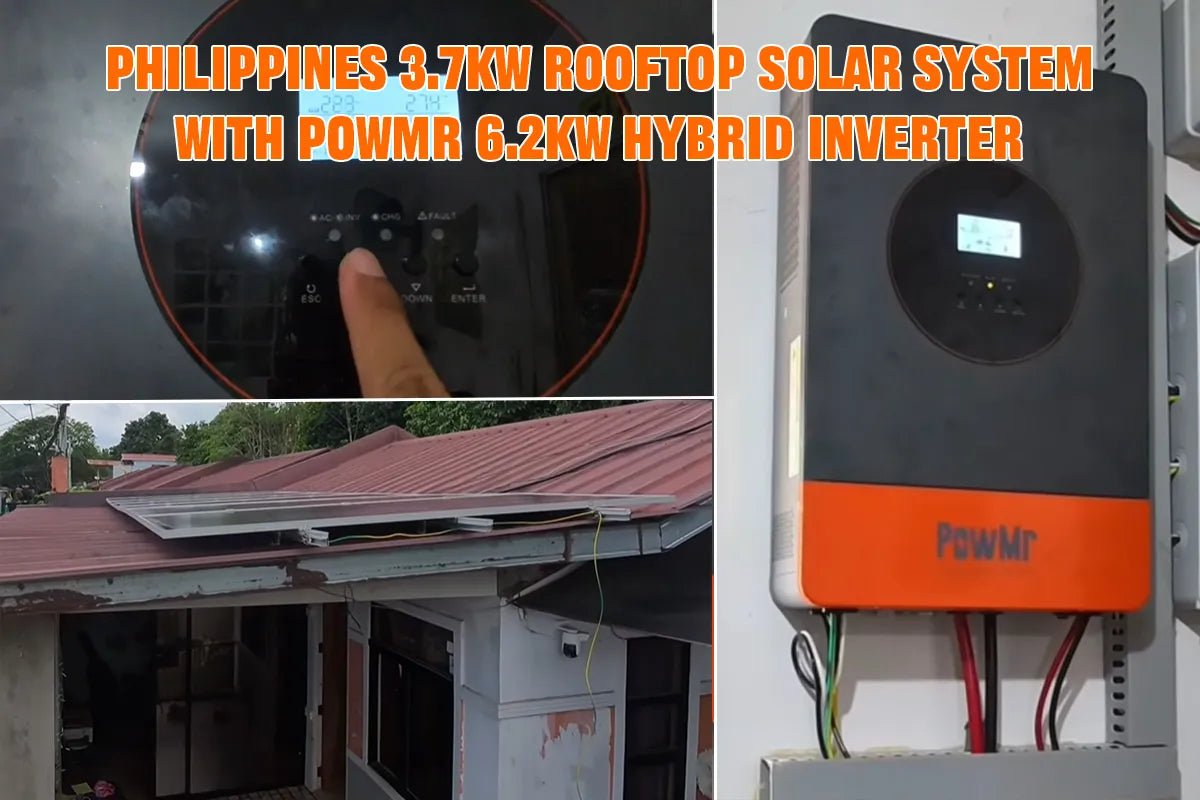
Kevin from the Philippines used a PowMr 6.2kW hybrid inverter with a 3.7kW rooftop solar array to build one of the most practical diy solar systems for homes—keeping daily household loads running while cutting his family’s reliance on the grid.
His 3.7kW rooftop solar array uses six 620W panels, paired with a PowMr 6.2kW hybrid inverter and a 48V 11.5kWh LiFePO4 battery bank. Running in SBU mode—solar first, then battery, utility as backup—it powers everyday loads like lights, fridge, and washers, and can even keep a 1HP inverter air conditioner running overnight on stored solar energy.
How SBU Mode Works From Morning to Night?
Kevin set his PowMr 6.2kW hybrid inverter to SBU mode (Solar → Battery → Utility): solar first, then battery, and the grid last. Across a normal day, it works like this:
Morning (when the sun comes up): As soon as his 3.7kW solar array roof (six 620W panels) starts producing, the inverter does two jobs at once—powering household loads and charging the 48V LiFePO4 battery with any surplus. Lights, router, fridge, and other early loads run mainly on solar, and this is when the daytime charging window begins.
Midday (peak solar production):This is the main battery-charging period. When sunlight is strong, the inverter can push charging current higher—around 50A in Kevin’s case, or roughly 2.4kW going into the battery (48V × 50A). That means the battery can recover quickly in just a few hours, while the system also covers higher daytime loads like laundry. Kevin also shifts energy-heavy tasks to midday so more solar is used directly.
Evening and night (after sunset): Solar charging largely stops, and the home runs on battery power. Nighttime loads are usually about 500–800W, including a 1HP inverter air conditioner running overnight on stored energy. When battery voltage drops to the back-to-grid threshold Kevin set on the inverter, the system automatically switches to utility backup—so the grid is only a safety net, not the main supply.
Nighttime Battery Use Calculation
For diy solar systems for homes, overnight runtime depends on your solar battery bank—and it’s easy to estimate:
Battery Runtime (hours) ≈ usable battery capacity (kWh) ÷ average nighttime load (kW)
Kevin’s battery storage is about 11.5kWh of 48V LiFePO4 battery. At roughly 90% usable capacity, that leaves around 10.3kWh for night use.
His typical nighttime load is about 500–800W (0.5–0.8kW), with a 1HP inverter air conditioner as the biggest draw. With the AC running, his PowMr 6.2kW hybrid inverter usually pulls about 12–19A from the battery. The power check matches:
Power (W) ≈ battery voltage × discharge current
48V × 12A ≈ 576W
48V × 19A ≈ 912W
Using the runtime formula:
- At 0.5kW 10.3 ÷ 0.5 ≈ 20.6 hours
- At 0.7kW:10.3 ÷ 0.7 ≈ 14.7 hours
- At 0.8kW 10.3 ÷ 0.8 ≈ 12.9 hours
So with a solid daytime charge from his 3.7kW rooftop solar array, this setup can usually cover a full night of basic household loads plus AC. If the battery isn’t fully charged—or the AC runs harder—runtime drops. When voltage reaches the back-to-grid threshold set on the inverter, the system switches to utility backup automatically, so the home stays powered.
Battery Charging Time Calculation
In Kevin’s diy solar systems for homes setup, battery charging time depends on how much solar power his inverter can send into the solar battery bank—and it’s easy to estimate:
Battery Charging Time (hours) ≈ battery capacity to recharge (kWh) ÷ charging power (kW)
When sunlight is strong, Kevin’s PowMr 6.2kW hybrid inverter can charge his 48V LiFePO4 solar battery bank at about 50A. Charging power is:
Charging Power (kW) ≈ battery voltage × charging current ÷ 1000
48V × 50A ÷ 1000 = 2.4kW
His battery is about 11.5kWh. From near empty to full (before losses):
11.5 ÷ 2.4 ≈ 4.8 hours
Using about 90% usable capacity (around 10.3kWh):
10.3 ÷ 2.4 ≈ 4.3 hours
In real use it is often faster, because the battery is rarely fully drained overnight and still has leftover charge in the morning. At midday, his 3.7kW rooftop solar array powers home loads first, then sends surplus energy into the solar battery—so on sunny days the bank can recover in just a few hours. On cloudy days, or when household demand is high, less power goes to charging and battery charging time gets longer.