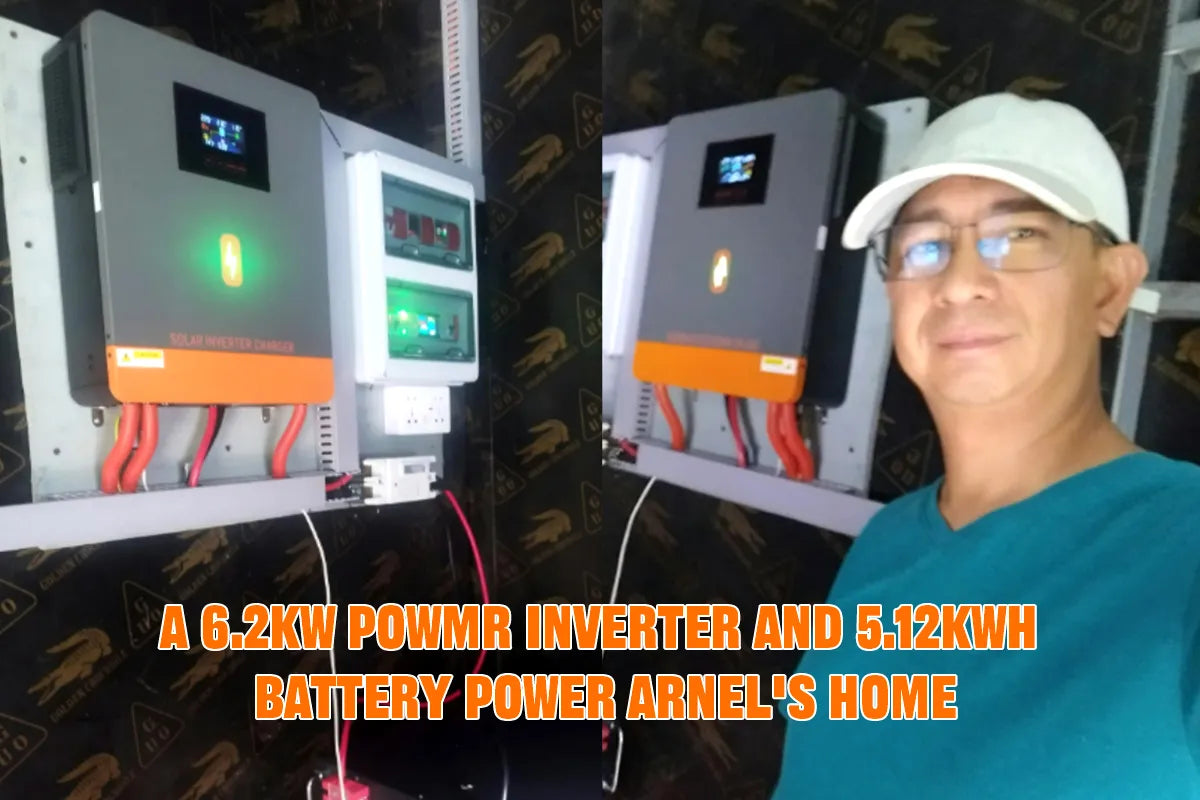
In the Philippines, Arnel runs his house on a PowMr 6.2kW solar inverter (SKU: POW-HVM6.2K-48V-E ) solar inverter paired with a 51.2V stackable powerwall lithium battery (SKU: POW-LIO48100-3U)— a same-brand 48V home energy storage system.
It covers his daily loads by day and keeps essentials running after sunset, with matched communication, compatible charging profiles, and one-stop support. A practical reference for anyone researching a Philippines home solar case study, off-grid solar inverter and battery kit, or lifepo4 batteries for solar energy storage.
Stackable Batteries: Flexible Energy Storage
Arnel currently uses 1 PowMr 5.12kWh 100Ah LiFePO4 lithium battery, which already covers daily electricity use and nighttime critical loads. This battery adopts a stackable / cabinet-style design. Its real advantage is that when electricity demand increases later, there is no need to tear down and rebuild the whole system—you only need to add batteries in parallel.
Batteries in the same series support parallel expansion (keeping the 51.2V system voltage unchanged, while capacity is added). For example:
- 1 unit ≈ 5.12kWh (current configuration)
- 2 units ≈ 10.24kWh
- 4 units ≈ 20.48kWh
- With up to about 16 units in parallel, total energy storage can reach about 81.92kWh
For household users, this means they can start with a compact 6.2kW inverter + 5.12kWh battery. When they need longer nighttime power supply, more loads, or longer outage coverage, they can simply stack more batteries.
When expanding capacity, note that: the positive and negative cable gauges and lengths should be kept as consistent as possible, the communication cables must be connected correctly, and non-duplicated master/slave addresses must be set.
Also remember—the more batteries you stack, the longer the runtime mainly becomes, while the system output power is still limited by the 6.2kW inverter.
Therefore, the flexibility of this PowMr home energy storage system lies in this: enough for today, expandable for tomorrow. Stackable lithium batteries allow Philippine household solar systems to be deployed quickly, and also grow with rising electricity demand.
How to Connect Stackable Batteries (Parallel Expansion)
These 51.2V 100Ah LiFePO4 packs are designed for parallel expansion only—series connection is prohibited. That keeps the system voltage at 51.2V while capacity increases with each added pack.
Power cable connection
Connect the battery positive (+) and negative (−) terminals to the inverter DC input with the supplied power cables. When two or more packs are paralleled, keep the positive and negative power cables the same gauge and the same length so current is shared evenly. Do not connect the battery directly to AC power or to PV wiring.
Communication cable connection
Use the RJ45 parallel communication cable between packs (RS485A/RS485B ports) so the BMS units can talk to each other. Use a separate PCS/inverter communication cable from the master pack’s RS485A/CAN port to the inverter—choose RS485 or CAN according to the inverter’s protocol. Typical setups in the manual include:
- 1 pack + 1 inverter: single-pack mode
- 2 packs + 1 inverter: one pack as master, one as slave
- 3 or more packs + 1 inverter: one pack as master, the rest as slaves
- N packs + multi-inverter / 3-phase: follow the same master/slave logic; inverter paralleling follows the inverter manual
Master / slave address setting
Before powering on, set a unique address on each pack with the DIP switch so addresses do not repeat. The manual’s address map is:
| Role | Address | DIP #1 | DIP #2 | DIP #3 | DIP #4 |
|---|---|---|---|---|---|
| Master | 1 | ON | OFF | OFF | OFF |
| Slave1 | 2 | OFF | ON | OFF | OFF |
| Slave2 | 3 | ON | ON | OFF | OFF |
| Slave3 | 4 | OFF | OFF | ON | OFF |
| Slave4 | 5 | ON | OFF | ON | OFF |
| Slave5 | 6 | OFF | ON | ON | OFF |
| Slave6 | 7 | ON | ON | ON | OFF |
| Slave7 | 8 | OFF | OFF | OFF | ON |
| Slave8 | 9 | ON | OFF | OFF | ON |
| Slave9 | 10 | OFF | ON | OFF | ON |
| Slave10 | 11 | ON | ON | OFF | ON |
| Slave11 | 12 | OFF | OFF | ON | ON |
| Slave12 | 13 | ON | OFF | ON | ON |
| Slave13 | 14 | OFF | ON | ON | ON |
| Slave14 | 15 | ON | ON | ON | ON |
Startup sequence
Before wiring, cut off grid power and make sure each battery is OFF. After power and communication cables are correctly connected and addresses are set, turn the packs ON. The Battery Management System runs a short self-test, then enables output. Adding more packs mainly extends runtime; continuous output power is still limited by the inverter (for example, 6.2kW).
How to Match Expanded Batteries with the Inverter
Expanding a system is not just about adding more batteries—the key is whether the batteries and the inverter are properly matched. Arnel currently uses a PowMr 6.2kW inverter (SKU: POW-HVM6.2K-48V-E) with a 51.2V stackable lithium battery (SKU: POW-LIO48100-3UL). Both belong to the same 48V home energy storage system: the battery’s nominal voltage is 51.2V, matching the inverter’s 48V battery side, so charging, discharging, and communication can work together stably.
When matching them, focus on four points:
1. Keep the same voltage platform
Stay on the 48V/51.2V system. Do not mix batteries of different voltage platforms into the same system. Batteries in the same series can be expanded in parallel; series connection for higher voltage is prohibited.
2. Match the communication protocol
After the battery master/slave communication is connected correctly, link the master pack to the inverter via RS485 or CAN. Choose the interface according to the protocol supported by the inverter, so SOC, charge/discharge status, and protection data can sync properly.
3. Respect current and power limits
For a single pack, the recommended charge/discharge current is about 50A, with a maximum of about 90A. Parallel batteries increase capacity and available current, but continuous household output power is still limited by the 6.2kW inverter. In other words, adding batteries mainly extends nighttime runtime and outage backup—it does not raise the inverter’s power rating.
4. Add capacity based on demand
One pack is about 5.12kWh; two packs about 10.24kWh; four packs about 20.48kWh. If nighttime loads grow or outages last longer, add batteries first according to energy needs. If more high-power appliances must run at the same time later, then consider whether the inverter power also needs to be upgraded.
Therefore, the right way to expand this PowMr system is: parallel same-voltage, same-series batteries + correct communication and address settings + a clear understanding of the inverter’s power limit. Batteries determine how long you can store energy; the inverter determines how much power you can output. When that match is clear, expansion is both safer and more effective.