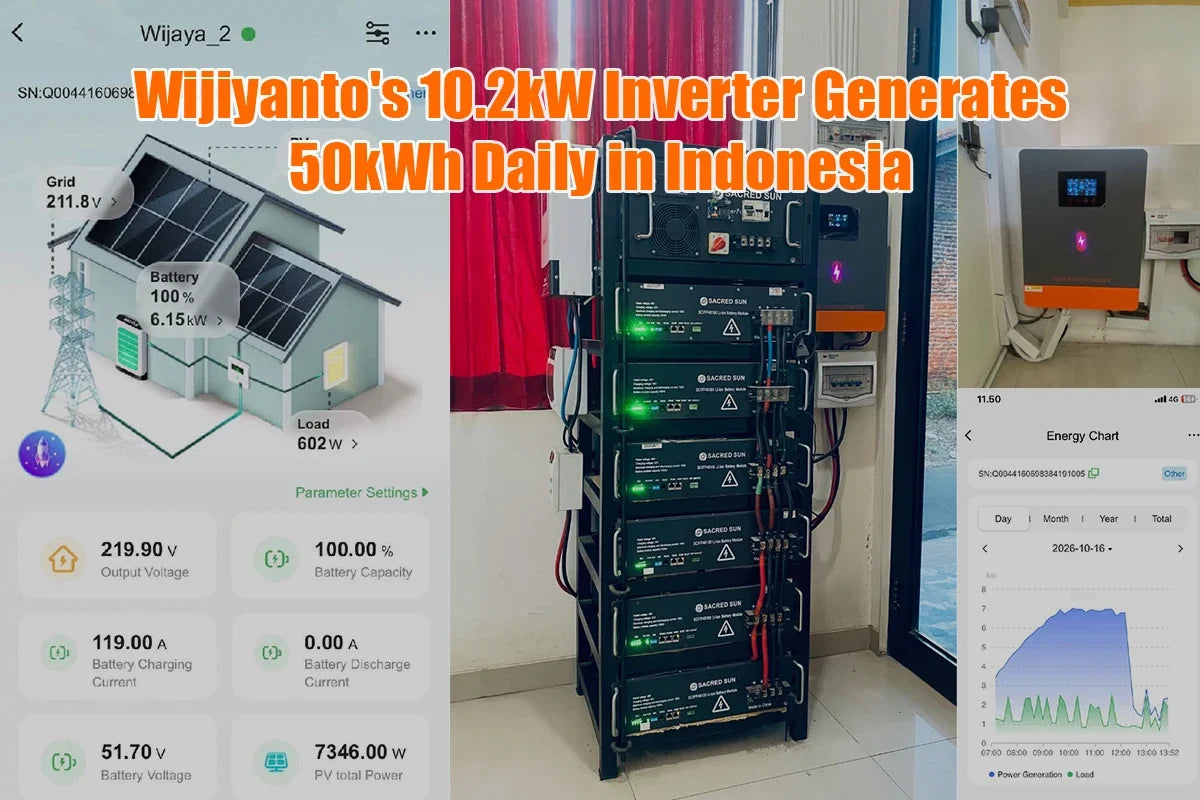
Indonesian solar user Wijiyanto shares his PowMr solar power system setup:the PowMr 10.2 kW high frequency power inverter , paired with a 48V solar battery system. During the day, his home solar energy system in Indonesia reaches a peak solar panel output of 7.215 kW, with daily solar production of up to 40–50 kWh.
Solar Panel Output Calculation
This solar panel output calculation shows how Wijiyanto’s system reached a peak solar output of 7.215 kW. He installed 18 solar panels on a PowMr 10.2 kW high frequency inverter with a 48V lithium battery system, and the total solar array capacity is calculated as:
(9 × 550 Wp) + (9 × 575 Wp) = 10,125 Wp
Under the strong midday sun in Semarang, Indonesia, the array delivered about 70% of its rated capacity, based on this solar panel output calculation:
7,215 W ÷ 10,125 Wp × 100% ≈ 71%
(or, using the user’s rounded figures: 7,125 / 10,125 × 100% = 70%)
In other words, a 10,125 Wp solar power system produced around 7.2 kW at peak—an efficient real-world result for a residential solar setup in a hot tropical climate. With stable high-power PV conversion from the PowMr inverter and efficient charging before the batteries entered the floating stage, the system maintained strong daytime solar generation.
Battery Charging Time Calculation for a 48V Battery
Wijiyanto’s PowMr 10.2 kW solar inverter works with a 48V battery system, and daytime peak solar power can reach about 7.215 kW—ideal conditions for fast battery charging. If you want to know how long to charge a 48V battery, use this battery charging time calculation:
Charging Time (hours) ≈ Battery Capacity (kWh) ÷ Charging Power (kW)
Based on roughly 7.2 kW peak input and about 10% conversion loss, effective battery charging power is around 6.5 kW. Here is a practical 48V Lithium battery charging formula example:
- 48V 100Ah Lithium battery(≈ 4.8 kWh): 4.8 ÷ 6.5 ≈ 0.7–0.8 hours
- 48V 200Ah Lithium battery(≈ 9.6 kWh): 9.6 ÷ 6.5 ≈ 1.5 hours
- 48V 300Ah Lithium battery(≈ 14.4 kWh): 14.4 ÷ 6.5 ≈ 2.2 hours
This how to calculate battery charging time method also explains why his batteries quickly enter the floating charge stage. In strong Indonesian sunlight, the 10.2 kW inverter delivers high-power solar battery charging.
The 48V solar battery system can reach full charge faster. Actual solar battery charging time still depends on starting SOC, MPPT current limits, temperature, and household load.
50kWh Energy Storage for Home Appliances and Daily Use
To put Wijiyanto’s daily generation of 50 kWh into perspective, 50 kWh is a massive amount of electrical energy for a residential setup. But exactly how big is a 50 kWh energy capacity, and how long can it keep your appliances running? We can quantify this using the standard energy runtime calculation:
Run Time (Hours) = [Total Energy Capacity (kWh) × DoD × Inverter Efficiency] ÷ Load Power (kW)
Assuming a 90% Depth of Discharge (DoD) for standard LiFePO4 batteries and a 92% inverter conversion efficiency, a 50 kWh system provides roughly 41.4 kWh of usable power. To understand just how large 50 kWh is in practical everyday terms:
- Whole-Home Grid Outage (Standard House, ~1.2 kW continuous average load):
A typical 3–4 bedroom home running lights, Wi-Fi, refrigerator, fans, TV, and occasional kitchen appliances:
41.4 kWh ÷ 1.2 kW ≈ 34.5 Hours (Nearly 1.5 days of completely autonomous off-grid living) - Heavy Cooling Loads (Two 1.5 HP Inverter Air Conditioners, ~1.8 kW combined):
Running continuous overnight cooling in hot tropical climates:
41.4 kWh ÷ 1.8 kW ≈ 23 Hours of non-stop air conditioning - EV Charging: A 50 kWh capacity is equivalent to fully charging a standard electric vehicle (like an MG4 or BYD Dolphin), giving around 300–350 km of driving range.
- High-Power Water Pump (2 HP / 1.5 kW Submersible Deep Well Pump):
Essential for agricultural irrigation or residential water supplies:
41.4 kWh ÷ 1.5 kW ≈ 27.6 Hours of continuous pumping
Generating or storing 50 kWh per day isn’t just enough to cover a household's basic lighting and refrigeration—it provides total energy freedom to run multiple air conditioners, water pumps, and heavy home appliances day and night without relying on the utility grid.