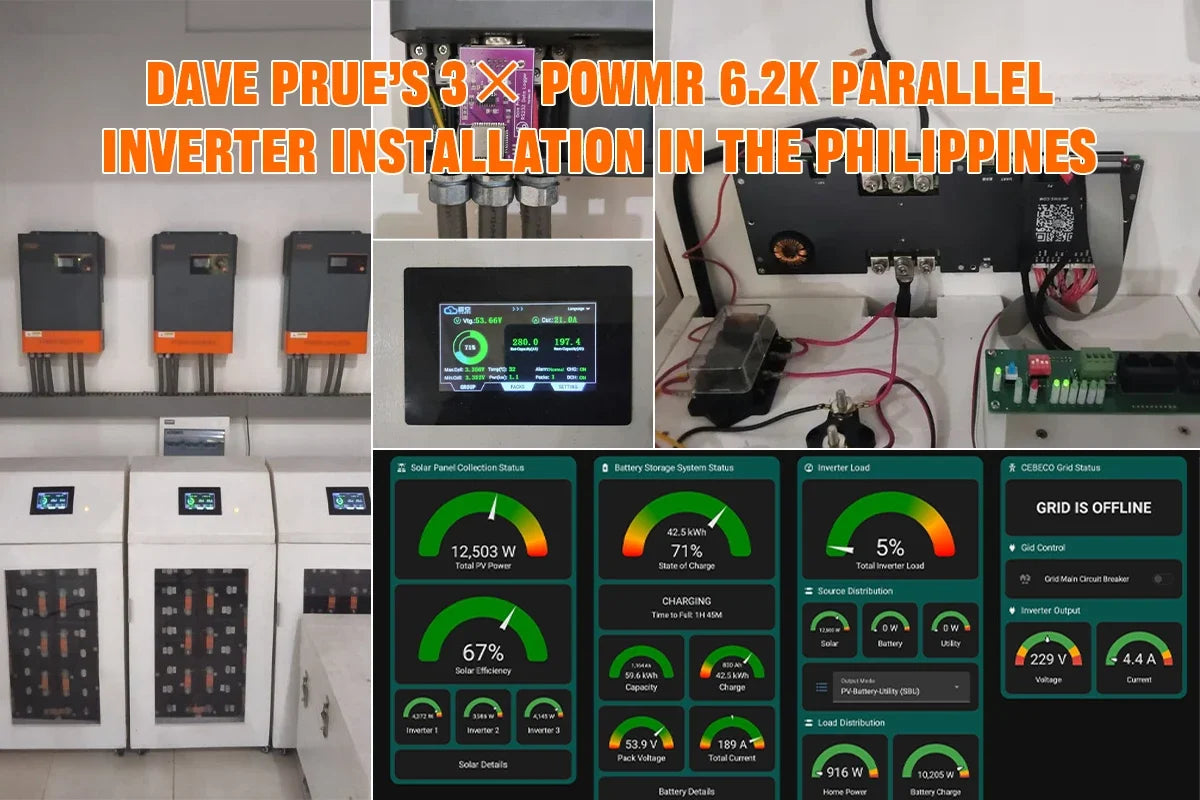
Philippine customer Dave Prue built a fully independent home microgrid with 3× PowMr 6.2kW hybrid inverters (SKU:POW-HVM6.2K-LIP) in parallel, paired with about 22.3 kW solar panel system and a 70 kWh LiFePO4 battery bank.
The solar system delivers roughly 18.6 kW of continuous output, enough to run multiple air conditioners and heavy household loads—and it keeps power on during blackouts and typhoons.
In this PowMr Dave's 6.2kW parallel inverter installation case study, we break down how he moved from hardware selection to smart load management, step by step toward a zero power bill and true off-grid energy independence.
How to Parallel PowMr 6.2kW Solar Inverters
In Dave’s Philippine home microgrid,three PowMr 6.2kW hybrid inverters are installed in single-phase parallel mode (PAL). The goal is simple: make multiple inverters work as one unified power source, delivering clean 230VAC single-phase output for the whole house—not three separate systems fighting each other.
1) Share one battery bank first
For a stable parallel inverter system, all units must connect to the same LiFePO4 battery bank. Keep battery cable lengths as equal as possible, then combine them through a busbar before reaching the battery terminals. This reduces voltage difference between units and helps prevent parallel faults. Install proper DC breakers on the battery side for each inverter (or one correctly sized breaker for the full parallel bank).
2) Parallel the AC input and AC output
Next, combine the AC input and AC output of each PowMr 6.2kW on a common bus: Line to Line, Neutral to Neutral, and a solid ground connection. Use cable sizes and torque values recommended for the 6.2kW model, and protect the AC side with appropriately rated breakers. For a 3-unit parallel installation, AC protection should be sized for the combined current of the system. Polarity matters: reversed L/N wiring can create a dangerous short when inverters operate in parallel.
3) Connect the parallel communication cable
Power wiring alone is not enough. Use the official parallel communication cable to link the three PowMr HVM6.2KW units so they can synchronize waveform, share load, and coordinate as master/slave. Weak or loose communication is a common cause of CAN communication loss or synchronization errors in parallel hybrid inverter setups.
4) Connect the Battery BMS to only one inverter
If the battery uses BMS communication, connect the RJ45 cable to only one inverter and set that unit’s battery type to lithium mode (for example, Li 2). Leave the other two units on the default battery setting. This is a key best practice for PowMr parallel lithium systems—multiple BMS links can create conflicts.
5) Set LCD Program 28 to PAL, then commission
On every inverter, set Program 28 (AC output mode) to PAL (Parallel) before final commissioning. Power the units on, confirm master/slave recognition with no fault codes, then close the load-side breakers. Once online, Dave’s 3× PowMr 6.2kW parallel inverters can deliver about 18.6 kW continuous output—enough for multiple air conditioners, heavy appliances, and workshop tools in an off-grid home solar system.
How Dave Uses Home Assistant for Intelligent Load Management
Three PowMr 6.2kW inverters in parallel solved Dave’s power-output challenge. He then went further with smart load management, using custom ESP32 communication boards and his own C firmware to bring inverter and battery data into Home Assistant—so the whole microgrid could run automatically by strategy.
At the center of that strategy is the Noon Target: get the battery bank as close to 100% by midday as possible. If the charge is ahead of schedule around noon and surplus solar is still available, Home Assistant triggers Smart Aircon Overrides.
Through a control board he designed for the maintenance ports on his TCL split air conditioners, the system redirects that “free” midday solar into cooling first. The house is pre-cooled in advance, turning the building mass itself into a thermal battery.
As a result, daytime solar does the heavy lifting on comfort, and the air conditioners draw far less from storage after dark. That boosts PV self-consumption by day and stretches battery runtime at night—one of the key reasons Dave’s off-grid home can stay both stable and efficient.
Local Monitoring Without the Cloud
Dave’s microgrid is designed for independence—not just from the utility, but from unnecessary cloud dependencies as well. Instead of using a commercially available WiFi adapter that routes data through PowMr’s cloud, he installed his own inverter WiFi board.
The difference is practical: his board is real-time, keeps monitoring and control local, and removes an extra point of failure along with the delays that come with remote servers. Even if his internet goes down, the system keeps running without interruption—exactly what an off-grid home needs when reliability matters most.