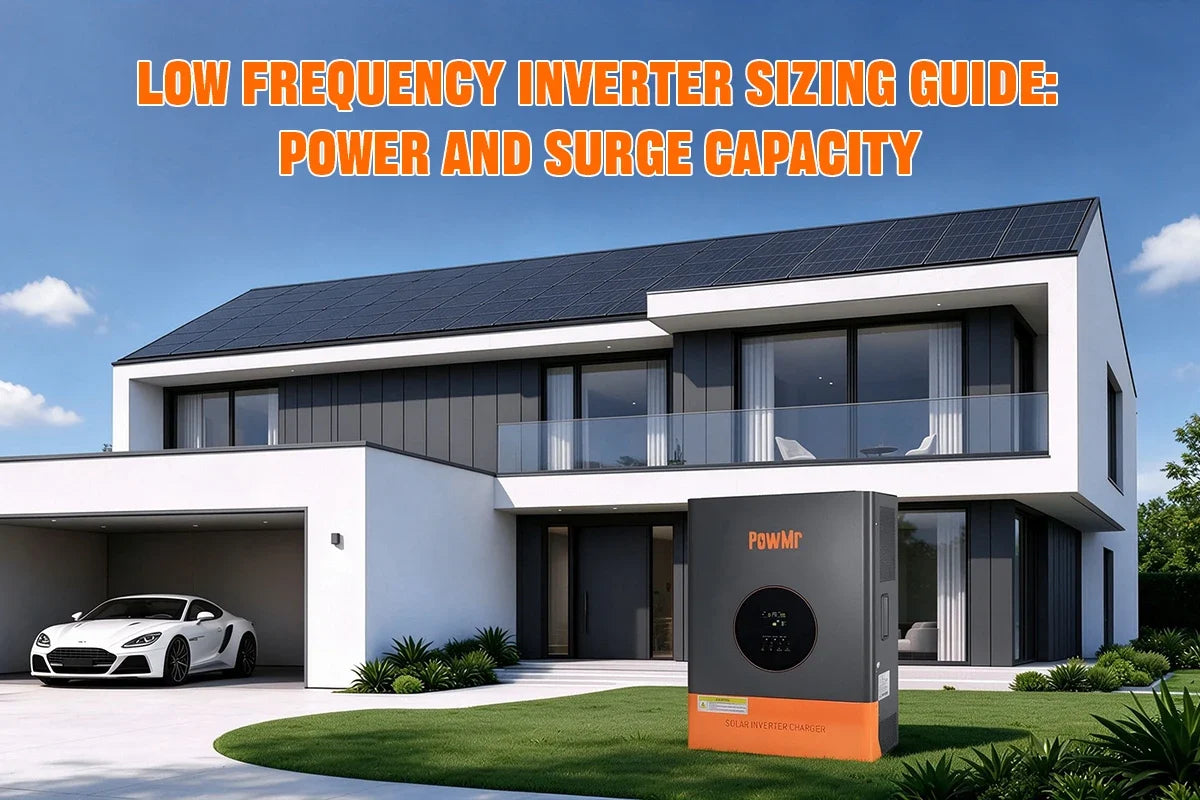
A low frequency inverter uses a heavy-duty transformer and typically handles overload and surge better than many standard inverters—making it a strong choice for motor loads, industrial equipment, and off-grid systems.
This sizing guide explains how low frequency inverters work, how they differ from standard solar inverters, and how to choose the right power capacity and surge capacity for your real-world loads.
What Is a Low Frequency Inverter?
A low frequency inverter is a power conversion device built around a heavy-duty transformer that converts DC power—from a battery or solar energy storage system—into usable AC electricity.
Compared with a standard solar inverter, a low frequency inverter is typically more robust and offers stronger overload and surge capacity, making it better suited for motor loads such as water pumps, refrigerators, and air conditioners.
If your appliances have high startup surge and you need stable, reliable power, a low frequency inverter is usually the safer choice.
How Low Frequency Inverters Work
A low frequency inverter converts DC power from a battery or solar energy storage system into AC electricity, then steps it up and isolates the output through a heavy-duty transformer. Instead of relying only on electronic switching for high-voltage output, it transfers energy through the transformer—helping it handle overload and surge demand more reliably.
The basic operating process looks like this:
- DC input: The battery bank or energy storage system supplies stable DC power to the inverter.
- Power conversion: The inverter converts DC into a low-frequency AC waveform.
- Transformer-coupled output: A line-frequency transformer steps up and isolates the power, delivering usable AC output—often pure sine wave.
- Load support and protection: When a load starts and draws a short surge current, the low frequency inverter can support it with higher surge capacity; if overload or a fault continues, protection circuits shut down to protect the system.
In off-grid solar and energy storage setups, many low frequency inverters also integrate charging and bypass functions: they prioritize solar charging when available, switch to utility or generator power when needed, and keep supplying loads such as lights, refrigerators, air conditioners, and water pumps.

5KW 48V 110/240Vac Split Phase Low Frequency Inverter5000W rated / 15000W peak · 48V · 110V single-phase / 220V split-phase |

10KW 48V 110/240Vac Split Phase Low Frequency Inverter10000W rated / 30000W peak · 48V · 110V single-phase / 220V split-phase |
Low Frequency vs. Standard Inverters: Key Differences
When sizing an solar inverter for an off-grid solar system or RV, the core difference between a low frequency inverter and a standard (high-frequency) solar inverter is internal design: the low frequency inverter uses a heavy-duty transformer, while the standard inverter relies on high-frequency switching circuitry.
- Surge capacity A low frequency inverter can typically handle a startup surge of about 2–3× rated power, making it easier to drive inductive loads such as refrigerators, water pumps, and air conditioners. A standard high-frequency inverter often supports only about 1.2–1.5×, so it is more likely to trip overload protection during motor startup.
- Overload and reliability A low frequency inverter can usually run at about 110%–150% load for short periods, with lower fault rates and longer service life in demanding conditions. A standard solar inverter is more sensitive to overload, and continuous full-load operation can accelerate wear.
- Efficiency and losses A standard (high-frequency) inverter generally offers higher conversion efficiency and lower idle loss, which is often better for battery energy storage. A low frequency inverter is usually a bit less efficient at light loads.
Size and cost A low frequency inverter is larger and heavier—often about 2–3× the weight of a comparable high-frequency unit—and typically costs more. A standard solar inverter is lighter, more compact, and usually more cost-effective when surge demand is modest.
Inverter Types Compared: Low-Frequency vs Standard
| Comparison Point | Low Frequency Inverter | Standard (High-Frequency) Inverter |
|---|---|---|
|
Internal design
|
Heavy-duty transformer
|
High-frequency switching circuitry
|
|
Surge capacity
|
About 2–3× rated power
|
About 1.2–1.5× rated power
|
|
Overload & reliability
|
Can run at about 110%–150% load for short periods; lower fault rates in demanding conditions
|
More sensitive to overload; continuous full-load operation can accelerate wear
|
|
Efficiency & losses
|
Slightly lower efficiency at light loads
|
Higher conversion efficiency and lower idle loss; often better for battery energy storage
|
|
Size & cost
|
Larger and heavier (often about 2–3× the weight); typically costs more
|
Lighter, more compact, and usually more cost-effective when surge demand is modest
|
Understanding Power Capacity in Low Frequency Inverters
Power capacity is the core baseline for low frequency inverter sizing. In a datasheet, it usually appears as rated output power (also called continuous power)—the power a low frequency inverter can deliver reliably for long periods under normal conditions. In short: surge/peak power decides whether a load can start; power capacity decides whether it can keep running without frequent overload trips.
A common mistake when buying a solar inverter is treating a high peak rating as everyday continuous capacity. For a low frequency inverter, the correct approach is different: first size rated power for simultaneous running loads, then check peak power for motor startup surge from refrigerators, water pumps, and air conditioners.
Peak Power of PowMr Low Frequency Inverters
Using the PowMr 5kW/10kW low frequency solar inverter-charger as a reference, the user manual lists these inverter-mode ratings:
| Model | Rated Output Power (Power Capacity) | Peak Power | Battery System Voltage | Output Voltage |
|---|---|---|---|---|
|
5000W
|
15000W
|
48Vdc
|
110V single-phase / 220V split-phase
|
|
|
10000W
|
30000W
|
48Vdc
|
110V single-phase / 220V split-phase
|
Understanding Surge Capacity in Low Frequency Inverters
Surge capacity—also called peak power—is the low frequency inverter rating most often overlooked, and the one most likely to cause “it won’t start my load” problems. It is the short-term power an inverter can deliver during startup inrush. In short: power capacity decides whether a load can run continuously; surge capacity decides whether motor loads can start successfully.
Inductive loads such as refrigerators, water pumps, air conditioners, air compressors, and power tools often draw far more current at startup than during normal running. If you size a solar inverter by rated watts alone and ignore surge capacity, you may see failed starts, voltage dips, or repeated overload protection.
Peak Power of PowMr Low Frequency Inverters
| Model | Peak Power (Surge Capacity) | Approx. Multiple of Rated | Battery System |
|---|---|---|---|
|
POW-RELAB 5KU-SPLIT
|
15000W
|
About 3×
|
48Vdc
|
|
POW-RELAB 10KU-SPLIT
|
30000W
|
About 3×
|
48Vdc
|