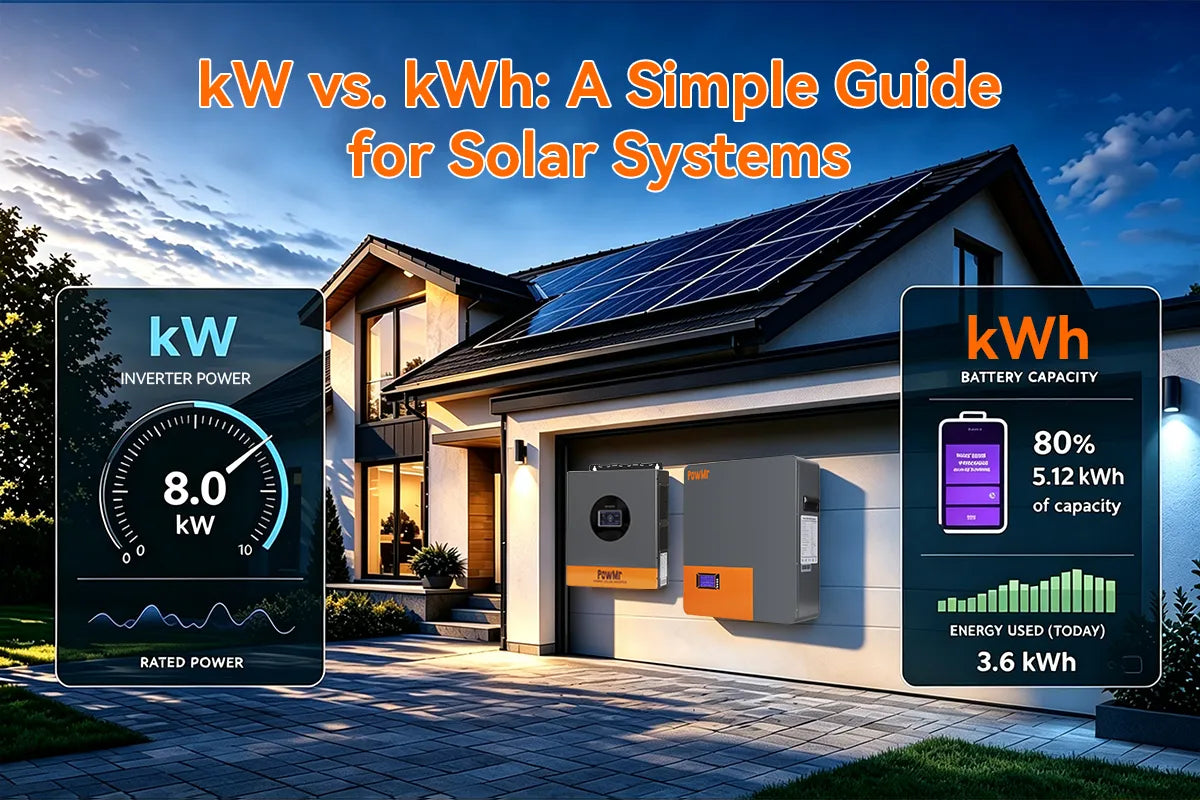
Whether you’re installing a home solar system or upgrading an off-grid setup, you’ll often come across two key units: kW and kWh. The former determines whether your system can handle the load, while the latter determines how long your stored energy can last.
In this guide, we’ll explain the basics step by step: what kW and kWh mean, the key difference between them, how to calculate kWh, and how to match your solar inverter and battery based on your power and energy needs.
What Are kW and kWh?
In a solar power system, kW (kilowatts) and kWh (kilowatt-hours) are two of the most common — and most often confused — units. kW measures power: how much electricity a system or device can output or consume at a given moment. For example, a solar inverter rated at 4.2kW can handle up to 4.2 kilowatts of load. A household appliance labeled 1kW needs about 1 kilowatt while it is running.
kWh measures energy: how much electricity is used or stored over time. 1kWh equals 1kW of power running for 1 hour. Solar battery capacity is usually listed in kWh. A 5kWh lithium battery, for example, can deliver about 5 kilowatt-hours of energy under ideal conditions.
kW vs. kWh: What’s the Difference?
kW (kilowatts) measures power: how much load a system can output or support at a given moment. Take the PowMr 4500W 110V 24V all-in-one inverter as an example. Its rated power is 4.5kW.
What matters is whether the combined load of appliances running at the same time stays within 4.5kW. If it goes over, the system may overload or shut down some loads.
kWh (kilowatt-hours) measures energy: how much electricity is used or stored over time. Take the PowMr 51.2V 100Ah LiFePO4 lithium battery as an example. Its energy capacity can be estimated like this:
| Comparison | kW | kWh |
|---|---|---|
|
Measures
|
Power
|
Energy
|
|
Key question
|
Can it run the load?
|
How long will it last?
|
|
PowMr example
|
4500W inverter = 4.5kW
|
51.2V 100Ah battery ≈ 5.12kWh
|
How to Calculate kWh from kW
The relationship between kW and kWh becomes easier to understand with a real-world solar system example. A PowMr 4.5kW inverter is rated to deliver up to 4.5kW of power, but the amount of energy used depends on the actual load and how long it runs.
Suppose the connected loads average 2kW and run for 3 hours. The energy consumption would be:
2kW × 3h = 6kWh
For battery energy storage, LiFePO4 batteries for solar energy storage are often rated in kWh. A PowMr 51.2V 100Ah LiFePO4 battery has a nominal capacity of:
51.2V × 100Ah ÷ 1,000 = 5.12kWh
This means the battery stores about 5.12kWh of energy under nominal conditions. In practice, the usable energy and actual runtime will vary depending on the battery's available capacity, inverter efficiency, load, and other system losses.
Note: The 4.5kW inverter and 51.2V battery above are used as separate examples. Always check the inverter's battery voltage requirements before matching a battery to an inverter.
Why kW Matters for Solar Inverters
In a solar power system, one of the most important specs on a solar inverter is kW (kilowatts). It tells you how much appliance load the inverter can support at the same time — in other words, its real power capacity.
Take the PowMr 48V all-in-one inverter (POW-SunSmart 8KP) as an example. It is rated at 8000W, or 8kW. That means refrigerators, lights, fans, computers, and other household loads should stay within this power range when running together. If the combined load gets close to or goes over 8kW, the system may overload, trigger an alarm, or cut power to some appliances.
Why does kW matter so much for solar inverters, instead of only looking at battery kWh?
- kW answers: Can the inverter handle the load right now?
- kWh answers: How long can the system keep running?
Even with a large battery, an undersized inverter still cannot run high-power appliances. Devices like refrigerators, water pumps, and air conditioners often need extra startup power, so choosing a solar inverter with enough kW — and a little headroom — helps keep the system stable.
When sizing a solar inverter, start with your total household load in kW, then match it to the right model. With an 8kW all-in-one inverter, you get higher power capacity for larger home or split-phase setups — as long as the load stays within that 8kW rating.
Why kWh Matters for Solar Batteries
When your solar inverter can handle the load, the next question is energy: how much electricity do you need at night, on cloudy days, or during a power outage? That is where kWh matters for solar batteries.
A PowMr 51.2V 100Ah LiFePO4 battery — a common choice among LiFePO4 batteries for solar energy storage — holds about 5.12kWh (51.2V × 100Ah). Use that battery capacity to estimate runtime and daily coverage. For example, a steady 500W load can use about 5kWh in 10 hours. Heavier loads or longer runtime will drain the same solar battery much faster.
When sizing solar energy storage, focus on:
- Your average daily electricity use in kWh
- How many backup hours you want after sunset or during an outage
- Whether one battery is enough, or you need more capacity in parallel
In short, choosing a solar battery is an energy-matching decision. Calculate your real kWh demand first, then select the right storage size for more reliable off-grid or hybrid performance.
<
How to Match Inverter Power with Battery Capacity
When sizing a solar system, match the inverter and battery separately: use kW to choose the inverter, use kWh to choose the battery, then confirm the voltage platform matches.
1. Size the inverter by load (kW)
Add up the appliances that may run at the same time, and leave headroom for startup surge from refrigerators, pumps, or air conditioners.
Rule of thumb: inverter kW ≥ combined running load.
For higher loads, a PowMr 8kW all-in-one inverter can be a strong option. If inverter power is too low, even a large battery still cannot run high-power appliances.
2. Size the battery by energy use (kWh)
Estimate daily electricity use, and how long you want backup at night or during an outage.
A PowMr 51.2V 100Ah battery is about 5.12kWh.
Use: battery kWh ≥ average load kW × hours.
For example, 1kW for 5 hours needs about 5kWh. If that is not enough, expand capacity in parallel.
3. Check voltage compatibility
Keep 12V, 24V, and 48V systems matched.Also confirm charge/discharge current and battery type are compatible with the inverter.
Common mismatch signs
- Inverter too small: overload when big appliances start
- Battery too small: power runs out quickly at night
- Voltage mismatch: the system cannot run stably
In short: set inverter power for the load first, battery capacity for runtime second, and voltage compatibility last.