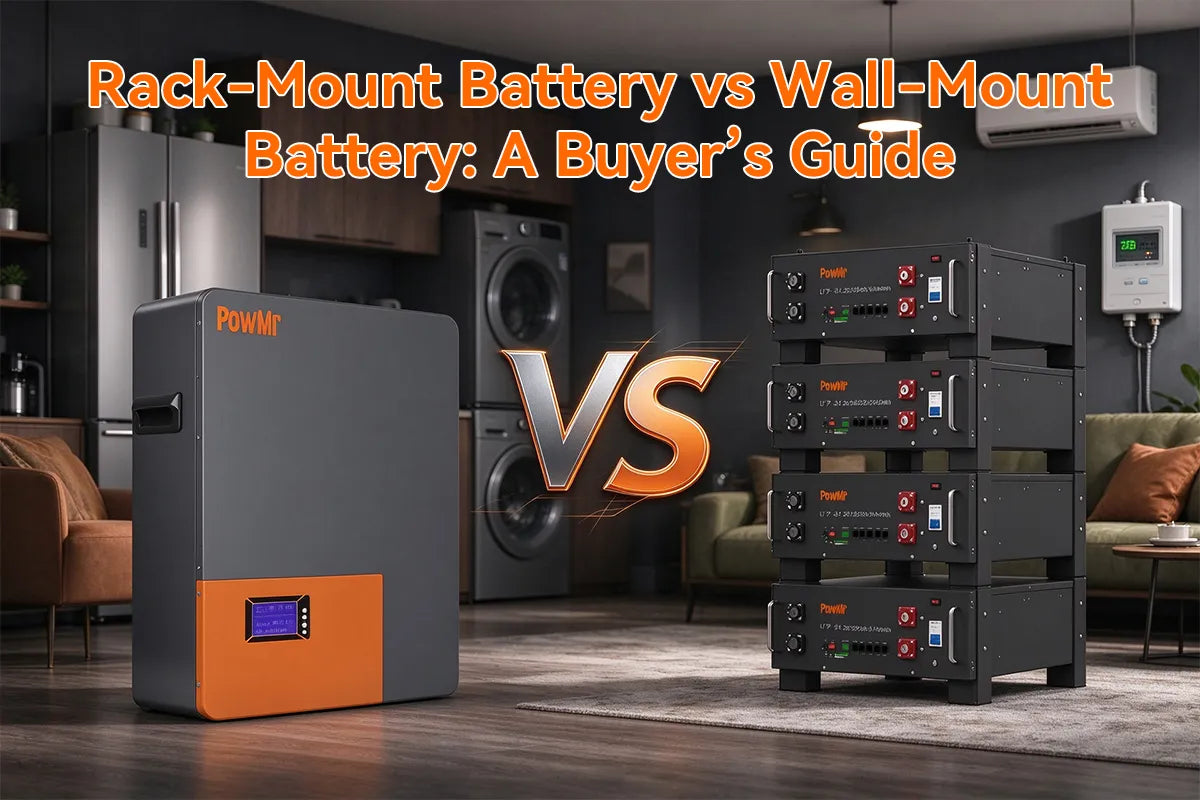
Comparing a rack-mount lithium battery and a wall-mount home battery, you are already looking at two of the most common energy storage formats on the market. A rack-mounted battery is built for cabinet or server-rack installation and modular expansion. A wall-mounted battery is designed to hang on a wall and save floor space in homes, garages, or small commercial sites.
In this rack-mount battery vs wall-mount battery guide, we break down the key differences in size, installation, capacity scaling, and use cases—helping you select the best energy storage battery for your project.
What Is a Rack-Mount Battery?
A Rack-Mount Battery is an energy storage battery designed to be installed in a battery rack or cabinet. Its modular design allows multiple battery units to be connected together, making it easier to expand storage capacity as energy needs grow.
Most Rack-Mount Batteries use Lithium Battery technology, especially LiFePO4 Battery chemistry. They typically include a built-in BMS for battery monitoring and protection, while the rack-mounted design makes installation, wiring, and maintenance more convenient.
For example, the PowMr 51.2V 100Ah Rack-Mount Lithium Battery (SKU: POW-LIO48100-3.5UN) provides about 5.12kWh of storage capacity per unit and supports parallel connection for capacity expansion. It can be used in residential and solar energy storage systems where modular capacity is needed.
What Is a Wall-Mount Battery?
A Wall-Mount Battery is an energy storage battery designed to be secured to a wall with a mounting bracket. It is commonly used for home battery storage, solar energy storage, and backup power systems. Many wall-mounted batteries feature a compact modular design and an integrated BMS (Battery Management System) to monitor voltage, temperature, and battery status.
A wall mount lithium battery often uses LiFePO4 battery chemistry, which is widely used in residential energy storage systems. For example, the PowMr 100AH 51.2V Lithium Battery with Max Charging & Discharging Current 100A (SKU:POW-LIO48100-16S) is a 48V LiFePO4 battery designed for solar energy storage and can communicate with compatible inverters for system monitoring and control.
Multiple batteries can also be connected in parallel to expand storage capacity based on the system's needs. This makes a wall mounted battery suitable for applications such as home battery storage, solar battery storage, and residential backup power.
Rack-Mount vs Wall-Mount: Key Differences
A rack-mount battery and a wall-mount battery can both power a home or light commercial energy storage system, but they are not the same product in different packaging.
The real differences show up in installation space, capacity scaling, power output, system compatibility, cost, and maintenance. Use the points below to choose the right lithium battery format for your project.
Installation and Space Requirements
A rack-mount lithium battery installs in a standard cabinet or battery rack. It works well in equipment rooms, utility spaces, and garages where a cabinet layout is already planned. The upside is neat cable management, modular stacking, and easier centralized monitoring. The trade-off is floor space: you need room for the rack, clearances, cable runs, and structural support.
A wall-mount battery mounts directly on a solid wall with a bracket, so it frees up floor space. That makes it a strong fit for residential garages, plant rooms, and small commercial walls where a clean install matters. PowMr’s wall-mounted series, for example, uses a dedicated wall-mount bracket and a compact stacked design for better vertical space use.
Battery Capacity and Scalability
Both formats can start small and expand later through parallel connection. The difference is how that expansion feels in real projects.
Rack-mount batteries are built for modular growth. You can add modules as demand rises and keep everything organized inside a rack. For example, PowMr’s 51.2V 100Ah rack mount lithium battery delivers about 5.12kWh per module and supports up to 16 units in parallel—around 81.92kWh of expandable capacity. That makes it a practical option for users who expect their battery storage system to grow.
Wall-mount batteries also scale through parallel connection (up to 16 units on PowMr’s POW-LIO48 series), but many buyers first choose the right single-unit size: 100Ah / 5.12kWh or 200Ah / 10.24kWh. Expansion is still flexible, yet wall strength, mounting points, and cable routing should be planned early.
Quick pick:Likely growth from about 5kWh toward 20kWh+ → rack-mount usually wins. Current household load first, with wall installation priority → wall-mount is often enough.
Power Output and System Compatibility
Do not buy on kWh alone. Match charge/discharge current, inverter voltage, and communication protocols.
Most residential LiFePO4 lithium batteries in this category run on a 48V / 51.2V platform and pair with hybrid or off-grid inverters. A rack-mount option like PowMr’s 51.2V 100Ah module supports up to 100A continuous charge and discharge, which helps when the system needs stronger power delivery and parallel expansion. Wall-mount models are also capable: POW-LIO48100-16S supports up to about 100A, while POW-LIO48200-16S reaches about 150A, with RS485/CAN communication for inverter integration.
Quick pick: Confirm inverter voltage (often 48V), max charge/discharge current, and BMS communication (CAN/RS485) before choosing either format. A mismatched power path wastes usable capacity.
Cost and Maintenance
Upfront cost: A wall-mounted battery is often simpler to budget—battery, bracket, and wall installation—especially for small to mid-size home systems. Aack-mounted battery may add cabinet, rails, and more structured cabling costs, but at larger scale the cost per kWh and service workflow can become more efficient.
Maintenance:Both rely on an intelligent BMS for protection and monitoring. Wall-mount units often include an LCD and status lights for quick daily checks. Rack-mount systems favor centralized inspection and communication management. In either case, plan for parallel address settings, communication cable checks, fastener inspection, temperature/humidity control, and routine SOC/alarm review.
Quick pick:Limited budget, moderate capacity, simple install →wall-mount battery. Larger capacity roadmap and long-term expansion →rack-mount battery usually offers better lifecycle value.