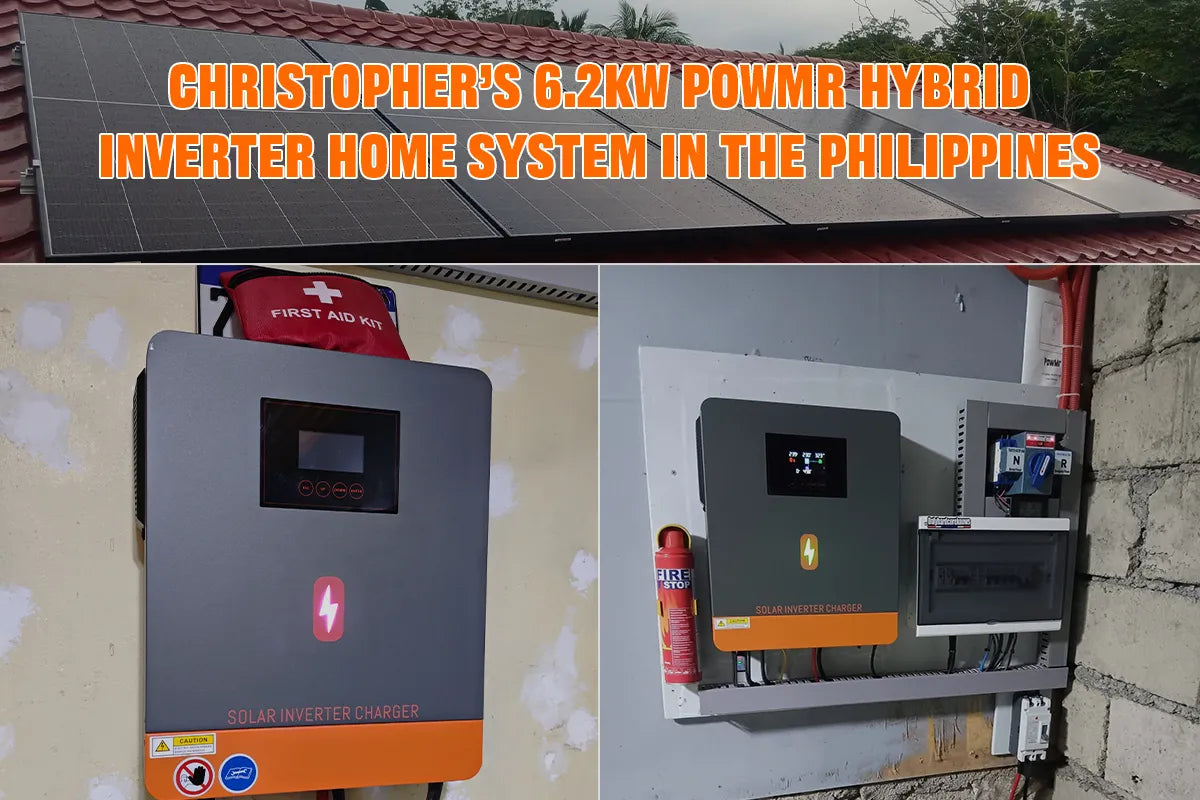
Christopher, a homeowner in the Philippines, shared the solar system he is using at home: a PowMr 6.2kW hybrid inverter, a 7kWh LiFePO4 battery, and about 3kWp (3,000W) of bifacial solar panels. The inverter can connect to solar panels, the battery, and the grid at the same time, so the home uses solar power during the day and switches to the battery during an outage.
The system is not large, but it already includes the three core parts of a home hybrid setup. Below is a look at what the solar inverter, lithium battery, and bifacial panels each do in Christopher’s system, and which homes this kind of setup fits.
Inside Christopher’s 6.2kW Hybrid Inverter
Christopher’s home solar system in the Philippines uses aPowMr 6.2kW hybrid inverter, (SKU:POW-HVM6.2K-48V-E). It has a 6200W rated output and delivers 230V pure sine wave power, which matches common 220–230V household appliances. For motor loads such as a refrigerator or water pump, the hybrid solar inverter can supply about twice its rated power for 3 seconds, so startup surge is covered.
This 6.2kW inverter uses a 48V LiFePO4 battery. It should be paired with a 48V LiFePO4 battery, not a 12V or 24V bank. On the solar side, the maximum PV input is about 8000W, the MPPT voltage range is 60–450V, and the PV open-circuit voltage must stay under 500V. Christopher’s 3kWp bifacial solar array is within that limit, so more panels can be added later. With solar and grid charging together, the maximum charging current is about 120A.
The inverter also has two AC outputs. The main output can reach 6200W, and the second output is about 1240–4340W. During a power outage, keep the refrigerator, lights, and router on the backup output, and leave high-power appliances on the other output so the home battery backup is not overloaded.
Why a 7kWh LiFePO4 Battery Matters
The 7kWh LiFePO4 battery stores leftover solar power during the day and keeps the home running at night or during a power outage. According to the manual, this 6.2kW hybrid inverter needs a 48V battery, so the battery voltage must match the inverter.
You can estimate backup time like this:
Backup time (hours) ≈ usable battery energy (kWh) ÷ load (kW)
With about 80% usable capacity, a 7kWh solar battery provides roughly 5.6kWh.
At a 1kW average load, that is about 5–6 hours. At 2kW, it is about 2–3 hours. A refrigerator, fans, and lights are usually fine; air conditioners and water pumps should run separately when possible.
In this setup, the goal is not to run the 6.2kW inverter at full load all the time. The home battery backup is there to cover essential loads during an outage. If Christopher needs longer backup later, more LiFePO4 batteries can be added in parallel.
3kWp Bifacial Solar Panels in This Home System
In this setup, the 3kWp bifacial solar panels handle daytime power generation. The solar energy first covers the home’s running loads, and any leftover power charges the 7kWh LiFePO4 battery.
Unlike standard monofacial panels,bifacial solar panels collect sunlight on the front and also use reflected light from the ground or roof on the back. That can mean a bit more energy from the same roof space, which is useful when mounting area is limited.
One point matters: 3kWp is not the same as 6.2kW. Solar panel capacity is about how much power the array can generate, while the hybrid inverter rating is about how much load it can run at once. Christopher’s PV array is still below the inverter’s maximum solar input, so the system can run now and add more solar panels later.