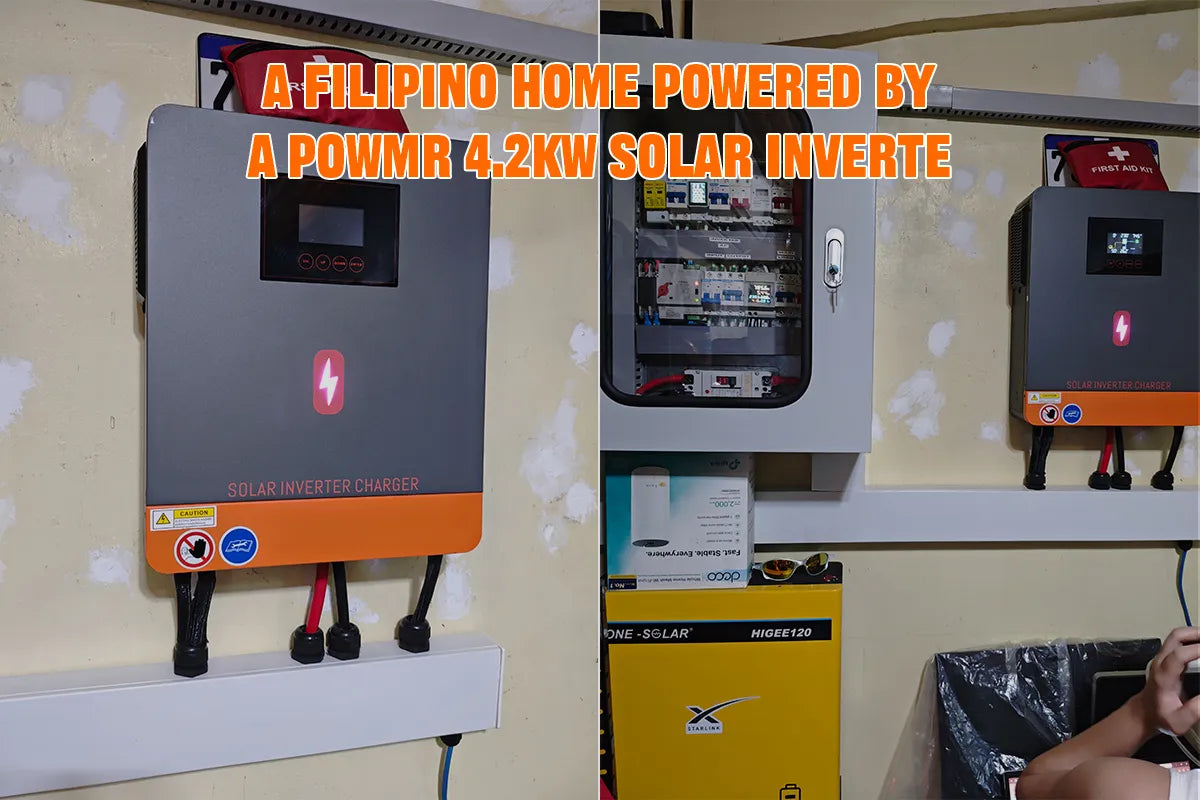
Limar is a PowMr user from Laguna, Philippines, running a 4.2KW solar inverter at home. With electricity costs among the highest in the region, more Filipino households are turning to a home solar system to take control of their power bills—and Limar is one of them.
His 4.2KW solar power system covers everyday household loads while reducing his dependence on the grid, giving him steady power and real energy savings month after month. Happy with the results, he is glad to share his PowMr solar inverter setup with the community.
How the 4.2KW Solar Inverter Powers a Home
Limar’s system is built around a PowMr 4.2KW solar inverter — a multifunctional unit that combines an MPPT solar charge controller, a high-frequency pure sine wave inverter, and a UPS function in one machine. It is designed for off-grid backup power and home self-consumption applications.
During the day, solar panels generate DC power. The 4.2KW solar inverter converts that energy efficiently through its built-in MPPT solar charge controller and sends electricity first to everyday household loads. The system can work with PV modules, utility grid power, and optionally a generator.
It also supports operation with or without batteries. When solar energy is sufficient, the home solar system prioritizes solar power to reduce grid consumption; when sunlight is low or at night, grid or battery power steps in to keep the home running steadily.
For Filipino households facing high electricity costs, this “solar first, grid as backup” approach helps cut dependence on the grid. That is why Limar’s 4.2KW solar power system can cover daily home use while delivering real energy savings month after month.
What Can a 4.2KW Solar Inverter Run?
A 4.2KW solar inverter can support a wide range of everyday household loads, making it a practical choice for a residential home solar system. Depending on the power requirements of each appliance, a 4.2KW inverter can run common household devices such as lights, refrigerators, TVs, fans, computers, routers, kitchen appliances, and selected pumps.
The actual number of appliances that can run at the same time depends on their rated power, startup power, and the total load of the home. Appliances with motors or compressors, such as refrigerators, air conditioners, and water pumps, may require additional startup power when they switch on.
Common Household Loads for a 4.2KW Solar Inverter
| Household Appliance | Typical Power Range |
|---|---|
| LED Lights | 5–20W per light |
| Wi-Fi Router | 10–20W |
| Phone Charger | 5–30W |
| Laptop / Computer | 50–200W |
| TV | 50–150W |
| Electric Fan | 40–100W |
| Refrigerator | 100–300W |
| Rice Cooker | 500–1,000W |
| Microwave Oven | 800–1,500W |
| Electric Kettle | 1,000–2,000W |
| Washing Machine | 400–1,000W |
| Water Pump | 300–1,500W |
| Air Conditioner | 800–2,000W+ |
| Vacuum Cleaner | 500–1,500W |
Example of Everyday Home Loads
For example, a 4.2KW solar inverter for home use could support a combination of everyday appliances such as:
- Refrigerator: 200W
- TV: 100W
- LED lighting: 100W
- Electric fan: 80W
- Computer: 150W
- Wi-Fi router: 20W
- Rice cooker: 800W
The combined running power in this example is approximately 1,450W, leaving additional capacity within a 4.2KW inverter's rated output.
How to Choose the Battery Capacity
When pairing a battery with a PowMr 4.2KW solar inverter, the key is how long your home needs power at night or on cloudy days. This inverter is typically matched with a 24V battery system — and the higher the battery capacity, the more energy you can store for longer backup time.
Start by estimating your electricity use. If your home uses about 500W overnight for 8 hours, you will need roughly 500W × 8h = 4,000Wh. Converted to a 24V battery, that is about 4,000Wh ÷ 24V ≈ 167Ah. To avoid deep discharge and keep the system more stable, a 200Ah battery is usually a safer practical choice.
Based on the product guidance, a lead-acid setup is commonly recommended at around 200Ah or more. If your home solar system includes higher loads such as an air conditioner or water pump, or if you want longer backup, consider 200–300Ah or higher. For Filipino households like Limar’s, a 24V 200Ah battery is a practical starting point for a reliable 4.2KW solar power system.