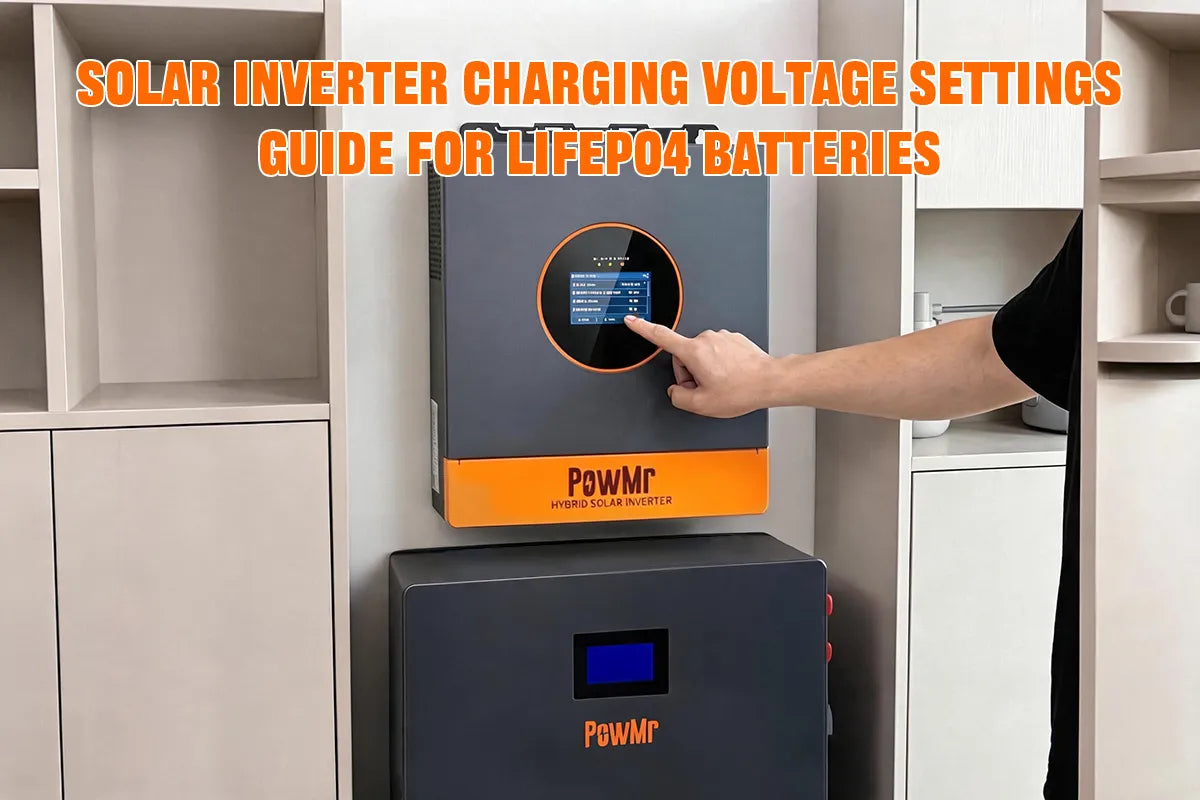
When setting up a solar inverter for LiFePO4 batteries, charging voltage is one of the most important settings for system safety and battery life. Wrong values can leave the battery undercharged or overcharged, trigger protection, and shorten cycle life.
This guide covers LiFePO4 battery charging voltage settings for 12V, 24V, and 48V systems — including a charge voltage chart, how to set CV, Float, and Cut-off on a solar inverter, and recommended settings for PowMr hybrid inverters — so you can optimize charging for your solar energy storage system.
What Is Charging Voltage on a Solar Inverter?
Charging voltage on a solar inverter is the DC voltage the inverter’s built-in charger (or MPPT solar charger) applies to the battery bank during charging. In a solar energy storage system, the inverter converts PV or grid power into controlled DC output and regulates battery charging according to the voltage parameters you set.
On most solar / hybrid inverters, charging and battery protection are controlled by these three voltage settings:
- Bulk charging voltage (CV):Also called absorption or constant-voltage charge. This is the target voltage the inverter holds while finishing the charge. Once the battery reaches this level, voltage stays constant and charging current gradually drops. For LiFePO4, this is the key value that determines whether the battery gets fully charged without overvoltage.
- Floating charging voltage:The lower maintenance voltage used after bulk/CV charging is complete. It keeps the battery topped up without holding it at high voltage for too long. For LiFePO4, float is often set slightly below bulk — or limited/disabled — based on the battery and Battery Management System(BMS) recommendations.
-
Low DC cut-off voltage:The discharge protection threshold. When battery voltage falls to this point, the inverter stops discharging (or shuts down output) to prevent over-discharge, BMS trips, and battery damage.
For LiFePO4 batteries, these voltages must match the battery bank size (12V / 24V / 48V) and cell chemistry. Set Bulk (CV) too high, and you risk overcharge or protection faults. Set it too low, and the battery may never reach full capacity. Set Low DC cut-off too low, and you risk deep discharge.
LiFePO4 Charge Voltage Chart (12V/24V/48V)
LiFePO4 batteries are commonly configured as 12V (4S), 24V (8S), or 48V (16S) battery banks. To charge them safely with a solar inverter, you must match three key settings to your system voltage: Bulk charging voltage (CV), Floating charging voltage, and Low DC cut-off voltage.
Use the LiFePO4 charge voltage chart below as a general reference (based on about 3.40–3.65V per cell for charging and about 2.50–3.00V per cell for discharge protection). Always follow your battery manufacturer and BMS specifications first.
| Battery System | Nominal Voltage | Bulk / CV (Constant Voltage) | Float (Floating Charge Voltage) | Low DC Cut-off |
|---|---|---|---|---|
| 12V (4S) |
12.8V
|
14.0 – 14.6V
|
13.5 – 13.8V
|
10.8 – 11.8V
|
|
24V (8S)
|
25.6V
|
28.4 – 29.2V
|
27.0 – 27.6V
|
20.0 – 22.4V
|
|
48V (16S)
|
51.2V
|
56.8 – 58.4V
|
54.0 – 55.2V
|
43.2 – 48.0V
|
Key Inverter Parameters to Set (CV, Float, Cut-off)
Bulk charging voltage (CV), Floating charging voltage, and Low DC cut-off voltage control how a solar inverter charges and protects LiFePO4 batteries. Setting any of them too high or too low can affect system safety, usable capacity, and battery life.
CV (Constant Voltage) Setting
- Set too high:Risk of overcharge, BMS over-voltage protection trips, and shorter LiFePO4 cycle life
- Set too low:The battery may stay undercharged, reducing usable capacity and solar energy storage efficiency
CV (Bulk / constant voltage) is the main charge ceiling: high enough to reach a full charge, but within the battery and BMS limits.
Floating Charge Voltage Setting
- Set too high (near or equal to CV):The battery stays at high voltage too long, adding battery cell stress and hurting longevity
- Set too low:Usually lower risk, but the battery may slowly lose charge after full and need more frequent top-ups
LiFePO4 usually does not need lead acid battery float charging mode. Follow the battery charger manual, or let the BMS manage charging when communication is enabled.
Low DC Cut-off Setting
- Set too high:The inverter cuts power too early, reducing usable capacity and backup runtime
- Set too low:Risk of deep discharge, BMS under-voltage protection, or battery damage
Low DC cut-off is the discharge floor: protect the battery without wasting too much available capacity.
How to Set Charging Voltage on a Solar Inverter?
To set solar inverter charging voltage for LiFePO4 batteries, follow these general steps. Use the charge voltage chart above for reference values, and always prioritize your battery manual and BMS specifications.
1. Confirm the battery system voltage
First, confirm your battery bank voltage is 12V, 24V, or 48V. Then check the battery manufacturer’s manual for the recommended charging voltage, float voltage, and cut-off voltage. The inverter settings must match the battery specifications to ensure safe and proper charging.
2. Open the inverter battery settings menu
Enter setting mode on the inverter display (often by holding ENTER, or via Setup on a touchscreen). Menu numbers vary by model, so look in your manual for battery-related items such as:
- Battery type
- Bulk / C.V. charging voltage
- Floating charging voltage
- Low DC cut-off voltage
- Battery charging current
Example on the 8KW 48Vdc all in one inverter (SKU: POW-SunSmart 8KP): go to Setup → Battery setting. Related items are around parameter 08 (battery type), 09 (bulk/CV), and 11 (float).
3. Select the battery type (User-Defined / LiFePO4)
Set battery type to USER (User-Defined) or the LiFePO4 option for your model (such as L16 for a 16S pack).
Only after the correct type is selected can you usually edit bulk charging voltage, float voltage, and cut-off.
Do not use AGM, GEL, or Flooded lead-acid battery profiles to fine-tune LiFePO4 charging voltage.
4. Set the bulk / constant voltage (CV)
This is the most important setting. Set Bulk charging voltage (C.V. voltage) to the constant voltage charging voltage listed in your battery datasheet.
Examples:
12V (4S): about 14.0–14.6V
24V (8S): about 28.0–29.2V
48V (16S): about 56.8–58.4V
Example (POW-SunSmart 8KP): For a 16S / 51.2V LiFePO4 battery with a 58.4V constant voltage rating, set Bulk charging voltage (Parameter 09) to 58.4V.
5. Set the float charging voltage
Set floating charging voltage equal to or slightly below bulk.
For LiFePO4 battery, float is often close to bulk—avoid the much lower default float used for lead-acid batteries.
Example: if bulk is 58.4V, float can be 57.6V–58.4V.
6. Set the low DC cut-off voltage
Set Low DC cut-off / over-discharge voltage near the battery’s recommended discharge cutoff—usually a bit higher than the absolute minimum—so the inverter shuts down first for safer operation.
Example: if the battery recommends 48V discharge cutoff, start around 48V.
7. Save settings and verify
After saving, watch a charge cycle: battery voltage should rise toward your bulk charging voltage, then current should taper into float.
If voltage stays much lower and the pack never fills, check for leftover lead-acid defaults, unsaved changes, or a different menu number than your manual.
Recommended Settings for PowMr Hybrid Inverter
Menu numbers can differ by model, but the values below follow the same logic: set battery type to USER (or LiFePO4), match bulk/CV to the battery datasheet, keep float ≤ bulk, set a safe cut-off, and disable equalization. Always confirm final numbers in your battery manual.
| Setting | POW-LVM4.5K-24V | POW-LVM6K-SP | POW-SunSmart 8KP |
|---|---|---|---|
|
Rated power
|
4500W
|
6000W
|
8000W
|
|
Battery system
|
24Vdc
|
48Vdc
|
48Vdc
|
|
AC output
|
110Vac single-phase
|
110/240Vac split/single
|
110/240Vac split/single
|
|
Battery type
|
USER / LiFePO4
|
USER / LiFePO4
|
USER / L16
|
|
Bulk (CV)
|
28.4–29.2V
|
56.8–58.4V
|
56.8–58.4V(e.g.58.4V)
|
|
Float
|
27.6–28.8V(≤ bulk)
|
56.8–58.4V(≤ bulk)
|
57.6–58.4V(≤ bulk)
|
|
Low cut-off
|
~22.4–24.0V
|
48.0V
|
48.0V
|
|
Example bulk target
|
24V LiFePO4 → set CV near 28.8V
|
16S pack @ 58.4V CV → set bulk58.4V
|
Same 16S example → Parameter 09 bulk = 58.4V, Parameter 11 float ≤ bulk
|