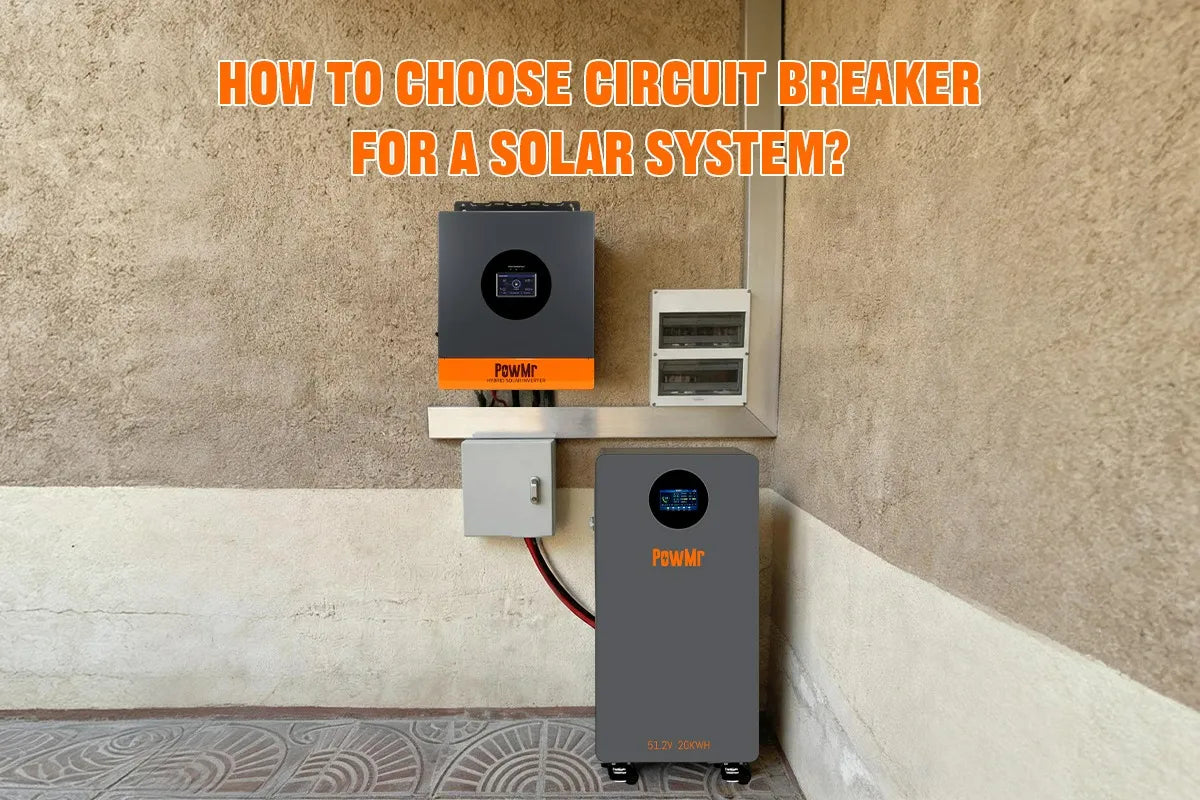
A solar circuit breaker is one of the most important safety devices in a home solar power system. It disconnects the circuit during overcurrent, short circuit, or maintenance to help prevent cable overheating, equipment damage, and fire risk.
This guide explains how a solar circuit breaker works, compares AC vs DC breakers, and covers selection tips for the battery/PV side and the grid/load side—so you can choose the right breaker for your solar inverter system.
What Is a Circuit Breaker in a Solar System?
A solar circuit breaker is an overcurrent protection and isolation device used in a solar power system. When overcurrent, a short circuit, or maintenance occurs, it quickly disconnects the related circuit to protect cables, the inverter, batteries, and other equipment—while helping reduce fire and electric shock risks.
In a solar inverter system, circuit breakers are usually divided into two types: DC breakers and AC breakers. They are used on different circuits, follow different selection standards, and should not be used interchangeably.
DC Breaker vs AC Breaker: What’s the Difference?
The main difference is the circuit type they protect. A DC breaker is designed for direct-current circuits, such as the battery line and the solar panel / soalr charge controller side. An AC breaker is designed for alternating-current circuits, such as the grid input and load output.
They also differ in how they break the circuit. AC power crosses zero naturally, so the arc is easier to extinguish. DC power has no zero-crossing point, so the arc is harder to stop—especially under high battery current or high PV voltage. That is why a DC breaker and an AC breaker are built differently and cannot be mixed or used interchangeably.
DC Breaker vs AC Breaker Comparison Table
| Comparison | DC Breaker | AC Breaker |
|---|---|---|
|
Current type
|
Direct current (DC)
|
Alternating current (AC)
|
|
Common install location
|
Battery side, solar panels / solar change controller side
|
Grid input, load output
|
|
Main protection target
|
Battery, PV cables, inverter DC input
|
Grid supply, load output, AC equipment
|
|
Arc extinguishing
|
More difficult (no zero crossing)
|
Easier (AC zero crossing)
|
|
Key ratings
|
Amp rating,DC voltage rating, interrupting capacity (AIC)
|
Amp rating,AC voltage rating, number of poles
|
|
Interchangeable?
|
Do not replace with an AC breaker
|
Do not use on battery/PV DC circuits
|
|
Sizing focus
|
Match battery max current or PV Isc, plus safety margin
|
Match grid/load current and local electrical codes
|
|
Risk if chosen wrong
|
Poor arc breaking, higher short-circuit hazard
|
Weak AC-side protection, overload/short-circuit risk
|
How Does a Circuit Breaker Work?
During normal operation, the breaker stays closed so current can flow through the battery, PV, grid, or load circuits.
When overload or short circuit occurs and the current exceeds the protection limit, the breaker trips and disconnects the faulty circuit. This helps prevent cable overheating, equipment damage, and fire risk.
For maintenance, you can also switch the breaker off manually to isolate the circuit safely. After the problem is resolved, switch it back on to restore power.
In a solar system, AC and DC breakers follow a similar protection principle, but DC arcs are harder to extinguish. That is why the battery and PV sides need DC breakers, while the grid and load sides use AC breakers.
Key Factors to Consider When Sizing a Breaker
When sizing a circuit breaker for a solar system, first confirm whether the circuit is DC or AC. Then choose the rating based on current, voltage, cable size, and installation location. The selection logic is different on each side, and the breakers are not interchangeable.
DC Breaker Selection (Battery / PV)
1. Battery-side DC breaker
Estimate the maximum battery discharge current from the inverter power and battery voltage:
I =V × 0.9
Here, 0.9 is an estimated inverter efficiency, and V is the battery system voltage (for example, 24V or 48V). After calculating the current, multiply by a 1.25 safety factor to choose the breaker rating.
Example: For a 3kW 24V battery inverter (used with a 24V battery bank),3200 ÷ 24 ÷ 0.9 ≈139A
After applying the 1.25 safety factor:139 × 1.25 ≈ 174A
A 175–200A DC breaker is typically suitable for a 3kW 24V solar system.
AC Breaker Selection (Grid / Load)
- Load output AC breaker
Size it according to the inverter’s rated output power and the actual load current.
Example: On a 230V system, 3.2kW is about 3200÷ 230≈14A , so a 16A or 20A AC breaker is commonly used (follow the manual and local codes).
Recommended Breaker Chart for PowMr Inverters
| Model / SKU | Power | Battery Voltage | AC Voltage | Battery Current | Recommended DC Breaker | AC Current | Recommended AC Breaker |
|---|---|---|---|---|---|---|---|
|
1000W
|
12V
|
220V
|
83.3A
|
100A DC
|
4.5A
|
6A AC
|
|
|
POW-RELAB 1.2KU
|
1200W
|
12V
|
110V
|
100A
|
100A DC
|
10.9A
|
16A AC
|
|
POW-HVM2H-12V-N
|
1600W
|
12V
|
220V
|
133.3A
|
150A DC
|
7.3A
|
10A AC
|
|
POW-HVM3.2H-24V-N
|
3000W
|
24V
|
220V
|
125A
|
125A DC
|
13.6A
|
16A AC
|
|
POW-HV3K-24V
|
3000W
|
24V
|
220V
|
125A
|
125A DC
|
13.6A
|
16A AC
|
|
POW-LV3.5K-24V
|
3500W
|
24V
|
110V
|
145.8A
|
150A DC
|
31.8A
|
32A AC
|
|
POW-LV3.5K-12V
|
3500W
|
12V
|
110V
|
291.7A
|
300A DC
|
31.8A
|
32A AC
|
|
POW-HV3.5K-12V-EU
|
3500W
|
12V
|
220V
|
291.7A
|
300A DC
|
15.9A
|
16A AC
|
|
POW-LVM4.5K-24V
|
4500W
|
24V
|
110V
|
187.5A
|
200A DC
|
40.9A
|
50A AC
|
|
POW-HVM4.5K-24V-E
|
4500W
|
24V
|
220V
|
187.5A
|
200A DC
|
20.5A
|
25A AC
|
|
POW-RELAB 5KU-SPLIT
|
5000W
|
48V
|
240V
|
104.2A
|
125A DC
|
20.8A
|
25A AC
|
|
POW-LVM6K-SP
|
6000W
|
48V
|
240V
|
125A
|
125A DC
|
25A
|
25A AC
|
|
POW-SPH-6KW / POW-ECO-6KW
|
6000W
|
48V
|
220V
|
125A
|
125A DC
|
27.3A
|
32A AC
|
|
6500W
|
48V
|
220V
|
135.4A
|
150A DC
|
29.5A
|
32A AC
|
|
|
POW-HVM7K-48V
|
7000W
|
48V
|
220V
|
145.8A
|
150A DC
|
31.8A
|
32A AC
|
|
POW-SunSmart 8KP
|
8000W
|
48V
|
240V
|
166.7A
|
175A DC
|
33.3A
|
40A AC
|
|
MEGA-10KW-L1PE-EU
|
10kW
|
48V
|
220V
|
208.3A
|
225A DC
|
45.5A
|
50A AC
|
|
FU10-248P / POW-RELAB 10KU-SPLIT
|
10kW
|
48V
|
240V
|
208.3A
|
225A DC
|
41.7A
|
50A AC
|
|
POW-HVM12KP / FU12-248P / POW-SunSmart LVM12K
|
12kW
|
48V
|
220/240V
|
250A
|
250A DC
|
50–54.5A
|
50–63A AC
|
|
13.2kW
|
48V
|
220V
|
275A
|
300A DC
|
60A
|
63A AC
|
|
|
MEGA-16KW-L1PE-EU
|
16kW
|
48V
|
220V
|
333.3A
|
350A DC
|
72.7A
|
80A AC
|