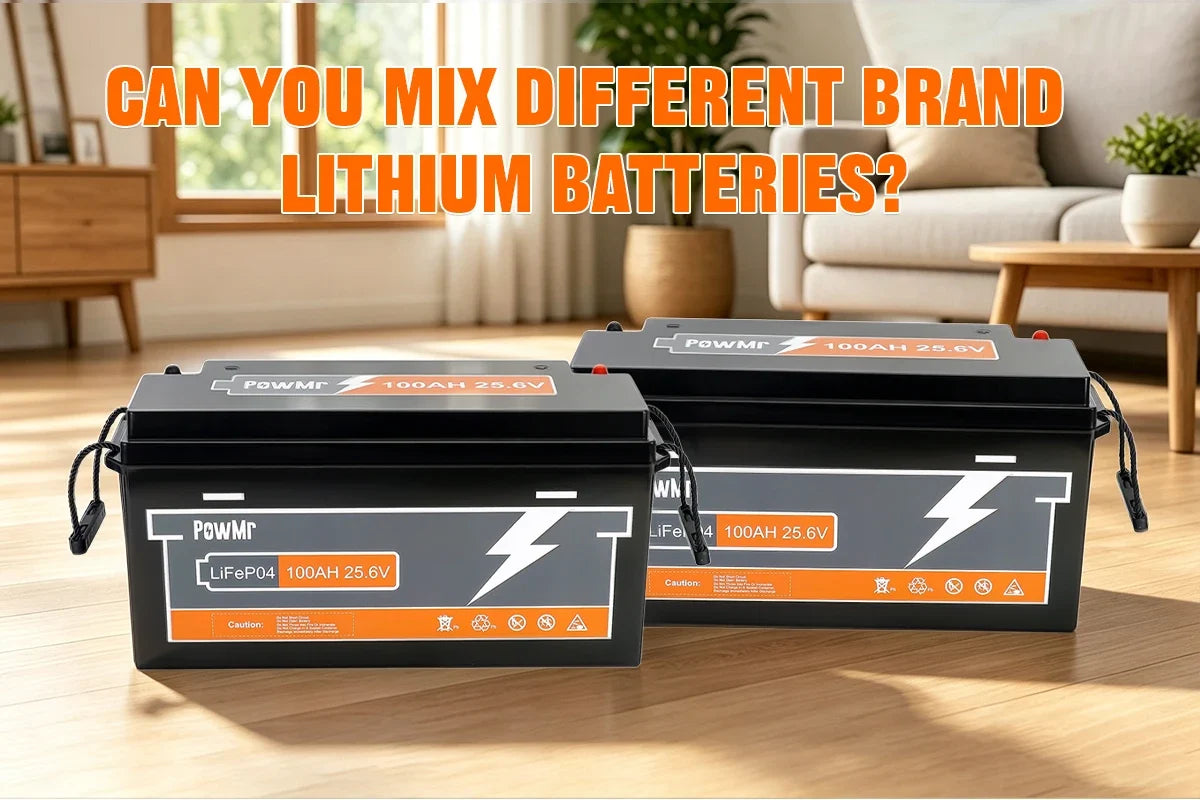
Many people ask the same question when expanding a home energy storage system or building a DIY battery pack: can you mix different brand lithium batteries? To save money or temporarily add capacity, some users connect batteries of different brands and capacities in series or parallel.
Whether you use a standard lithium battery or a PowMr solar battery, you should first check battery voltage, capacity, internal resistance, and BMS (Battery Management System) compatibility before mixing. Below, we explain why you should not mix different brand lithium batteries, break down lithium battery series vs parallel mixing restrictions, and share safe lithium battery expansion rules.
Why You Should Not Mix Different Brand Lithium Batteries
Lithium batteries from different brands may have significant differences in several key specifications. Even if two batteries have the same nominal voltage and capacity, they are not necessarily compatible for direct connection. The main reasons include:
1. Different Cell Performance
Different manufacturers may use different battery types or grades of lithium battery cells. Their internal resistance, charging and discharging efficiency, cycle life, and overall performance may vary. When different batteries are used together for a long period, these differences can lead to inconsistent battery performance.
2. Different BMS Settings
Each battery may use a different BMS with its own overvoltage, undervoltage, overcurrent, and temperature protection settings. If these parameters are different, one battery may enter protection mode earlier than the others, affecting the performance of the entire battery bank.
3. Different Charging and Discharging Characteristics
Different lithium batteries can have different max charging currents, continuous discharge currents, and operating voltage ranges. When batteries with different characteristics are connected together, they may charge and discharge at different rates, which can lead to battery imbalance and reduce overall system performance.
4. BMS Communication May Not Be Compatible
In a solar energy storage system, the battery BMS may need to communicate with the solar inverter charger through protocols such as CAN or RS485. Different battery brands may use different communication protocols or settings, which can prevent the inverter from correctly reading important battery information such as SOC, voltage, current, and temperature.
5. Potential Impact on Battery Life and System Stability
Long-term use of different brand lithium batteries can increase imbalance within the battery bank and may affect overall capacity and cycle life. In some cases, incompatible batteries may also cause frequent BMS protection or unexpected system shutdowns.
Therefore, when expanding a PowMr battery system or another LiFePO4 battery bank, do not compare voltage and capacity alone. Battery model, BMS settings, charging and discharging parameters, efficiency, and communication protocols should all be checked for compatibility.
Different Brand 12V 100Ah LiFePO4 Battery Comparison
The following comparison shows why batteries with the same nominal capacity and chemistry may still have different specifications:
| Parameter | PowMr POW-100AH-12.8V | Renogy 12V 100Ah LiFePO4 | Battle Born 12V 100Ah LiFePO4 |
|---|---|---|---|
| Battery Chemistry | LiFePO4 | LiFePO4 | LiFePO4 |
| Nominal Voltage | 12.8V | 12.8V | 12V |
| Rated Capacity | 100Ah | 100Ah | 100Ah |
| Energy | 1,280Wh | — | — |
| Max. Charge Current | 100A | 100A | 50A |
| Max. Discharge Current | 100A | 100A | — |
| Charge/Discharge Efficiency (Round Trip) | >98% | — | — |
| Cycle Life | 6,000 cycles* | 5,000 cycles* | 3,000–5,000 cycles |
| Max. Series Connection | 4 | 4 | 4 |
| Max. Parallel Connection | 4 | 4 | — |
| Built-in BMS | Yes | Yes | Yes |
Mixing Different Lithium Battery Brands in Series vs. Parallel
When planning connecting lithium batteries in series vs parallel, mixing different brands introduces distinct electrical risks depending on the wiring configuration. Regardless of whether you are increasing voltage or capacity, mixing brands is strongly discouraged:
- Mixing in Series (Increasing System Voltage, e.g., 24V / 48V):In a series circuit, the exact same current flows through every battery. Because different brands vary in internal resistance, actual capacity, and charge efficiency, the weaker or higher-resistance battery will reach full charge or empty first. This causes its internal BMS (Battery Management System) to trigger overvoltage or undervoltage protection early—cutting off the entire circuit, causing unexpected system shutdowns, and creating severe voltage imbalance.
- Mixing in Parallel (Increasing Total Capacity): In a parallel bank, all batteries share the same terminal voltage while dividing the load current. Even if two units share identical nominal ratings (such as two 12V 100Ah LiFePO4 batteries), differences in discharge curves and BMS thresholds lead to uneven current sharing. The battery with lower internal resistance handles a heavier workload, and minor voltage discrepancies can cause internal circulating currents between batteries, accelerating cell degradation and shortening overall cycle life.
- Key Takeaway: Mixing brands in series primarily causes frequent BMS trips and sudden power loss, while mixing in parallel leads to uneven load distribution, circulating currents, and premature battery aging. Always use identical brands and specifications for both configurations.
Correct and Safe Lithium Battery Expansion Rules
To ensure a safe lithium battery expansion and maximize the lifespan of your solar LiFePO4 battery bank, follow these essential rules before wiring your batteries together:
- Use the Same Brand and Model: Always expand your system with batteries of the exact same brand, model, nominal voltage, and capacity (such as matching PowMr 12.8V 100Ah LiFePO4 batteries) to keep internal resistance and BMS settings uniform.
- Match Voltage Before Connecting: Before connecting lithium batteries in parallel, charge each battery to 100% individually and verify that the voltage difference is less than 0.1V to prevent dangerous inrush currents.
- Avoid Mixing Old and New Batteries: Do not pair brand-new units with batteries that have already been cycled for over 1–2 years, as capacity degradation and higher resistance in older units will accelerate wear on the new battery.
- Follow Max Series and Parallel Limits: Respect the manufacturer's limits for your lithium battery series and parallel connection. For example, the PowMr POW-100AH-12.8V supports up to 4 in series (4S) or 4 in parallel (4P).
- Use Equal-Length, Properly Sized Cables: For a balanced 12V LiFePO4 battery parallel connection, use cables of the exact same wire gauge (AWG) and length—or connect via a common busbar—so every battery shares the load equally.
- Verify BMS Communication Protocols: Ensure all batteries use compatible CAN or RS485 protocols and proper DIP switch settings so your solar inverter charger can accurately monitor the entire battery bank.