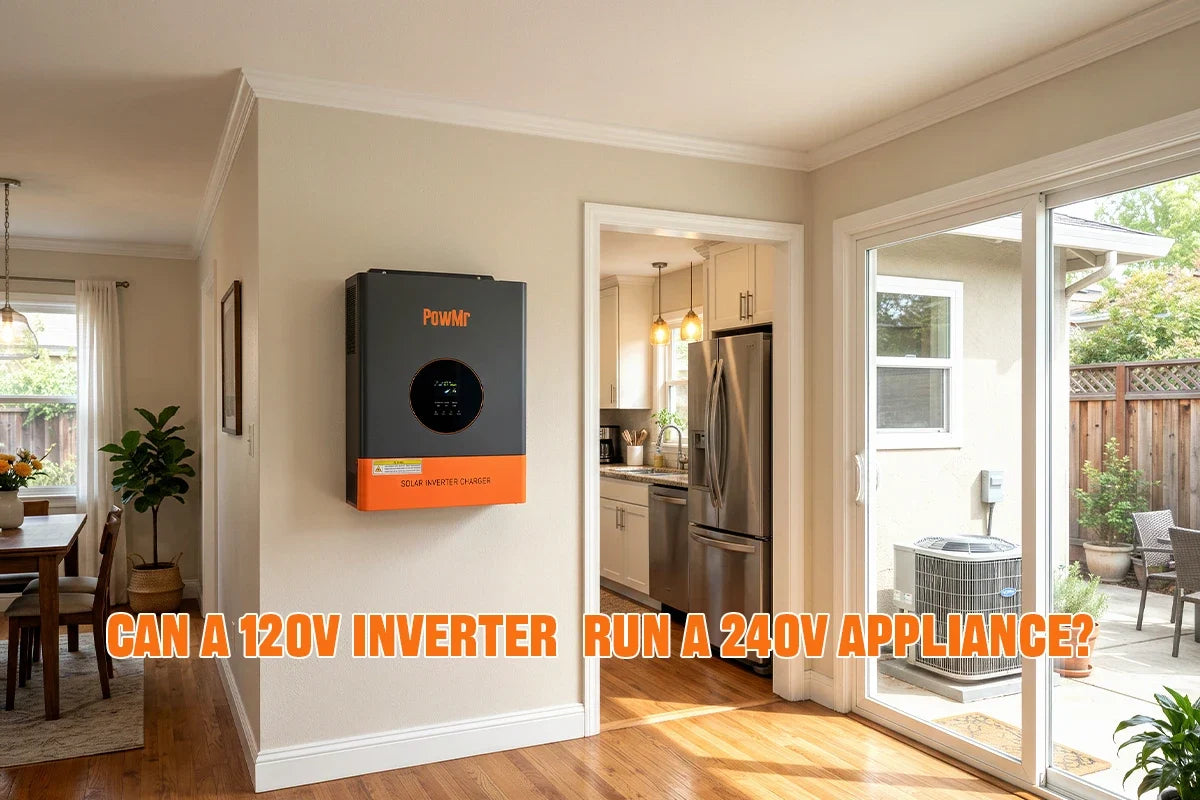
A 120V solar inverter outputs only single-phase 120V, while a 240V appliance such as an air conditioner, water heater or well pump needs two out-of-phase hot legs. Connecting one directly will at best trip protection and at worst damage the inverter. A step-up transformer is not a workable fix either, because a standard 120V inverter lacks the power headroom and surge capacity for 240V loads.
The right solution is a 120V/240V split-phase inverter, which supplies both voltages from one unit. This guide explains what happens on a wrong connection, how split-phase output works, which appliances it can run, how to size it, and whether the PowMr 10kW 48V split-phase inverter suits your home.
What Happens If You Connect a 240V Appliance to a 120V Inverter?
The home appliance will not work, and the inverter will likely fail first. A 240V appliance needs two out-of-phase hot legs, each at 120V, whose combined voltage forms 240V. A 120V inverter provides only one hot leg and a neutral, so the 240V circuit inside the appliance never receives a complete supply.
In practice, one of the following happens:
- The appliance will not start or keeps faulting. 240V air conditioners, water heaters, dryers and welders typically include voltage monitoring and will refuse to start on undervoltage, showing a fault code on the display.
- The inverter trips into overload or undervoltage protection. Motor-driven loads draw 3–7 times rated current at startup, which collapses a 120V inverter and causes repeated shutdowns.
- Low voltage overheats and destroys the motor. Even if the appliance does turn, insufficient voltage forces abnormally high current, and compressor or pump windings overheat until insulation fails.
- The output stage burns out, creating a fire risk. Sustained overload overheats and shorts the inverter’s MOSFETs, damaging the output section and, in the worst case, igniting cabling.
Note that adding a step-up transformer does not solve this. A standard 120V inverter has no power headroom reserved for 240V high-load equipment; after stepping up, current doubles, losses climb sharply, waveform quality degrades further, and the startup surge of compressor loads is still beyond its capability.
What Is a 120V/240V Split-Phase Inverter?
In one sentence: it is an inverter that outputs both 120V and 240V. "Split-phase" means the output has two hot legs (L1 and L2) plus a shared neutral (N), with L1 and L2 180° out of phase. Each hot leg to neutral is 120V, while L1 to L2 gives the combined 240V — the standard structure of North American residential power.
The difference from an ordinary 120V inverter is straightforward:
- A standard 120V inverter has a single hot leg and outputs 120V only, enough for receptacle circuits, lighting, TVs and refrigerators.
- A 120V/240V split-phase inverter has two hot legs plus a neutral and delivers both 120V and 240V, so it can run air conditioners, water heaters, well pumps and dryers.
- A European 230V single-phase inverter outputs 230V on one hot leg. Its wiring differs completely from US-style 240V appliances and it is not a substitute.
A typical split-phase inverter also includes:
- Pure sine wave output for motors, compressors and other inductive loads
- L1/L2 load balancing, so the two legs can feed separate circuits within the total rated power
- Grid or generator input with bypass, switching automatically when utility power is available to reduce battery draw
- 48V battery input with MPPT charging, forming a complete off-grid system
Take the PowMr 10kW 48V split-phase inverter (SKU: POW-RELAB 10KU-SPLIT) as an example: its output uses the L1/L2/N/G four-wire structure, and its 10kW rating can cover the main circuits of a household, which is why it is widely chosen for North American off-grid and backup applications.
How Does a Split-Phase Inverter Produce Both 120V and 240V?
The principle comes down to one line: two opposite-polarity 120V outputs add up to 240V. The output stage of a split-phase inverter first creates a 240V bus, then splits it into two hot legs, L1 and L2, through a center-tapped transformer (or through two synchronized, symmetrical half-bridge outputs). The neutral N connects to the center tap, which sits exactly at the midpoint between the two legs.
The voltage relationships are:
- L1 to N: 120V
- L2 to N: 120V, shifted 180° from L1
- L1 to L2: 120V + 120V = 240V
How the PowMr POW-RELAB 10KU-SPLIT does it
The PowMr 10kW 48V 110/240Vac split-phase low-frequency inverter follows exactly this architecture, with a toroidal transformer at its center:
- Boost stage. The 48V battery is stepped up by a high-frequency stage into a high-voltage DC bus, which sets the output power ceiling behind its 10,000W continuous and 30,000W peak (5-second) ratings.
- Inversion stage. A full bridge converts that DC bus into AC and drives the primary of the toroidal transformer.
- Center-tapped secondary. The tap becomes neutral N, and the two winding ends become L1 and L2 — inherently 180° apart because they are two halves of the same winding.
- Two ways to tap the output. L1–N and L2–N each give 120V for receptacle circuits, while L1–L2 gives 240V for air conditioners, water heaters and pumps.
The low-frequency toroidal design also explains two practical traits of this model: pure sine wave output with low THD, because the transformer smooths the switching waveform and keeps motors and compressors cool; and strong inrush tolerance, which is why it can hold a 30kW surge long enough for pump and compressor starts.
Operationally, it offers a 120V single-phase mode when only small loads are connected, selectable 50/60Hz output, a built-in AC output circuit breaker, and RS232/RS485 plus BMS communication for monitoring and battery integration. Two installation rules still apply: keep the L1 and L2 currents reasonably balanced, and bond neutral to ground at one point only, on the source side.
What Appliances Can a 120V/240V Split-Phase Inverter Run?
Short answer: any 120V or 240V appliance whose startup surge stays within the inverter's peak rating and whose running load stays within its rated power. The PowMr 10kW 48V 110/240Vac split-phase low-frequency inverter (POW-RELAB 10KU-SPLIT) illustrates the limits clearly:
- Rated output: 10,000W continuous
- Peak output: 30,000W for up to 5 seconds
- Output: 120V single-phase or 120/240V split-phase
- Waveform: pure sine wave with low THD
- Design: toroidal transformer, low-frequency topology, strong surge tolerance
- Battery: 48V, supporting lithium, lead-acid and BMS communication
Typical appliance matching
| Appliance type | Typical power | Startup surge | Supported by 10kW split-phase |
|---|---|---|---|
| 240V electric water heater | 3,000–4,500W | Close to 1× | Yes, ample headroom |
| 240V oven / induction cooker | 2,000–3,500W | Close to 1× | Yes |
| 240V central or mini-split AC | 1,500–5,000W | 3–5× (LRA) | Yes, surge covered by 30kW peak |
| 240V well pump | 750–2,200W | 3–7× | Yes, transformer design handles inrush |
| 240V air compressor | 1,500–3,700W | 3–5× | Yes, watch continuous runtime |
| 120V refrigerator, lighting, TV, router | 100–800W | 2–3× | Yes, on L1 or L2 circuits |
| 120V microwave, coffee maker, hair dryer | 800–1,800W | Close to 1× | Yes |
| 240V welder | 3,000–6,000W | High and intermittent | Possible with derating; use soft start |
Four rules to follow in use
- 10kW rated does not stack indefinitely. When several high-power appliances run at once, total draw must stay below 10kW or the unit will trip on overload.
- Balance L1 and L2. Keep each hot leg near or below 5kW and the two currents reasonably close, otherwise neutral current rises sharply.
- Judge startup surge against peak time. The 30kW peak lasts 5 seconds, which covers most compressor and pump starts. If a motor takes longer to start, verify the surge window.
- PV input is not output capacity. Maximum PV input is 5,400W (MPPT 60–245V) and its only job is charging the 48V bank. What you can actually run depends on battery capacity and the inverter's output stage, not on array size.