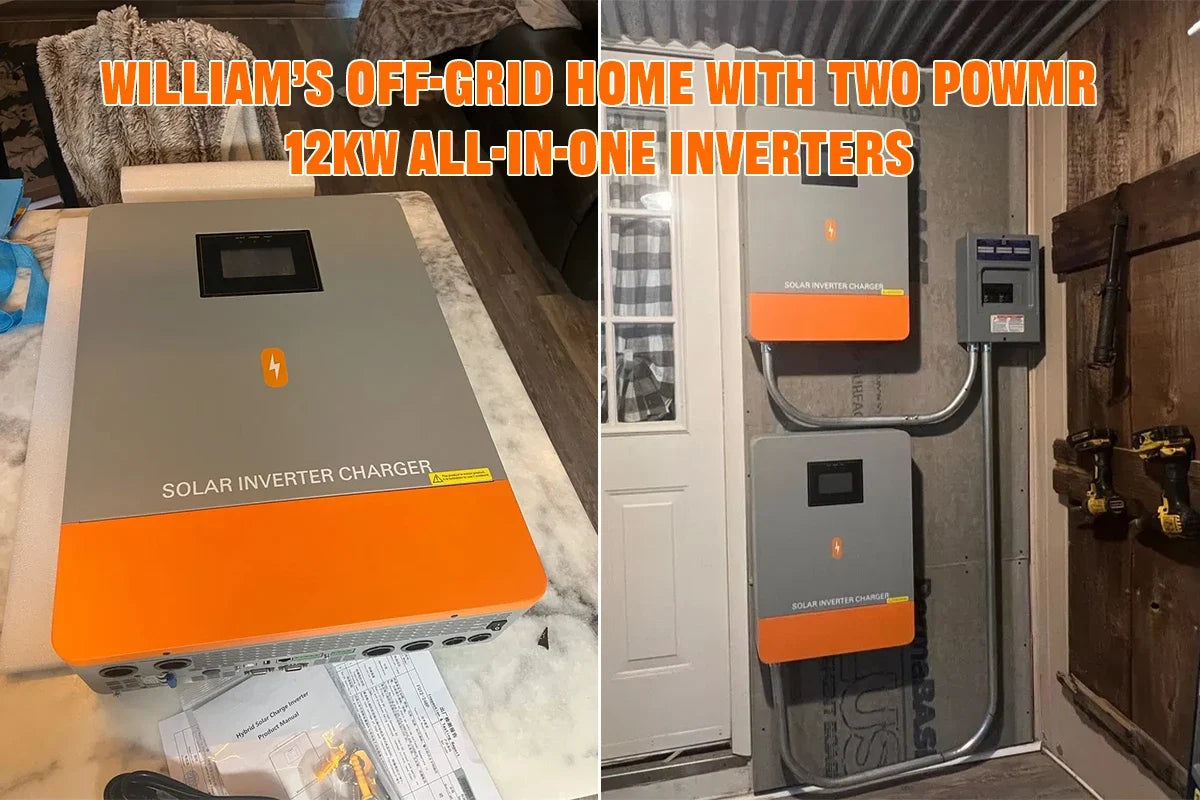
At 63, former licensed master electrician William had reached his limit. After watching his electric bills spike to $750–$800 a month, he decided to build a fully off-grid power system himself—installed to electrical code.
To handle whole-home heavy loads with room to spare, he chose two PowMr 12KW 48Vdc All in One Inverters (FU12-248P) in parallel, delivering a combined 24kW of continuous output on a 240V split-phase setup. That capacity keeps everyday household use covered, with headroom for peak demand.
William’s Inverter Installation Conditions
William’s pure off-grid home power system is a real U.S. residential retrofit. With solar arrays already in place, he mounted two PowMr 2KW 48Vdc off-grid inverters (SKU: FU12-248P) on a mudroom wall beside the existing generator and 200A transfer switch. The wall was reinforced with plywood and fire-resistant backer board, with conduit-ready wiring, for a code-minded, grid-independent install—no utility interconnection and no monthly bill reliance.
At the core is William’s PowMr dual solar inverter parallel setup, delivering 24kW continuous output on 240V split-phase for whole-home loads with spare headroom. Next, he plans two PowMr 600ah 51.2V lithium batteries (SKU:POW-LIO48600-16S) plus AC-input backup from his ~14kW generator, so the off-grid inverter system can run on solar, storage, and generator support as needed.
How William Paralleled Two PowMr 12kW Inverters for 24kW
To get two 12kW PowMr inverters units working together as a combined ~24kW off-grid inverter system, sync and clean AC combining matter most. In his mudroom install, William followed the manual for a proper dual inverter parallel setup—not a loose wire splice.
Master–Slave parallel communication
Each FU12-248P has dedicated parallel communication ports. William linked the upper unit as Master and the lower as Slave with the parallel cable (one-in, one-out). The Master sets voltage, phase, and frequency; the Slave tracks it so both inverters stay locked on matching 120/240V split-phase output and circulating current stays under control.
Sub-panel AC combining
Each inverter is set up for about 60A on the AC side. William added a compact sub-panel with two 60A breakers for back-feed combining: each inverter’s AC output runs on roughly 6 AWG into its breaker, then a larger ~1 AWG feeder carries the combined path toward the transfer switch. The system is rated for about 24kW total (~100A at 240V), with the sub-panel combine side set up around two 60A breakers (~120A bus capacity at 240V)—enough for whole-home loads with headroom.
EMT conduit and bonding
Instead of loose hanging wires, he used 1″ and 1¼″ metal EMT conduit. He also added a bonding bar so inverter cases, conduit, and the house grounding system share one equipotential bond—a safer approach for a high-current pure off-grid home power install.
Next Step: Battery Purchase and Installation
With both PowMr 12kW soalr inverters mounted and the parallel path mapped out, William is not ready to fully power up the system yet. His next priority is to buy and install two PowMr 600Ah batteries—chosen from the same brand so storage and the inverters can communicate properly.
In his words, the batteries are the most expensive and most important piece still ahead: once they are in place, the dual 12kW inverters parallel setup can store daytime solar for night and cloudy hours, and the ~24kW off-grid system becomes a complete home power solution. After the lithium battery install, he plans to continue with generator AC backup and whole-home commissioning.